
[A humble request: If you can, please donate to help me carry on tracing word histories. Thank you.]
Based on the phonetic similarity of the two words that compose it (i.e., in the International Phonetic Alphabet, /ˈbɑːmi/ and /ˈɑːmi/), the British-English expression barmy army designates, in particular:
– (frequently as a self-designation): a group of followers of a sports team;
– (frequently as a self-designation): a youth street gang;
– (derogatorily): a political faction regarded as extremist or fanatical.
—Cf. also the expressions Tartan army, Tartan gang, loony left, lunatic fringe and idiot fringe.
The adjective barmy means: crazy—cf. origin of the adjective ‘barmy’.
Before it came to be specifically applied to groups of team supporters, to street gangs and to political factions, the expression barmy army had occasionally been used to designate various groups of people—these are, in chronological order, three early occurrences:
a) From The Wrexham Advertiser, and North Wales News (Wrexham, Denbighshire, Wales) of Saturday 7th January 1882 [page 5, column 4]:
THE SALVATION ARMY.
This earnest but eccentric body of Christians have been recently having what Americans know as “a good time.” If a multiplicity of meetings means a corresponding increase of usefulness, then we may ere long expect to find the Salvation Army in Wrexham assume gigantic proportions. […] Their services are popular, and the audiences are very large. Opposition, of course, meets them, and an opposition body has been organised, calling itself “The Jolly Army,” but perhaps “The Barmy Army” would be more appropriate.
b) From a theatrical review, published in The Referee (London, England) of Sunday 28th September 1902 [page 4, column 3]:
Among the chief stars which scintillated at the Empress this week were the Collinson Combination, whose recently announced “Barmy Army” proved to be but an elongated version of their previous “Othello” travesty, written by Harry Pleon and set to music by Fred Eplett. This, although somewhat unduly spun out, was very popular, thanks chiefly to the broad comic acting of Mr. Jack Collinson, as Othello, and Miss Selina Seaforth as an “Ongbongpong” Desdemona.
c) From a theatrical review, published in the Evening Despatch (Birmingham, Warwickshire, England) of Tuesday 17th June 1952 [page 4, column 2]:
“Pack Up Your Troubles” at the Plaza Theatre, West Bromwich, this week is a show for the family, and it is a family which is the main attraction.
The Merry Martins—mother, father and son—“pack their troubles” into a fresh comedy act, rounded off with a selection of melodies sung in close harmony.
Sandy Lane and Dick Benedetti—who also sings—are partners in and out of their barmy army, and Patricia Joyce is an attractive soprano.
1-: These are, in chronological order, the earliest occurrences that I have found of the expression barmy army used in the sense of a group of followers of a sports team:
1.1 & 1.2-: From an article about the return home of the Blyth Spartans, who had defeated Stoke City Football Club on Monday 6th February 1978, published in The Journal (Newcastle-upon-Tyne, Northumberland, England) of Wednesday 8th February 1978:
1.1-: [page 1, column 7]:
Blyth’s football team supporters have now christened themselves as “Spartans’ barmy army.”
It was the name they gave themselves before setting off on the four-hour trip to Stoke and one which they are convinced will now stick.
1.2-: From the caption to the following photograph [page 1, column 8]:
Some of the “Barmy Army” celebrate in the Spartan pub, Blyth.
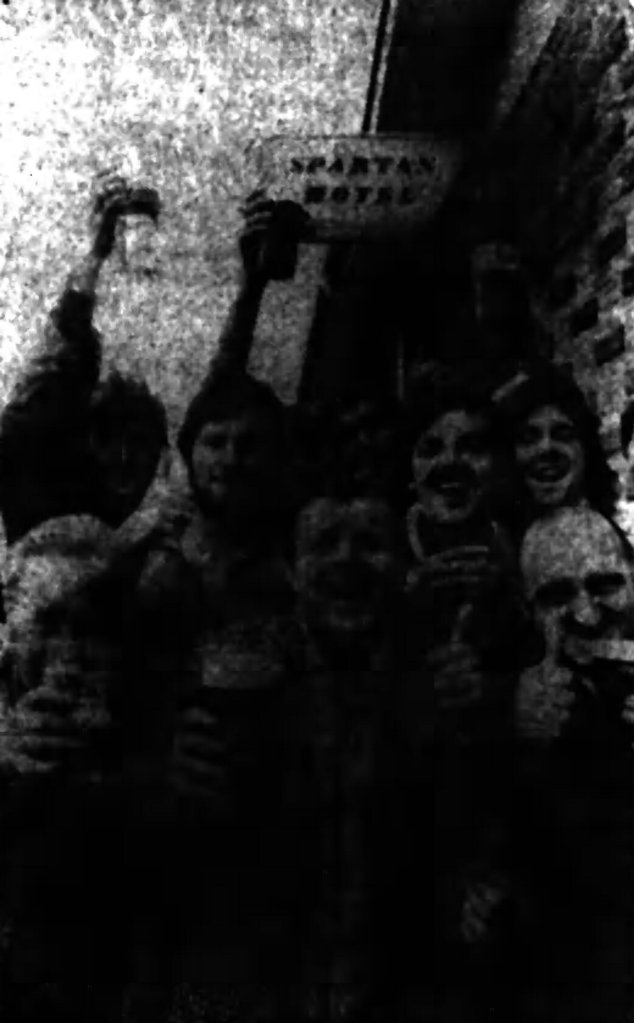
1.3-: From a letter to the Editor, published in the North-western Evening Mail (Barrow-in-Furness, Lancashire, England) of Wednesday 29th March 1978 [page 19, column 5]:
When my son and I were returning home on the 19.36 Lancaster to Barrow train, a group of so-called football fans, who were returning from the Everton-Leeds game were the most foul-mouthed and idiotic crowd I have seen for many years.
They called themselves the Barmy Barrovian Army. They are right with the word Barmy, but to call themselves Barrovians is beyond a joke, as other passengers will agree.
1.4-: From the page Mainly for women, by Liz Thompson, published in the Derby Daily Telegraph (Derby, Derbyshire, England) of Wednesday 24th May 1978 [page 6, column 2]:
A comedy football team of Derby women are throwing out a challenge to serious amateur footballers in the area. Their goal is to establish a weekly series of matches to raise £4,500 for a portable kidney machine.
Organiser Mrs Ann Vasey and fellow staff at the Allenton Market fruit and vegetable stall decided to work together to do their bit for Derby’s kidney sufferers. Raising the money should take about two years.
Ann’s team of female footballers, whose ages range from 16 to 42, have their own referee to ensure that they win. Christened Wyn’s Barmy Army after fellow organiser Mrs Wyn Jones, they hope to play a team of firemen in their first fixture on June 11 and are looking for a suitable personality to kick off.
Teams willing to take up the gauntlet should contact Ann on Derby 368941.
2-: These are, in chronological order, the earliest occurrences that I have found of the expression barmy army used in the sense of a youth street gang:
2.1-: From the Eastern Daily Press (Norwich, Norfolk, England) of Tuesday 5th September 1978 [page 8, column 6]:
‘BARMY ARMY’ CHANTS LED TO ATTACK, COURT TOLD
The battle of the Cattle Market car park took place in Norwich late one night last January, when groups of youths from Yarmouth and the city clashed, a Norwich Crown Court jury was told yesterday.
During the initial skirmishing, said Mr. David Penry Davey, prosecuting, one group was chanting “We’re the barmy Norwich army,” and the other responded with: “We’re the Yarmouth barmy army.”
2.2-: From Clampdown on school gangs, about gang warfare between two Nottinghamshire comprehensive schools, published in the Evening Post (Nottingham, Nottinghamshire, England) of Thursday 14th September 1978 [page 1, column 3]:
21 boys appeared in court.
[…] Parents described their shock and disgust at learning how their children ran wild during school lunchbreaks.
One mother was in tears in court after hearing how the “Wheldon Barmy Army” confronted boys from Gelding Comprehensive School.
2.3-: From the Telegraph & Argus (Bradford, Yorkshire, England) of Saturday 25th November 1978 [page 6, column 2]:
Eight youths fined after fighting
‘Barmy army’ gang’s night of terrorChanting “we’re the barmy Bradford army”, a gang of youths descended on Keighley for a drinking spree and terrorised the town, leaving three men—including Keighley Rugby League star Joe Bardgett—badly beaten.
3-: These are, in chronological order, the earliest occurrences that I have found of the expression barmy army used in the sense of a political faction regarded as extremist or fanatical:
3.1-: From the Derby Evening Telegraph (Derby, Derbyshire, England) of Thursday 11th June 1981 [page 28, column 6]—Cliff Fox, of Clay Cross, was the leader of the Labour-run North East Derbyshire District Council, and a committed anti-monarchist:
[The Union Jack] has been unfurled to celebrate the Duke of Edinburgh’s 60th birthday but within minutes Councillor Fox had it taken down.
[…]
A few days ago Councillor Fox announced he would be running a Republican Day in Clay Cross on July 29, the day of the Royal Wedding.
[…]
The ruling Labour group on the district council have voted in favour of flying the red flag from the official council flag pole on July 29.
[…]
Councillor Terry Smith, leader of the Conservative opposition on the council, said acidly: “This whole thing is typical of General Fox and his barmy army.”
3.2-: From Ratepayers the pawn in Labour’s ‘private war’, by Andrew Calvert, published in the Lancashire Evening Telegraph (Blackburn, Lancashire, England) of Wednesday 8th July 1981 [page 4, column 4]:
The controversy over Lancashire’s shock 18p extra rate demand continued today with a bitter war of words between Labour and the Tory opposition.
Conservative leader Councillor Len Broughton, returned to the attack to accuse Labour’s “barmy army of political spendthrifts” of irresponsibility and deceit.
3.3-: From the title of an article by James McMillan, published in the Daily Express (London, England) of Saturday 10th December 1983 [page 8, column 2]—the Welsh politician Neil Kinnock (born 1942) was the Leader of the Opposition and the Leader of the Labour Party from October 1983 to July 1992—CND stands for Campaign for Nuclear Disarmament:
Neil Kinnock’s barmy army
Ever wonder what it would be like if the lunatics took over the asylum? Wonder no longer.
Go instead on a way-out trip (no fares and free beer for Lesbian CND supporters) to those Meccas of Socialism: Liverpool, Dundee, Sheffield and, of course, dear old London Town.


It seems unfair to the comedian and impresario Frederick John Westcott [26 March 1866 – 17 September 1941], known worldwide as Fred Karno, to make no mention of his pioneering barmy army in the blog on the phrase “barmy army”.
Fred Karno’s Army was active throughout the music halls of Britain in the 1890s. Karno promoted teams of visual and physical comedians, trained at his ‘Fun Factory’ in Camberwell, London, to evade local theatrical censorship by performing without speaking. Fred Karno’s soon became a byword for chaos.
In 1910 a Fred Karno’s Army troupe toured American vaudeville theatres. Charles Chaplin and his understudy, Stan Laurel [Arthur Stanley Jefferson; 16 June 1890 – 23 February 1965] sailed together aboard SS Cairnrona from Southampton to Quebec in September 2010. On a second US tour, Chaplin signed a contract in September 1913 to perform for the Keystone film studios in Los Angeles.
Stan Laurel said of Fred Karno: “He didn’t teach Charlie and me all we know about comedy, he just taught us most of it. Above all he taught us to be supple and precise. Out of all that endless rehearsal and performance came Charlie Chaplin, the most supple and precise comedian of our time.”
A First World War trench song, sung by the British volunteer army of 1916, to a Samuel Wesley melody, was a variation on the hymn “The Church’s One Foundation”.
“We are Fred Karno’s army,We are the ragtime infantry.We cannot fight, we cannot shoot,What bleeding use are we?And when we get to BerlinWe’ll hear the Kaiser say,Hoch, hoch! Mein Gott, what a bloody rotten lot,Are the ragtime infantry.”
LikeLike