
[A humble request: If you can, please donate to help me carry on tracing word histories. Thank you.]
Of American-English origin, the slang expression love-glove designates a condom.
This expression is based on the phonetic similarity between the two nouns that compose it.
The expression love-glove occurs, for example, in the following from The San Francisco Examiner (San Francisco, California, USA) of Friday 14th February 2014 [page 12, column 3]:
Condom delivery in SF
So your Valentine’s Day date is going great, way better than expected, and it’s looking like some hot sex might be where this is headed. But, d’oh, you forgot the condom! What to do? Well, San Francisco-based condom manufacturer L. is now launching a new project to “save your date,” as they say: a condom delivery service.
That’s right, starting on Valentine’s Day, L will have a bike messenger deliver one of its high-quality, socially conscious, sustainably produced love gloves anywhere in San Francisco that you need it, within one hour, for just $5.
These are, in chronological order, the earliest occurrences of the expression love-glove that I have found:
1-: From Condoms can help make your heart grow fonder, by Susan Hopkins, health educator at Planned Parenthood in Champaign, published in The Daily Illini (Urbana-Champaign, Illinois, USA) of Saturday 3rd March 1979 [page 11, column 2]—The Daily Illini is the independent student newspaper at the University of Illinois in Urbana-Champaign:
Some points to keep in mind if you don’t want to be 100 percent pregnant are:
Don’t assume she won’t get pregnant during her period (or any other time of the month) and not use a “love-glove” unless you are well-practiced in the art of natural family planning.
2-: From Behind snickers, teens admit fear of catching AIDS, by Beth Jackendoff, Advance staff writer, published in the Staten Island Advance (Staten Island, New York, USA) of Thursday 4th June 1987 [page C1, column 2]:
While many teen-agers said they are using condoms—or “love gloves,” as one Tottenville student called them—more than they used to, they also said they would not refrain from intercourse if they lacked a condom when the opportunity to have sex came along.
3-: From AIDS Brings Big Change To TV’s Ads, Vocabulary, published in the Tyrone Daily Herald (Tyrone, Pennsylvania, USA) of Tuesday 3rd November 1987 [page 4, column 5]—Dan Wakefield was the author of the story published in TV Guide:
RADNOR, Pa., (UPI)—Despite the widely known social problems of teenage pregnancy, it took the deadly AIDS virus to prod network television executives into airing information on contraception, according to TV Guide.
[…]
“The Bronx Zoo,” a series about an inner-city high school, presented an episode last spring in which the school opened a clinic that dispensed condoms. Executive producer Patricia Jones said “NBC was pretty terrific” in allowing the episode to be realistic.
But she added that although the network’s standards and practices permitted use of the words “prophylactic” and “contraceptive,” and even permitted a student to call a condom a “love glove,” the word “condom” was not allowed.
“One tries in vain to imagine the community whose standards would be offended by ‘condom’ but not by ‘love glove,’” Wakefield wrote in the magazine.
4-: From a review of the concert given on Saturday 30th July 1988, at the Broadway Performance Hall, Seattle, by the U.S. singer-songwriter Charlie Murphy (1953-2016)—review by Casey Hannan, published in the Seattle Gay News (Seattle, Washington, USA) of Friday 5th August 1988 [page 1, column 2]:
The highlight of Murphy’s performance was “Love Glove,” a festive approach to safe sex. He announced that the “Love Glove” t-shirts now available will be sold to provide funding for a safe-sex musical video.
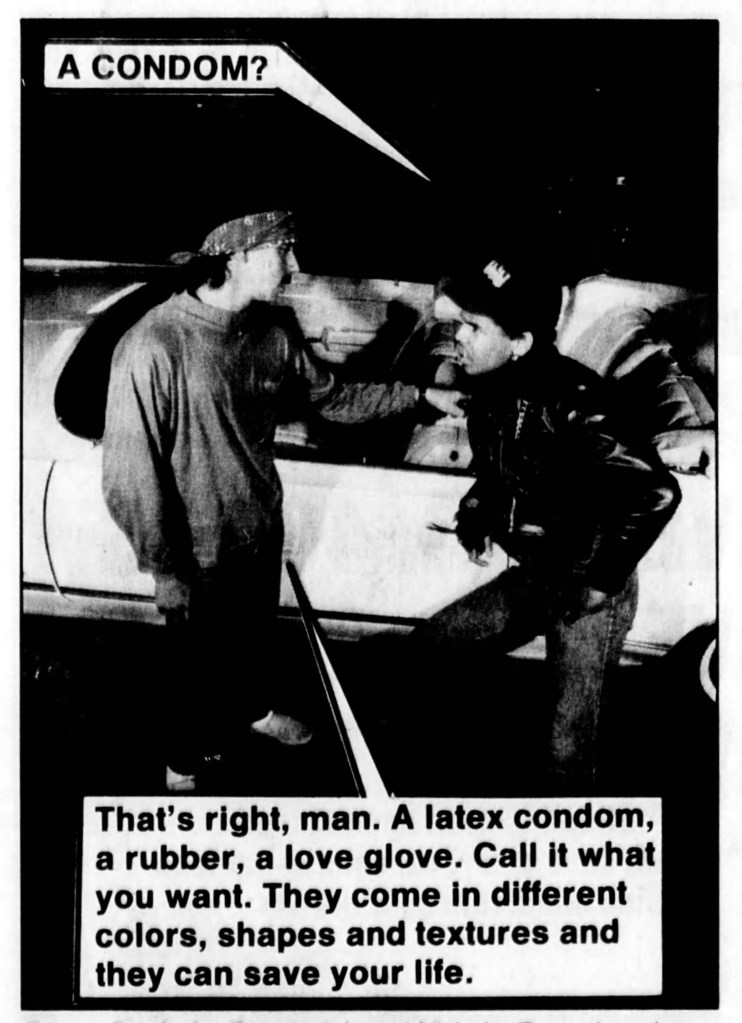
5-: From a photograph from Saturday Night Special, a fotonovela produced by Ana Consuelo Matiella, of California AIDS Clearinghouse in Scotts Valley. (In this fotonovela about AIDS, the different parts were played by students from local high schools.) This photograph illustrated A novel way to learn about AIDS, by Denise Franklin, Sentinel staff writer, published in the Santa Cruz Sentinel (Santa Cruz, California, USA) of Sunday 28th May 1989 [page E-1, column 1]:
“A CONDOM?”
“That’s right, man. A latex condom, a rubber, a love glove. Call it what you want. They come in different colors, shapes and textures and they can save your life.”
6-: From Taking a raincoat to the cape of Venus can present multilingual problems, by Jill Margo, about the New-South-Wales Multilingual HIV/AIDS Education Program, published in The Sydney Morning Herald (Sydney, New South Wales, Australia) of Monday 10th July 1989 [page 15, column 1]:
“Love glove”, “rubber” or “preservative”—all slang words for the condom and problems for researchers developing an AIDS education program for the State’s ethnic population […].
The Portuguese romantically call it “the cape of Venus”. To Vietnamese it’s “a raincoat”. And to generations of Australian school children, it has been affectionately known as “a franger”, “a frog”, or “a frenchie”.

