
Based on the image of a policeman lying asleep in the middle of a road, the expression sleeping policeman denotes a raised band across a road, designed to make motorists reduce their speed.
—Cf. also the expression silent policeman, which designates a small structure placed at the centre of a road junction.
The French equivalent of the expression sleeping policeman is gendarme couché, in which:
– gendarme designates a paramilitary police officer;
– couché means lying (i.e., in a horizontal position).
The earliest occurrence of the French expression gendarme couché that I have found is from Ephémérides 1978, published in Ephémérides 1976/80—1er janvier 1976 au 31 décembre 1980 (Turckheim (Haut-Rhin): Société Wickram, 1981), by Alphonse Edel (1903-1992):
1978
16 mai LE GENDARME COUCHE—macadam en dos d’âne—à hauteur de la maison N° 10 rue du Muguet, limite la vitesse des véhicules.
translation:
1978
16 May THE LYING GENDARME—humpbacked macadam—at the level of the house N° 10 rue du Muguet, limits the speed of the vehicles.
The earliest occurrences of sleeping policeman that I have found are as follows, in chronological order—in early use, this expression often referred to Jamaica:
1-: From Benevolent Or Cruel, Trujillo Was ‘The Boss’: People Loyal—They Had To Be, by James F. Cunningham, published in The Honolulu Advertiser (Honolulu, Hawaii, USA) of Thursday 1st June 1961—the following takes place in Santo Domingo, the capital of the Dominican Republic:
Supplementing the men in uniform at strategic points along the streets and highways were “sleeping policemen”—oversized humps in the pavement, like those designed to restrain drivers at the Ala Moana Shopping Center.
2-: From Alcan widens industrial scope, published in The Financial Post (Toronto, Ontario, Canada) of Saturday 5th December 1964:
As you approach the last few yards of smooth road before the office building of Alcan Ltd.’s alumina plant at Ewarton, Jamaica, you see an arresting sign with red letters on a white background:
DEAD SLOW. SLEEPING POLICEMAN.
Those who know what a sleeping policeman is will slow down right away. The less sophisticated will slow down, too, because the mere thought of a policeman telling all and sundry that he is asleep on the job (in the middle of the road, perhaps?) is intriguing.
The “sleeping policeman” is, in fact, a hump of rounded concrete stretched across the road, about six in. high.
As a deterrent to rapid driving through the Alcan plant and office area, it has a salutory [sic] effect.
3-: From “Sleeping Cops” And Other Hazards, by Rabbi Brasch, published in The Sydney Morning Herald (Sydney, New South Wales, Australia) of Saturday 20th March 1965:
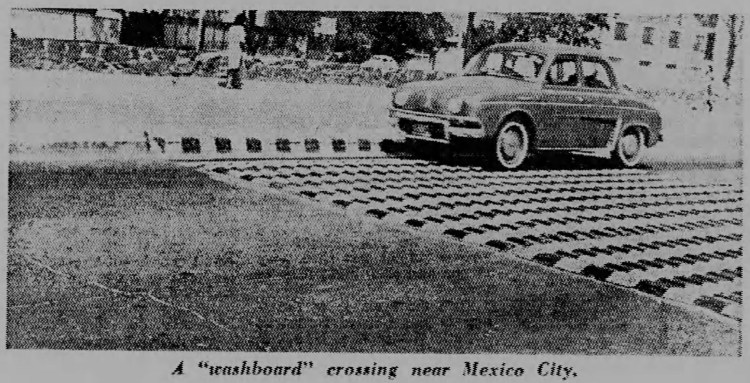
—However, in this passage about Mexico City, the expression denotes a row of metal studs embedded across a road; and I wonder whether, in this instance, sleeping policeman could be a loan translation from Spanish:
Mexicans have also learnt to tackle the problem of speeding. They do so in a new and ingenious way. All through the city, you can find rows of huge metal studs, embedded across the width of the road. They are the sleeping policemen. If you drive across them at excessive speed, you will not kill them but, instead, break your car’s springs!
And if not a sense of responsibility, just selfish consideration will force you to observe the speed limit, halt signs and crossing pedestrians.
Though, once again, Mexicans were not slow to outwit the authorities. In not a few places I found that “anxious” drivers had removed several of those studs, those at the most strategic place, so that they could sail through the “obstruction” with unreduced speed, penetrating a new kind of Siegfried Line.
But if “sleeping policemen” could thus be reduced to helplessness, the authorities have thought out another means to control the speed. They replaced the vulnerable studs by foolproof “washing boards.” These are wide raised strips of corrugated concrete, once again extending across the width of the road. No one can interfere with them. However, should you suffer from a slipped disc, it might be advisable for you to leave the car at such dangerous crossings.
Students everywhere love speeding. I was not surprised, therefore, to find a superabundance of “sleeping policemen” and “washing boards” within the vast grounds of the University City.
A “washboard” crossing near Mexico City.
4-: From Jamaica-Kaleidoscope Of Color, Customs, Beauty, by Thelma B. Olival, of Pan American World Airways, published in the Hawaii Tribune-Herald (Hilo, Hawaii, USA) of Wednesday 6th October 1965:
There’s a no-nonsense quality about the British. As you near a road construction job, a sign says, “Construction Ahead.”
The follow-up to this sign, a “chain” or so ahead, reads tersely, “You Have Been warned.”
I couldn’t figure out what the “Slow, Sleeping Policeman” signs meant.
Well, travel and learn. A “Slow, Sleeping Policeman” sign signifies a large bump on the road, purposely put there to guard against speedy entry or exit in and out of driveways.
5-: From a letter to the Editor, by Mrs. Robert H. Taylor, published in The Cedar Rapids Gazette (Cedar Rapids, Iowa, USA) of Thursday 3rd March 1966:
As a resident on Eaglemere court SE, I am deeply concerned by the hazardous driving conditions on East Post road.
[…]
[…] I doubt that a lower legal speed limit would deter any drivers. I know, too, that it is not possible to maintain a constant patrol out here.
Would it be feasible to install along the road “sleeping policemen”—that is, a raised strip the width of the paving, such as one finds at approaches to stop signs on major highways? If such installations were made at intervals along the road, drivers would be forced to slow down, as there is no way to maneuver around or through these barriers.
6-: From a travel story by Anna Jennings, professor of English at Monmouth College, published in the Asbury Park Evening Press (Asbury Park, New Jersey, USA) of Sunday 6th March 1966—the following takes place in Kingston, the capital of Jamaica:
The road to the Jamaica Hilton which we were to visit was placarded: “Beware the sleeping policemen.” These turned out to be protruding obstacles set into the roadway, designed to insure slow speeds. They did.
7-: From a story from Guatemala, by Shandy Hill, published in the Pottstown Mercury (Pottstown, Pennsylvania, USA) of Friday 20th May 1966:
—However, here, the expression sleeping policeman denotes a deep ditch hollowed out of the macadam:
The machine gun along the roadside was aimed at our hearts. A squad of soldiers heavily buttressed with rifles and sidearms patroled the checkpoint. An officer poured over some reports with several footsoldiers. At least 12 of the militia walked the area with carbines at belt-level.
The bus was slowed by “sleeping policemen,” which in Central America meant deep ditches hollowed out of the macadam to stop anyone brash enough to try to run the checkpoint. Any such attempt would demolish an auto’s front end, not saying what it would do to a driver.
8-: From People at Work, by Herb Stoy, published in the Stockton Daily Evening Record (Stockton, California, USA) of Monday 22nd August 1966:
Lincoln High School parking lot is well populated with “sleeping policemen.” They’re concrete humps to slow down speeding motorists.
9-: From Jet-Set Vacation Starts in Jamaica, by Micky Baird, published in the Honolulu Star-Bulletin (Honolulu, Hawaii, USA) of Sunday 27th November 1966:
When my driver turned me into a shady lane entrance to one of the hotels I saw a huge sign warning me to “be careful of the Sleeping Policeman.”
It struck me rather peculiar that policemen on duty should be sleeping and I remarked about it. My driver roared with Jamaican good humor. This is merely the name they give those concrete bumps placed in the road to slow cars down. In Jamaica they indent rather than protrude.
10-: From the account of the annual meeting of Old Bennington’s Village, published in the Bennington Banner (Bennington, Vermont, USA) of Wednesday 10th May 1967:
[Trustee Harry Cumpston] sought opinion of residents of construction of “sleeping policemen” to curb speeding along Vt. 9 and on Monument Avenue. These are bumps built into the road that are hazardous to drivers that hit them at high speeds. This proposal was not endorsed in view of the unlikely possibility the state would approve construction of the “sleeping policemen” on state and state-aid highways.
11-: From Editor’s Notes, published in the Bennington Banner (Bennington, Vermont, USA) of Thursday 11th May 1967:
Building big bumps—known as sleeping policemen—in the streets of Old Bennington as a deterrent to speeders would indeed be an effective way to discourage motorists from stomping too hard on their accelerators. The sleeping policemen—proposed by Harry Cumpston at Old Bennington’s Village Meeting this week—would vastly complicate the job of junked car control, however, for any auto that hit one of those bumps at 50 or 60 miles per hour would be ruined. Wrecked cars would litter the streets of the historic old village, and Old Bennington would probably have to invest in a wrecker to haul them away. […] Actually, Old Bennington tried out a type of sleeping policemen for a couple of months this spring on Walloomsac Road. The potholes were so numerous there, that no motorist in his right mind dared let his speedometer needle go beyond the 10 mph mark. Perhaps some permanent potholes in all the old village’s streets would be a cheap and easy way to solve the problem. And the damage to speeding cars would not be all that serious.
12-: From a story by Doyle Klyn, Weekend Magazine Women’s Editor, published in several Canadian newspapers on Saturday 23rd March 1968—for example in The Montreal Star (Montreal, Quebec):
Signs Of The Times
Bill Palmer, a Montreal sign-spotter, writer and word-game player, says that a trip to Jamaica gave him some good signs. Caution: Sleeping Policeman is one of his favorites.
Another is actually this set of three signs, some distance apart on a road:
1. Road repairs underway ½ mile.
2. Road repairs ahead 500 feet.
3. You have been warned!
13-: From the Decatur Daily Review (Decatur, Illinois, USA) of Monday 21st April 1969:
Sign Warns Of Big Bump
Contrary to what certain signs in Fairview and Kiwanis Parks might lead one to believe, Decatur’s policemen are not prone to sleeping on the job.
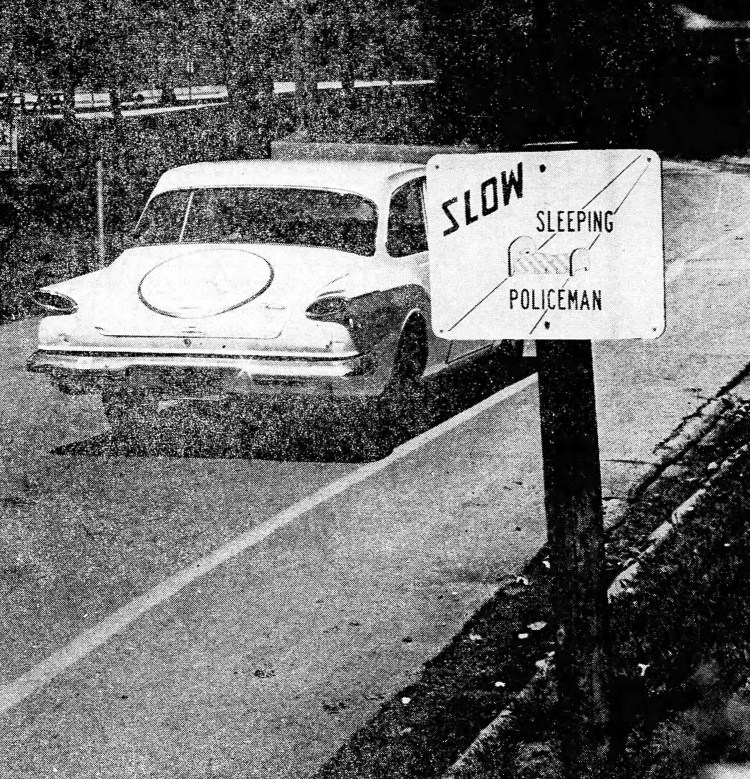
The recently-installed signs warning of a snoozing man in blue were put in the parks to warn motorists of bumps in the pavement. The bump itself is the “sleeping policeman.”
The bumps are there to slow would-be race drivers who think the winding park roads are a Grand Prix circuit.
The signs were installed late last week, according to Donald Hart, park district facilities director.
The brainstorm belongs to Royce H. Huss, park board president.
So far, motorists have stopped, gawked, smiled or guffawed but most have slowed down. After all, it isn’t every day you legally get to run over a policeman.
The parks are patrolled by city police as well as special park district police.
A Decatur motorist is about to run over a “sleeping policeman.”
14-: From the Decatur Daily Review (Decatur, Illinois, USA) of Thursday 8th May 1969:
Warning Signs Stolen
‘Sleeping Policemen’ Just SnoreAll but one of the sleeping policeman signs installed recently in parks on the west side of Decatur have been stolen.
The signs were put up to warn motorists of bumps across the roadway which are designed to prevent cars from traveling through the parks at a high rate of speed.
15-: From Highlights: Decatur In Review, by Don W. Roberts, published in the Decatur Sunday Herald and Review (Decatur, Illinois, USA) of Sunday 11th May 1969:
The Park District’s sleeping policemen—except for one at last report—are no longer sleeping on duty in the parks.
This takes a nickle’s worth of interpretation. The “sleeping policemen” were signs warning of bumps in park drives. A dime’s worth of publicity resulted in the disappearance of all but one signs.
Happy motoring in the parks.
16-: From the account of a meeting of the commissioners of the Decatur Park District, published in the Decatur Daily Review (Decatur, Illinois, USA) of Friday 6th June 1969:
A request from William P. Shade for the installation of one or more sleeping policemen on the park drive near the Fairview Park tennis courts (directly north of West William Street) was referred to Donal F. Hart, director of facilities for consideration.
17-: From an article about a campaign, headed by Mrs. Pat Seers, to provide more play-space for children in West Chelsea, London, England—article published in The Kensington News & West London Times (London, England) of Friday 6th June 1969:
Mrs. Seers had a meeting with Ald. Mrs. Diana Paul, chairman of the Borough Council’s Town Planning Committee. Mrs. Seers suggested:
[…]
Play streets to have more effective notices. Also possible “sleeping policemen”—raised surfaces which cut down speed, and half barriers at entrances and exits.
[…]
[…] The Borough Surveyor, Mr. F. H. Clinch, […] said the Works Committee would prefer to try carriageway markings before the “sleeping policemen” which although they protect children could cause other accidents.
18-: From The Hartford Courant (Hartford, Connecticut, USA) of Sunday 28th September 1969:
Island “Sleeping Police” Really Wide Awake
QUESTION. I remember once hearing about Jamaica’s “sleeping policemen.” Are they allowed to sleep on duty?—L. B., Terryville.
ANSWER. Jamaican lawmen are wide awake. A “sleeping policeman” is island slang for a hump built across the streets to slow down speeders. We call them “thank you ma’ams.”
19-: From an article about the creation of a traffic-free area of pedestrian streets in the centre of the city of Norwich, Norfolk, England, published in The Birmingham Post (Birmingham, Warwickshire, England) of Friday 31st October 1969:
The core of the change lies in the closing of London Street, in July, 1967. […]
[…]
Closure has created no problems in delivering goods. Some shops have access at the back. There are service bays at each end of the street and it is crossed by one small street which does carry traffic and which has a “sleeping policeman”—an artificial hump and trough in the road—to make sure that traffic slows down.
20-: From a UPI story published in several newspapers—for example in The Cincinnati Post (Cincinnati, Ohio, USA) of Monday 3rd November 1969:
Sleeping Policemen
KINGSTON, JAMAICA (UPI): When you hear a Jamaican talk about his country’s “sleeping policemen,” he isn’t implying that Jamaican lawmen aren’t wide awake. The term “sleeping policeman” is used to describe the hump built across streets to slow down speeders.
21-: From the account of a meeting of the commissioners of the Decatur Park District, published in the Decatur Daily Review (Decatur, Illinois, USA) of Friday 19th December 1969:
After some discussion of the committee’s report, Gary G. Gray, park board president, said that many of the requests, such as installation of “sleeping Policemen” to slow traffic and a general clean up of the park should be quite possible.
22-: From The Birmingham Post (Birmingham, Warwickshire, England) of Saturday 17th January 1970:
“Sleeping policemen”—a ridge and trough to give a rough ride to cars travelling at speed—have been installed in places in Norwich to keep down the speed of traffic.
23-: From the account of a “My job” luncheon talk that Tony Froud gave at the local Rotary Club about Stratford-upon-Avon’s Royal Label Factory, published in the Stratford-upon-Avon Herald and South Warwickshire Advertiser (Stratford-upon-Avon, Warwickshire, England) of Friday 18th September 1970:
Mr Froud told of the difficulties of choosing the right signs and erecting them. He said that on the Shipston road there was a sign to Preston with “on Stour” written smaller underneath. A lorry driver had mistaken Preston-on-Stour for the Lancashire one and was not pleased. The sign to Atherstone had been confused with the town in North Warwickshire.
They were now making one for Wales which read “Dead slow, sleeping policemen,” but why he did not know.
 word histories