Tip-Cat in A Little Pretty Pocket-Book, Intended for the Instruction and Amusement of Little Master Tommy, and Pretty Miss Polly (1787 edition) The phrase to see which way the cat jumps means to see what direction events are taking before committing oneself. One of its earliest instances is from The Berkshire Chronicle […]
The proper noun Disgusted (with initial capital D) was originally used as a self-designation by a member of the public writing anonymously to a newspaper in order to express outrage about a particular issue—cf. also meaning and history of ‘to write to The Times about it’. The earliest instance of this noun that I have found is […]
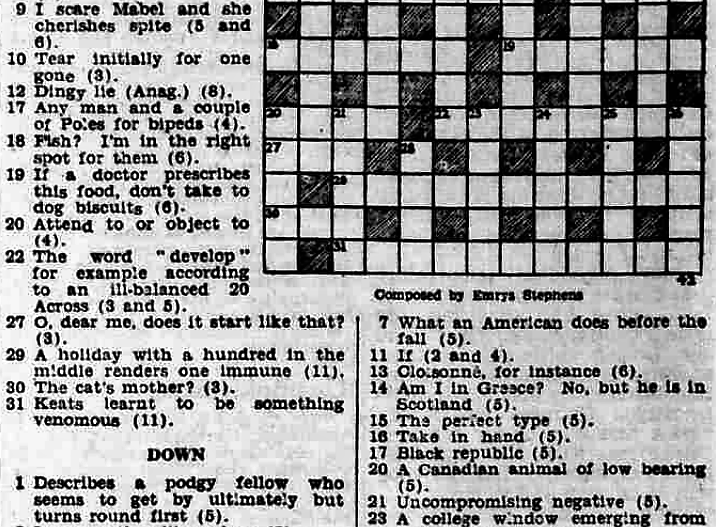
crossword in The Yorkshire Post and Leeds Mercury of 23rd January 1950 30 across: The cat’s mother? (3). The phrase who’s ‘she’—the cat’s mother? and variants are said to a person, especially a child, who uses the feminine third person singular pronoun impolitely or with inadequate reference. The earliest use of the phrase that I found is from The White […]
The adjective fed up means annoyed, unhappy or bored, especially with a situation that has existed for a long time. The original, literal meaning is simply sated with food, since to feed up an animal or a person is to supply them with rich and abundant food. For example, the author of Whether Love be a natural or fictitious Passion, published in Pope’s Bath Chronicle of 3rd May 1764, wrote: The […]
The Latin noun lupus/-pi meant wolf. It is kindred with ancient Greek λύκος (lukos). —Cf. lycanthrope, which originally designated a person who believes that he or she is a wolf, and which, via the modern Latin noun lycanthrōpus, is from Greek λυκάνθρωπος (lukanthropos), literally wolf-man, from λύκος and ἄνθρωπος (anthropos), man. The Latin lupus has sometimes been used in English in the sense of wolf; for instance, a Scottish […]
One of the earliest instances of posh is from a cartoon published in Punch, or The London Charivari (London, England) of 25th September 1918. An RAF officer is talking to his mother: “Oh, yes, Mater, we had a posh time of it down there.” “Whatever do you mean by ‘posh,’ Gerald?” “Don’t you know? […]
image: nageur-sauveteur MEANINGS The noun starboard denotes the side of a ship or aircraft that is on the right when one is facing forward, while port denotes the opposing side. ORIGINS From the Germanic bases of the nouns steer and board, starboard, which appeared in Old English as steorbord, denotes literally the steer board, the steer side. This side of the ship […]
The phrase to take French leave means: to depart unnoticed or without permission.—Synonym: to take Dutch leave. The earliest (and most curious) occurrence of to take French leave that I have found is from the anonymous novel Benedicta (1741)—the heroine is about to get married: Mrs Butler, who on this extraordinary occasion, had taken French leave […]
MEANING a member of a family or group who is regarded as a disgrace to it ORIGIN This was perhaps originally an allusion to the book of Genesis, 30. Jacob has already worked fourteen years for both of Laban’s daughters, and after Joseph’s birth he desires to take leave of Laban. They reach […]
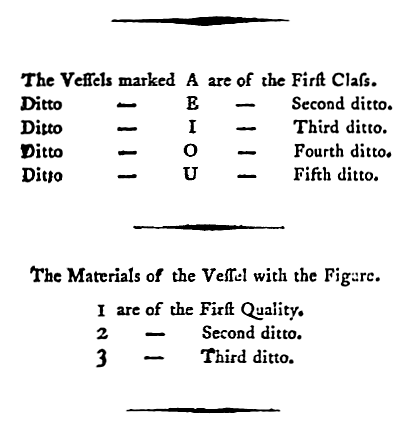
MEANING first class, outstanding ORIGIN Lloyd’s Register, historically Lloyd’s Register of Shipping, is an independent society formed in 1760 by a group of merchants operating at Lloyd’s coffee house in London, which surveys ships to ensure compliance with standards of strength and maintenance. The name also denotes an annual publication giving details […]