MEANING The phrase to beggar belief (or description) means to be too extraordinary to be believed (or described). ORIGIN The literal meaning of the verb to beggar is to make a beggar of, exhaust the means of, reduce to beggary. It came to be used figuratively to mean to exhaust the resources […]
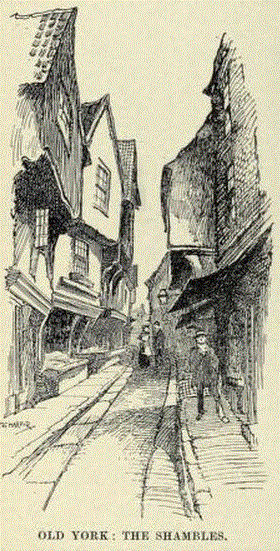
Old York: the Shambles – illustration by Charles G. Harper for his book The Great North Road: The Old Mail Road to Scotland: York to Edinburgh (1901) (The pavements are raised either side of the cobbled street to form a channel where the butchers would wash away the offal and blood.) MEANING […]
The phrase to carry coals to Newcastle means to supply something to a place where it is already plentiful; hence, figuratively, to do something wholly superfluous or unnecessary—cf. also to sell refrigerators to the Eskimos and to sell sand in the Sahara. This phrase (in which coals is an obsolete plural) refers to Newcastle upon Tyne, in […]
It was only from the mere accident of his bearing the name that he did that the phrase ‘Hobson’s choice’ was applied to Thomas Hobson (1544-1631), an English liveryman who supposedly gave his customers no choice but to take the horse closest to the stable door or none at all. MEANING The […]
MEANING The phrase donkey’s years means a very long time. ORIGIN This expression is inseparable from donkey’s ears. In fact, these two expressions were originally a single one, donkey’s years being simply a dialectal pronunciation of donkey’s ears—or the other way around. And donkey’s ears/years (also donkeys’ ears/years) was part of a […]
MEANING The Northern Daily Mail and South Durham Herald (Hartlepool, County Durham, England) of 14th July 1894 published an article titled Naval Slang. How Jack Re-christens Things, which contains the following: The preserved meat served out to him is known as “Fanny Adams” or “Harriet Lane.” But the term Harriet Lane was also […]
The exclamation OMG expresses astonishment, excitement, embarrassment, etc. It is from the initial letters of oh my God (the final element may sometimes represent gosh or goodness). This initialism is older than the Internet or even the Usenet (an early computer network established in 1980), since it is first found in a letter that the […]
Buggins’ turn, or Buggins’s turn, is the principle of assigning an appointment to persons in rotation rather than according to merit. The earliest recorded use of this expression is in a letter written on 13th January 1901 by the British admiral Lord John Arbuthnot Fisher (1841-1920): Favouritism was the secret of our efficiency in the […]
MEANING to smell a rat: to detect something suspicious ORIGIN The first known use of this phrase is in The Image of Ipocrysy, an anonymous poem written around 1540, denouncing “the cruell clergy”: (published in 1843) Suche be owr [= our] primates, Our bisshopps and prelates, Our parsons and curates, With other […]
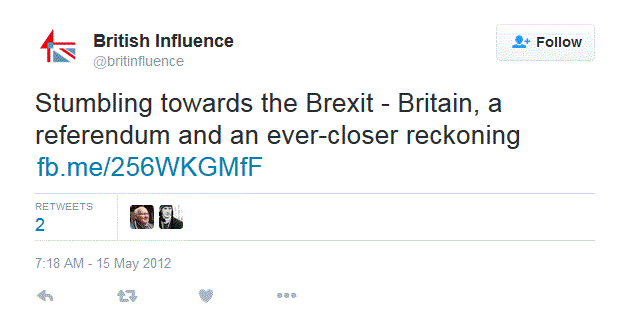
MEANING Brexit: the departure of the United Kingdom from the European Union ORIGIN A blend of British, or Britain, and exit, this term dates back to 2012. The form Brixit appeared in Bagehot’s notebook on British politics, in The Economist of 21st June: A Brixit looms MY PRINT column this week […]

 word histories