The proper name Guy is derived, via French, from the Old German Wido, either from wit, meaning wide, or from witu, wood. Wido has become Guy in French because in words of Germanic origin, when initial, the labio-velar approximant /w/ has regularly become the velar /g/. For instance, in the French noun loup-garou, the element garou corresponds to English werewolf—in fact, loup was added when the […]
The phrase trick or treat is a traditional formula used at Hallowe’en by children who call on houses threatening to play a trick unless given a treat or present. In early use, the phrase was also tricks or treats, treat or trick, and variants. This phrase seems to have originated in Ontario (capital: Toronto), a province of […]
James Crichton of Clunie (circa 1560-1582) was a Scottish prodigy of intellectual and knightly accomplishments, and the epithet admirable became traditionally applied to him. The Scottish scholar John Johnston (circa 1565-1611) used the Latin adjective admirabilis in Heroes ex omni historia Scotica lectissimi (1603), a collection of biographies and eulogies in elegiac couplets of great […]
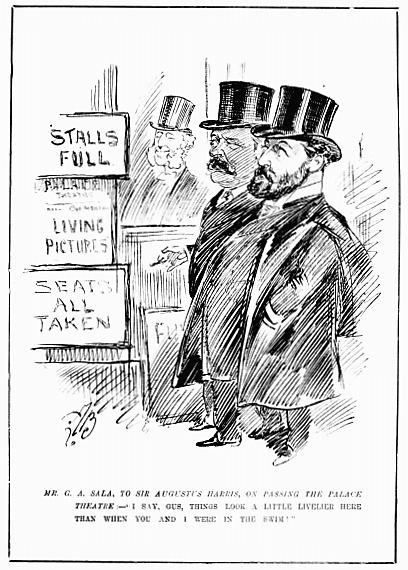
G. A. SALA, TO SIR AUGUSTUS HARRIS, ON PASSING THE PALACE THEATRE:—“I SAY, GUS, THINGS LOOK A LITTLE LIVELIER HERE THAN WHEN YOU AND I WERE IN THE SWIM!” — from The Entr’acte and Limelight (London) of 10th March 1894 (Augustus Harris (1825-73) was a British actor and theatre manager. George Augustus Sala (1828-95), was an […]
The phrase ‘pour encourager les autres’ (‘in order to encourage the others’) was coined by Voltaire with reference to the execution of Admiral John Byng in 1757.
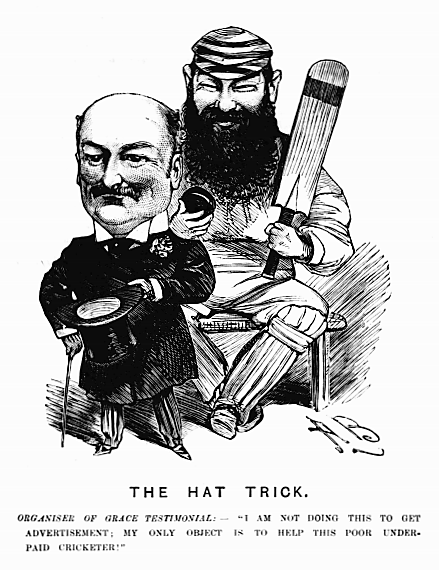
THE HAT TRICK. ORGANISER OF GRACE TESTIMONIAL: — “I AM NOT DOING THIS TO GET ADVERTISEMENT; MY ONLY OBJECT IS TO HELP THIS POOR UNDERPAID CRICKETER!” caricature from The Entr’acte & Limelight (London) – 22nd June 1895 In 1895, a testimonial fund was set up for W. G. Grace (1848-1915), the Grand Old Man […]
According to the National Museum of the Royal New Zealand Navy, in 1731 rum was made an official issue to seamen and the daily half pint was issued in two equal parts, one in the morning and the other in the evening. This was neat spirit and drunkenness became rife especially on the West Indies […]
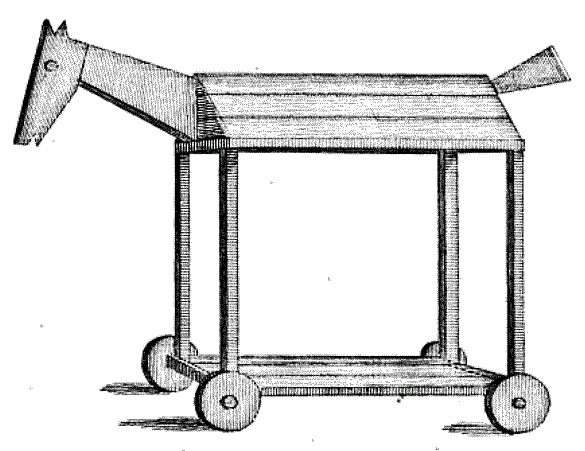
The phrase a horse that was foaled of an acorn denoted the gibbet, sometimes also called triple tree. In A Collection of English Proverbs (1678), the English naturalist and theologian John Ray (1627-1705) wrote: You’ll ride on a horse that was foal’d of an acorn. That is the gallows. Pelham; or, The Adventures […]
MEANING of payments: without delay ORIGIN This expression refers to the fingernail and might originally have alluded to drinking fair and square. A clue might be provided by the French phrase payer rubis sur l’ongle (literally to pay ruby on the fingernail), which means to pay exactly what is due. (A variant, used by prostitutes, was rubis sur pieu, […]
Witham is the name of several villages in Lincolnshire and Essex. With a pun on wit, the expression little, or small, Witham was used proverbially for a place of which the inhabitants were remarkable for stupidity. For example, the following, from A fourth hundred of epygrams (1560) by the English playwright and epigrammatist John Heywood […]