The phrasal verb shell out means to pay a specified amount of money, especially one regarded as excessive. It is first recorded in Moral tales for young people (1801), by the Anglo-Irish novelist and educationist Maria Edgeworth (1768-1849): “One of you, it’s plain, must shell out your corianders.” (The word coriander (or coliander), short for coriander-seed (or coliander-seed), was slang for coin, money. The form coliander-seed, […]
The phrase to miss the bus, or the boat, etc., means to be too slow to take advantage of an opportunity. In A Concise Dictionary of Phrase and Fable (1993), B. A. Phythian explained: This expression is said to originate in an Oxford story of the 1840s about John Henry Newman, fellow of Oriel College, […]
“HUNS KILL WOMEN AND CHILDREN!” “TELL THAT TO THE MARINES!” First-World-War US recruiting poster by James Montgomery Flagg image: Disappearing Idioms This poster, which attracted a great deal of attention, portrays an angry-looking young man in the act of pulling off his coat as though he were anxious to get into a fight. The […]
The noun fly-by-night, or fly-by-nighter, denotes an unreliable or untrustworthy person. As an adjective, fly-by-night means unreliable or untrustworthy, especially in business or financial matters. However, the term seems to go back to the idea of witches flying on their broomsticks by night. At least, its first recorded instance is as a term of contempt […]
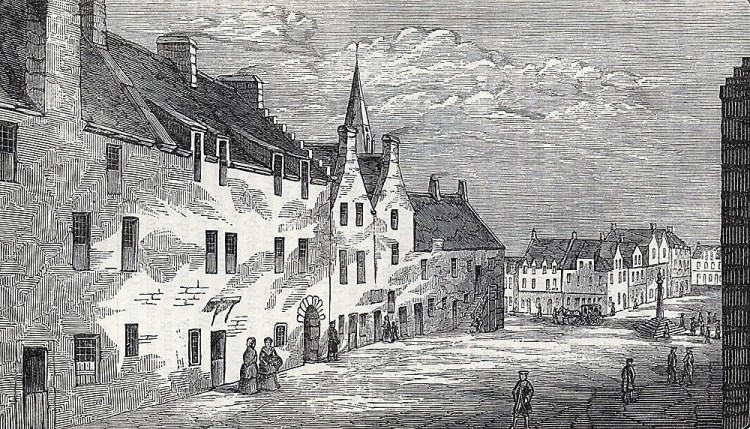
the Rotten-row in Glasgow, circa 1570 image: The Glasgow Story The street name Rotten Row occurs in many different towns. For example, The Caledonian Mercury (Edinburgh) of 10th December 1728 published the following advertisement: There is just come to Leith, a Parcel of fine Figs both in Casks and Frails [= baskets], […]
MEANINGS – the last part of something, especially when regarded as less important or interesting – British, informal: a cigarette end ORIGIN The obsolete adjective flag, attested in the late 16th century, meant flabby, hanging down. It was either an onomatopoeic formation or, via Middle French flac, from Latin flaccus, of same […]
A drawing of Peeping Tom, in the exact state in which he is carved, but divested of all paint and superfluous ornaments. W. Reader in The Gentleman’s Magazine: and Historical Chronicle (London) of July 1826 The Coventry Peeping Tom statue, which dates from around 1500, survives today. Though it is now stripped down to […]
Nowadays, a curfew is a regulation requiring people to remain indoors between specified hours, typically at night – for example: a dusk-to-dawn curfew. The word is from Old French and Anglo-Norman forms such as cuevre-feu and covrefeu, hence the Modern French word couvre-feu (plural couvre-feux), composed of: – couvre, imperative of the verb couvrir, to cover, – feu, meaning fire. The corresponding medieval Latin names were ignitegium […]
The Cheshire cat is now largely identified with the character in Alice’s Adventures in Wonderland (1865), by the English writer Lewis Carroll (Charles Lutwidge Dodgson – 1832-98): “Please would you tell me,” said Alice, a little timidly, for she was not quite sure whether it was good manners for her to speak first, “why your […]