
[A humble request: If you can, please donate to help me carry on tracing word histories. Thank you.]
The following is from Live Letters, conducted by the Old Codgers, published in the Daily Mirror (London, England) of Thursday 24th November 1966 [page 18, column 4]:
V. J. Cook, of Bennetts Castle-lane, Dagenham, Essex, writes:
Whenever my grandmother came to the last halfpenny in her purse she would say: “Well, up goes the donkey!”
Have you any idea where this saying came from?
♦ We know the expression as: “Two more and up goes the donkey.” It was an old cry used by fairground showmen, promising their audience that as soon as enough pennies or customers had been collected, the donkey would balance itself on the top of a pole.
Needless to say, it was always a matter of “two more,” and the donkey never went up!
—Cf. also the phrase free beer tomorrow.
Albert Barrère and Charles Godfrey Leland defined the phrase three more and up goes the donkey as follows in A Dictionary of Slang, Jargon & Cant. Embracing English, American, and Anglo-Indian Slang, Pidgin English, Tinkers’ Jargon and other irregular Phraseology (Edinburgh: The Ballantyne Press, 1889) [Vol. 1, s.v. Donkey, page 321, column 1]:
(Common), “Three more and up goes the donkey,” that is, three pennies more and the donkey will go up the ladder. This phrase, used by mountebanks to denote that the performance will begin when the sum required is complete, is often said mockingly to a braggart to imply disbelief in accounts of his own wonderful performances.
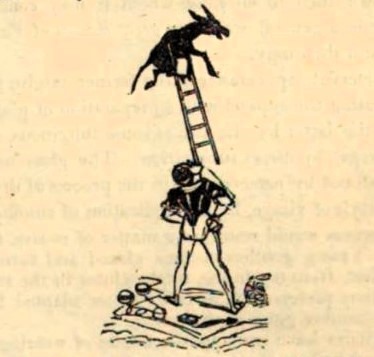
The following image of a showman balancing on the tip of his nose a ladder on the top of which a donkey is balancing itself is from Punch, or the London Charivari (London, England) of Saturday 17th July 1841 [page 41, column 2]:
These are, in chronological order, the earliest occurrences of the phrase two more and up goes the donkey, and of its variants, that I have found:
1-: From a letter to the Editor, by ‘Dick Homespun’, of Muggerhanger, Bedfordshire, published in The Weekly True Sun (London, England) of Sunday 17th August 1834 [page 403, column 2]:
Sir,—We country folk have been a goodish bit poozled of late by a paper which the parsons are circulating among us, called a “Declaration of the King in favour of the Established Church.” […]
For my own part, I can’t see what the plague the paper means, unless it is to say as how the parsons are going down in the world, and want somebody to hoist ’em up a little […].
[…] Its [sic] all very well at first; they’ll go cringing and fawnicating on so quiet, and so humble, till they’ve made themselves safe, as they think, and then, you know, “up goes the donkey,” and they’ll want the best of every thing.
2-: From Sketches of the Country. [For the Sussex Advertiser.] No. X.—The Races, by ‘L.’, published in The Sussex Advertiser: Or, Lewes and Brighthelmston Journal (Lewes, Sussex, England) of Monday 5th September 1836 [page 3, column 4]:
The moment the race is concluded, innumerable professionals begin to exercise their various callings on the course […]. In another place a similar audience is collected around a dirty faced personage, clad in a tawdry slashed jacket and soiled tights, who is displaying divers twistings and balancings and contortions with infinite approbation; his principal feat is the balancing of a ladder on the top of which is fastened with cords an undergrown, wretched-looking donkey. He makes a kind of auction sale of his performances, progressively developing his talents in proportion to the amount of coppers subscribed, until the last and grand effort—“tuppence more, and hup goes the donkey!”
3-: From the subtitle of a poem published in The Comic Almanack: An Ephemeris in Jest and Earnest, containing Merry Tales, Humorous Poetry, Quips, and Oddities (London: Chatto and Windus) of 1837 [as published in First Series, 1835—1843, page 99]:
THE BALLOON ASCENT.
“Only threepence more, and up goes the Donkey.”Dear Captain! let me thank my lucky fate
That brings me safe and sound through every strait,
And when my rebel subjects tipp’d me over,
Placed between them and me the Straits of Dover:
On terra firma I’ve at length alighted,
[&c.]
4-: From an open letter to the British politician Richard Temple-Nugent-Brydges-Chandos-Grenville (1797-1861), 2nd Duke of Buckingham and Chandos—letter by ‘A Farmer not under Influence’, dated Stony Stratford, Wednesday 25th October 1837, published in The Aylesbury News, and Advertiser for Bucks, and the Surrounding Counties (Aylesbury, Buckinghamshire, England) of Saturday 28th October 1837 [page 8, column 1]:
Emulate your royal ancestor Harry the Fifth; and, in amending yourself shake off all suspicious company.
I will relate to your Lordship a little anecdote which may put this matter in a clearer view; always protesting against personal allusion.
At a fair, lately, I saw a man who drew considerable attention. He was a fine fellow, with a glibness of tongue which first astonished you; but you soon found it a round and round drollery which by repetition grew tedious and disgusting. At each round he concluded “Threepence more and up goes the donkey!” People were all anxious to witness this feat of dexterity; the more so, as he did not lack in vauntings of his own ability. This lasted a long time, and might have lasted I know not how much longer, for the country folk kept coming and going, and our mountebank shifting a little at a time, so that, though all grumbled, none saw the downright deepness of the trick. But, worse luck for him! he had a “chummy,” who performed more sleights than he promised; and, for companionship alone, the mob decreed the donkey-balancer to the horse-pond.
Take the hint, my Lord. You have no credit to throw away. Have done with all those vile braggarts of Eastcheap—the panders of your past duplicity—until they “purge and live clean.”
This will be a real earnest to us that your professions are now honest.
5-: From a correspondence from Oxford, Oxfordshire, England, published in The Age (London, England) of Sunday 3rd December 1837 [page 392, column 3]:
The cruel system of plucking geese flourishes here in spite of Mr. Martin’s Act, though several of these geese are known to have plucked themselves. It’s rather funny that at 10 o’clock every morning a fellow takes his station near the Schools, and sings the stale ditty of “Tuppence more, and up goes the donkey.”
6-: From Actors by Daylight, and Pencilings in the Pit (London, England) of Saturday 3rd March 1838 [page 8, column 1]—Nelson Lee (1806-1872) was a British actor, playwright and theatre manager; ‘Ossy’, i.e., David Webster Osbaldiston (1794-1850), was a British actor:
Mr. Nelson Lee […] was the renowned tumbler who invented, and first practised, the novel and ingenious feat known by the appellation of “twopence more, and up goes the donkey”—a famous artist with the cups and balls, balances a sword on his nose exquisitely, and fulfils his present situation, that of a toady to Ossy at the “Wells,” to the entire satisfaction of his master, and the evident dismay of the supernumeraries under him.
7-: From Ascot Cup Day, published in The Comic Almanack: An Ephemeris in Jest and Earnest, containing Merry Tales, Humorous Poetry, Quips, and Oddities (London: Chatto and Windus) of 1839 [as published in First Series, 1835—1843, page 203]:
“The modern Hercules, ladies and gentlemen; the modern Hercules: he will take and tie that ere donkey to this here ladder, and balance the astonishing conjunction on the tip of his nose. Waiting for a ha’penny, ladies and gentlemen; make it another brown, and—up—he—goes.” Such is the chorus of the Olympic song, chanted what time Ascot celebrates her right-royal revels; but we tarry not for the ladder, or the staves.


“Needless to say, it was always a matter of “two more,” and the donkey never went up!”
Like the sign in a pub window: “Free beer tomorrow.”
LikeLike
Also like the sign in a French barber’s window: “Demain on rase gratis” (i.e., “Tomorrow we shave for free”).
LikeLike