
[A humble request: If you can, please donate to help me carry on tracing word histories. Thank you.]
The phrase to fiddle while Rome burns, and its variants, mean: to occupy oneself with trivial or relatively unimportant matters while failing to act on an issue or situation of great urgency.
This phrase alludes to the behaviour of Nero (37-68), Roman emperor from 54 to 68, who, according to the Roman historian Suetonius, sang happily while enjoying the spectacle of the fire that destroyed much of Rome in 64.
Since the 17th century, there have been direct references to the behaviour of Nero during the fire of Rome, but the earliest allusive use in a more generalised context that I have found dates back to 1770:
1-: This earliest allusive use is—as Nero fiddled whilst Rome was burning—from the concluding line of an account of the answer given by George III, King of Great Britain and Ireland from 1760 to 1820, to the remonstrance that a delegation led by the Lord Mayor of London presented to him on Wednesday 14th March 1770, at St. James’s Palace—account published in The Public Advertiser (London, England) of Thursday 15th March 1770 [page 2, column 2]:
—Note: The English political writer and philologist John Horne (1736-1812) claimed the authorship of this account—cf., below, quotation 4:
His most gracious Majesty was pleased to read the following most gracious Answer:
‘I shall always be ready to receive the Requests, and to listen to the Complaints of my Subjects; but it gives me great Concern to find, that any of them should have been so far misled as to offer me an Address and Remonstrance, the Contents of which I cannot but consider as disrespectful to me, injurious to Parliament, and irreconcileable to the Principles of the Constitution.
‘I have ever made the Law of the Land the Rule of my Conduct, […] and while I act upon these Principles, I shall have a Right to expect, and I am confident I shall continue to receive, the steady and affectionate Support of my People.’
When his Majesty had done reading the Speech, the Lord Mayor, &c. had the Honour of kissing his Majesty’s Hand; after which as they were withdrawing—his Majesty instantly turned round to his Courtiers, and burst out a laughing.
Nero fiddled whilst Rome was burning.
2-: The concluding line of the account published in The Public Advertiser of 15th March 1770 immediately caused an outcry. The following, for example, is from a letter by a person signing themself ‘Vindex’, published in The Public Advertiser (London, England) of Monday 19th March 1770 [page 3, column 1]:
To the Printer of the Public Advertiser.
Nero fiddled whilst Rome was burning.March 15, 1770.
Sir,
In your Paper of this Morning’s Date, you have closed your Account of his Majesty’s Reception of the City Remonstrance with the above recited Line printed in Italicks, and introduced into the Body of your Paper. If you are at all acquainted with the History of the Person, to whom you have thus compared your Sovereign, I think you owe it to the Public to explain in what one Act of his Life he can be said to bear a Resemblance to that execrable Tyrant. […]
By this Act you have injured every Individual, who retains any Duty or Affection for the just and merciful Prince you have traduced. All the Redress I can obtain, as one under that Description, is to withdraw my small Contribution from you, and never to admit your Paper into my House again: This I know can be no Object in your View; but, if I am not mistaken, it is a Resolution that Numbers besides myself will adopt.
3-: With reference to the concluding line of the account published in The Public Advertiser of 15th March 1770, the following anonymous engraving appeared in The Oxford Magazine: Or, Universal Museum. Calculated for General Instruction and Amusement […]. By a Society of Gentlemen, Members of the University of Oxford (London, England) of May 1770 [page 192]:
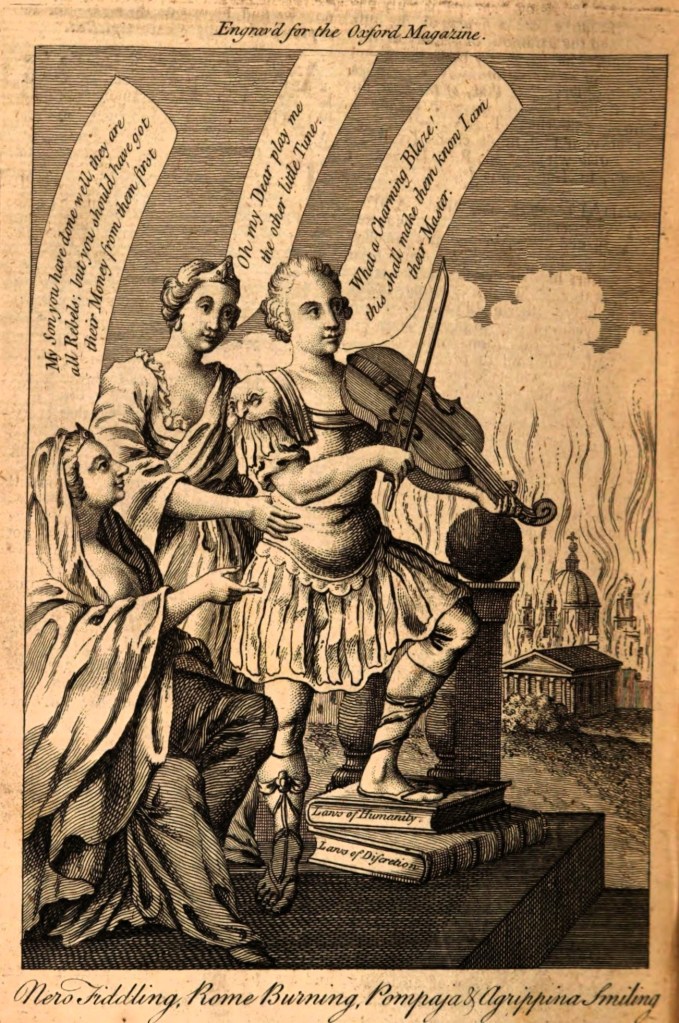
Entitled Nero Fiddling, Rome Burning, Pompaja & Agrippina Smiling, this engraving depicts:
– (on the right-hand side) George III as Nero, in a Roman habit, playing on a fiddle while in the distance London/Rome is burning; his left foot is resting on two books: Laws of Humanity and Laws of Discretion;
– (on the left-hand side) Augusta, the mother of George III, as Agrippina the Younger, the mother of Nero;
– (in the centre) Charlotte, the wife of George III, as Poppaea Sabina, the second wife of Nero.
Augusta/Agrippina says: My Son you have done well, they are all Rebels; but you should have got their Money from them first.
Charlotte/Poppaea Sabina says: Oh my Dear play me the other little Tune.
George III/Nero says: What a Charming Blaze! this shall make them know I am their Master.
4-: So great was the scandal caused by the concluding line of the account published in The Public Advertiser of 15th March 1770 that the Attorney General filed an information against the printer of that newspaper—as mentioned, for example, in London. June 7, published in The Leicester and Nottingham Journal (Leicester, Leicestershire, England) of Saturday 16th June 1770 [page 3, column 2]—Henry Sampson Woodfall (1739-1805) was an English printer and journalist:
We hear an Information is filed in the Court of King’s Bench against Mr. Woodfall the Printer for the remark after the Account of the reception of the first City Remonstrance, “So Nero fiddled whilst Rome was burning,” which we hear Mr. Horne has taken upon himself.

