
[A humble request: If you can, please donate to help me carry on tracing word histories. Thank you.]
Of American-English origin, the colloquial noun cop shop (also cop-shop) designates a police station.
Here:
– the noun cop designates a police officer;
– the noun shop designates the place where one works.
IN AMERICAN ENGLISH
These are, in chronological order, the earliest uses of the noun cop shop (also cop-shop) that I have found:
1-: From the Buffalo Evening News (Buffalo, New York, USA) of Wednesday 15th February 1882 [page 1, column 5]:
VALENTINES AT THE COP-SHOPS.
Judge King’s—
“Wants to be a sheriff,
And with the sheriffs stand,
Pulling against the Police Commissioners,
With Clerk Albro well in hand.”
Dimick’s—A book worm.
[…]
Capt. Kraft’s—The jolly Teuton, who believes in the adage, “Live and let live!”
Supt. Wolfe’s—A big refrigerator labeled the “freezer.” Presumably sent from Matthews, with two t’s.
2-: From The Buffalo Daily Times (Buffalo, New York, USA) of Friday 4th April 1884 [page 4, column 2]:
FROM THE “COP” SHOP.
Items Picked Up by the “Times” Reporter at Headquarters.Three patrolmen on sick list yesterday.
Fifteen men and one woman were arrested for vagrancy.
Twenty-seven arrests were reported at headquarters yesterday.
[&c.]
3-: From The Buffalo Daily Times (Buffalo, New York, USA) of Thursday 3rd February 1887 [page 4, column 1]:
The Cop Shops.
There were twenty-three prisoners behind the bars at the several police stations this morning, and the watchhouse justices imposed fines to the amount of $61.50. During last night twenty-seven homeless wanderers found cold comfort in the station houses, the majority of them being approved types of the genius [sic] “tramp.”
IN AUSTRALIAN ENGLISH
These are, in chronological order, the earliest Australian-English uses of the noun cop shop (also cop-shop) that I have found:
1-: From A Chinese Gambling Raid, published in the Sunday Chronicle (Perth, Western Australia, Australia) of Sunday 11th September 1898 [page 3, column 6]:
On Wednesday evening Inspector McKenna and his officers played their cards nicely, and the Chief soon had a routine flush of Chow gamblers on the road to the kitty. […] Ah Ho, which means anyhow, and Ah Fan, which means a Chinese fat man, with all the push, and paraphernalia were accomodated [sic] with a drive as far as the Police Station, when they alighted, and after going through the cop-shop formula, were bailed out by their almond eyed vegetarian and laundry compatriots.
2-: From the column In and Around Town, by Frank Henty, published in The Labor Call (Melbourne, Victoria, Australia) of Thursday 3rd October 1912 [page 2, column 1]:
We know by the papers how it is that the burglars get away unless arrested by the burgled citizen himself. The burglar gets away because the cop is doing housemaid duty at the barracks. According to the daily press, seventeen cops were carpeted at the Russell-street cop-shop last week “for allowing their rooms to be in an untidy condition,” and the charges laid against them were concerned with “the presence of three dead matches under one constable’s bed, a piece of orange peel under another, dust on a policeman’s locker, and for not having the window blind at the regulation height.”
John Hop no more: it is Jane Hop he shall be in future—by the grace of his extraordinary “superiors!”
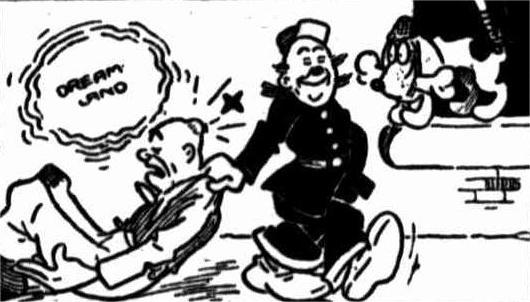
3-: From the caption to the following drawing, in a comic strip entitled Inspector Spot always on the spot, published in The Mirror Comic (Sydney, New South Wales, Australia) of Saturday 13th October 1917 [page III, column 3]:
A lump on his fat head as big as an egg, thanks to the tripehound’s rudder work. And while he was in dreamland, Spotty dragged him hence, and he’ll rest in the cop-shop while his bump goes down, and a bit longer, we hope.
4-: From the account of an incident that took place at Kulin on Saturday 5th November (Guy Fawkes Day) 1927, published in the Kondinin-Kulin Kourier and Kalgarin Advocate (Kondinin, Western Australia, Australia) of Friday 11th November 1927 [page 3, column 2]:
Shortly after 8 o’clock nearly all the boys of the town gathered around the b——s—— and threw crackers under the verandah and made a fine din. Blank (the proprietor) got wild and put on his coat and went up to the cop shop, but the arm of the law was up at Kondinin watching the scrap, so that Blank was disappointed.
5-: From Razor Gang in Gundagai. A Few Pages from the Note Book of Bexton Slake, by R. Ernest, published in The Gundagai Times and Tumut, Adelong and Murrumbidgee District Advertiser (Gundagai, New South Wales, Australia) of Friday 13th January 1928 [page 3, column 2]:
“I arrest you,” he shouted.
“Arrest that,” he did, on the chin. It was a leg of mutton fist.
With stars dancing all round him, he battled against great odds and evens. After being knocked out completely ten times and out of the car seven times, he kicked off his boots and the prisoners went quiet.
He sure wore hot socks.
Taking them to the cop-shop in the car, he charged them.
IN BRITISH ENGLISH
These are, in chronological order, the earliest British-English uses of the noun cop shop (also cop-shop) that I have found:
1-: From Workshop Notes, by W. F. Watson, published in The Workers’ Dreadnought (London, England) of Saturday 30th November 1918 [page 1134, column 3]:
MY NATIONAL FLAG, SIR.
We have just heard of a remarkably fine incident in connection with the celebrations on the signing of the armistice.
A Russian Comrade celebrated the event by displaying a huge red flag from his window and by sending his two children to school with red flags. The teacher, amazed to see any flag other than the Union Jack, asked the kiddies from whence they got their flags, the reply being: “Daddy gave them to us.”
The teacher, alarmed for the safety of the realm, informed the police, and two hefty boys in blue took our Comrade from his work to the cop shop, where he was interrogated in the following fashion:—
Station Sergeant: What do you mean by inciting the people to revolt?
Our Russian Comrade: Inciting to revolt!! How? I don’t know what you mean.
S.S.: By displaying red flags and sending your children to school with red flags.
O.R.C.: Inciting to riot by displaying red flags? Heavens!! Surely you know my nationality?
S.S.: Oh, yes. You are a Russian.
O.R.C.: That is so, and my national flag is red, just as the Union Jack is the British national flag.
2-: From Workshop Notes, by W. F. Watson, published in The Workers’ Dreadnought (London, England) of Saturday 22nd February 1919 [page 1235, column 2]:
DAVE RAMSAY ARRESTED.
Apparently the authorities consider that Comrade Ramsay is too dangerous to be at large, so on Friday last he was arrested in Leicester […].
[…] About 8.30 on Friday night five hefty defenders of “loranorder” called at the house and took Dave to the cop shop.
3-: From the Lincolnshire Echo (Lincoln, Lincolnshire, England) of Tuesday 13th August 1929 [page 4, column 7]:
Enter Edmund and officers with Lear and Cordelia as prisoners.
Lear: Say! are you con-veying us to the cop-shop?
If so, well, ramble right now.
But if not, you make a noise like a hoop and roll away.

