
[A humble request: If you can, please donate to help me carry on tracing word histories. Thank you.]
In British English, the expression council-house television was a derogatory appellation for Sky Television Network, which was launched on Sunday 5th February 1989, and was originally regarded as downmarket. This expression alluded to the number of satellite dishes on council houses and council tower-blocks—cf. below, quotation 7.
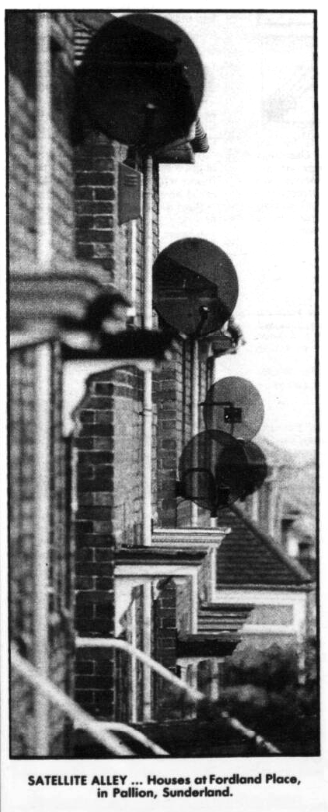
—Cf. also a British use of ‘satellite alley’.
The expression council-house television occurs, for example, in The Simpsons to WWF: the Sky TV Rishi Sunak would have missed out on, by Emily Dugan, published in The Guardian (London and Manchester, England) of Wednesday 12th June 2024:
While scouring his memory for the “lots of things” he missed out on as a child, Rishi Sunak plumped for Sky TV as his best example of hardship.
But the prime minister, who attended Winchester College boarding school, did not acknowledge the role that snobbery may have played in that choice. As satellite dishes multiplied across the country, Sky was derided by critics as “council house TV”—and many wealthier families demurred from more than four channels.
The following is from 50 facts about satellite television, an advertisement for Sky Television Network published in the Sunday Mirror (London, England) of Sunday 22nd October 1989 [page 18]:
1 Sky Television broadcasts from a satellite 23,000 miles above the earth.
2 The Sky network is made up of four different channels: Sky One, Sky Movies, Sky News and Eurosport.
[…]
7 The signals from the satellite are picked up by a dish-shaped aerial on your home.
[…]
14 The special aerial does not have to be on the front of your house. Some people have them on the side or back or in the garden. It simply has to have a direct line of sight to the satellite.
[…]
16 You can paint your aerial to make it blend in with the background if you wish.
[…]
20 Sky Television offers a special package at a cost of £4.49 a week. Sky provides a satellite aerial, a set-top receiver and a remote controller for changing channels. The price also includes a subscription to Sky Movies.
21 Standard installation is free. Sky will maintain equipment at no extra cost.
The earliest occurrences of the expression council-house television that I have found are as follows, in chronological order:
1-: From News in brief, published in the Evening Standard (London, England) of Monday 12th July 1993 [page 14, column 5]:
Sky goes upmarket for new image
SKY TV today attempted to shrug off the stigma of the satellite dish with a programme revamp across all six channels, writes Nicholas Hellen.
Programme chief David Elstein announced plans to replace sleazy imports on the network’s entertainment channel Sky One with more upmarket shows and declared: “This is not council house television.”
It now wants to be known for an open-air Pavarotti concert from Paris, a cookery series called The Urban Peasant, CBS evening news with Dan Rather and soap opera Paradise Beach.
2-: From In brief, published in the Press and Journal (Aberdeen, Aberdeenshire, Scotland) of Tuesday 13th July 1993 [No. 43,146, page 11, column 7]:
Viewers
SKY TV viewers tend to be male, aged 25 to 54, in the affluent ABC1 category 1 and with children at home, the satellite station said yesterday.
“This is not council house television,” BSkyB’s head of programming David Elstein claimed.
1 In Britain, ABC1 category designates the middle and upper-class society, presumed to have a higher level of disposable income.
3-: From Quick takes, published in the Evening Standard (London, England) of Wednesday 14th July 1993 [page 29, column 1]:
SKY Television is to spend £15 million in an advertising blitz this autumn in a bid to demolish its image as “Council House Television”. The three-month autumn campaign is the biggest Sky has ever mounted and rivals the money spent on the current BT share offer campaign starring Mel Smith’s Inspector Morose 2.
2 Inspector Morose (with the British comedian Mel Smith (1952-2013) in the title role) was a parody of the British television series Inspector Morse for the British Telecom share offer campaign of 1993.
4 & 5-: From The Guardian (London and Manchester, England) of Saturday 28th August 1993:
4-: From Murdoch has his eye on a richer pie—in the sky, by Lisa Buckingham [page 33, column 1]:
INTELLECTUAL derision has never bothered Rupert Murdoch very much. Cleverer by far than many of his critics, Mr Murdoch demonstrated with the Sun that catering for the masses was no impediment to his goal of massive profits—the tabloid is the most profitable English-language newspaper in the world.
Now, with what even its director of programmes has dubbed “council house television”, Mr Murdoch’s satellite TV operation, BSkyB, seems about to follow a similar gravity-defying profits path.
5-: [page 36]:
33 SATELLITE
‘Council house TV’ is set for profits stratosphere
6-: From MacKenzie warms to the Sky hot seat, by Nicholas Hellen and Tony Maguire, published in the Evening Standard (London, England) of Wednesday 2nd February 1994 [page 39, column 4]—Kelvin MacKenzie (born 1946) had just been appointed managing director of BSkyB:
The first bid he will authorise is likely to be a £20 million offer for a joint deal with the BBC to screen the Five Nations rugby championship. Next target will be Wimbledon, considered crucial to shaking off the “council-house TV” tag by converting the middle classes.
7-: From Birthday joy as satellite comes good, by Gary Welford, published in The Echo (Sunderland, Tyne and Wear, England) of Saturday 5th February 1994 [No. 37,941, page 7, column 2]:
Sky Television was launched five years ago today—and how it has grown!
From humble beginnings, more than 3.25 million people now subscribe to its sport, film, entertainment and news-led Multi Channel package.
More than a million homes a year are tuning in as viewers look for options to mainstream television.
The familiar dishes have sprung up in virtually every street, with some becoming “satellite alleys.”
[…]
But Sky wasn’t always one big success story. The early days were difficult, not least because of the competition from British Satellite Broadcasting (BSB).
[…]
All that ended when Sky and BSB merged, becoming British Sky Broadcasting (BSkyB). Huge losses were quickly turned into an operating profit, and it now makes £3 million a week.
At one time Sky had a reputation as “council house television”, due to the number of dishes its sales team sold to tower-block tenants.
But its image has changed, going decidedly upmarket, and it now reckons 70 per cent of its sales are to people in the middle class and upwards social bracket.
Photograph illustrating Birthday joy as satellite comes good, by Gary Welford, published in The Echo (Sunderland, Tyne and Wear, England) of Saturday 5th February 1994 [121st Year, No. 37,941, page 7, column 1]:
SATELLITE ALLEY … Houses at Fordland Place, in Pallion, Sunderland.
 word histories