
The Australian- and British-English derogatory and offensive slang phrase old boiler designates a middle-aged or elderly woman, especially one who is unattractive or unfeminine.
The reference is to the noun boiler, designating a tough old chicken for cooking by boiling—as opposed to the noun roaster, designating a young chicken suitable for roasting.
The Hungarian-born British food critic Egon Ronay (1915-2010) used both the nouns boiler and roaster in Spit Cookery Banishes Tough Chicken from Restaurants, published in The Daily Telegraph and Morning Post (London, England) of Wednesday 7th January 1959 [No. 32,262, page 9, column 2]:
The tough old boiler, thinly disguised as “roast poulard,” is on the way out from the average restaurant, and the ideal young 3lb roaster is served by the tens of thousands for 4s to 5s a portion.
The phrase old boiler has occasionally been applied to men—but, significantly, with positive connotations. These are three early examples:
1-: From the column Getting Around, by ‘Buzz’, published in The Sunday Sun (Sydney, New South Wales, Australia) of Sunday 18th November 1951 [No. 2,535, page 37, column 2]:
Jovial old boiler Jack Crawford wore a youthful line in neckwear.
2-: From The Senate in revolt, by Jonathan Gaul, published in The Canberra Times (Canberra, Australian Capital Territory, Australia) of Thursday 25th May 1967 [Vol. 41, No. 11,697, page 2, column 1]—here, the phrase old boiler is part of an extended metaphor:
IT often takes quite a time, but political chickens have a way of coming home to roost. The current crop was hatched back in 1963 by Sir Robert Menzies and they have now reappeared as rather formidable old boilers to disrupt the political comfort of his amiable successor, Mr Harold Holt.
3-: From Old boys’ reunion at Formby, by Leslie Edwards, published in the Liverpool Echo (Liverpool, Lancashire, England) of Tuesday 8th April 1969 [No. 27,777, page 15, column 9]:
Wales has sent three of its best and most distinguished ‘old boilers’ if they’ll excuse that ribaldry.
Preliminary note: According to the Oxford English Dictionary (OED – online edition, December 2023), the derogatory and offensive phrase old boiler—as applied to a middle-aged or elderly woman—was “originally British (now also Australian)”. This is probably because the earliest occurrence of this phrase that the OED has recorded is from The Observer (London, England) of Sunday 24th June 1962—cf., below, quotation 8. But, at least according to my own research, the phrase old boiler originated in Australia in 1950.
The earliest occurrences that I have found of the derogatory and offensive phrase old boiler—as applied to a middle-aged or elderly woman—are as follows, in chronological order:
1-: From They’re All A-Twitter Over That Posh Party, published in Truth (Sydney, New South Wales, Australia) of Sunday 1st January 1950 [No. 3,127, page 4, column 1]:
BETWEEN chews of caviar and sips of sparkling of champagne they can talk of nothing else but The Party.
More precisely, it’s what is alleged to have happened during The Party that has the Point Piper hens—old boilers and young pullets alike—clucking like broody Wyandottes.
2-: From 50-50 (Letterettes In Fifty Words), published in the Daily Telegraph and Daily News (Sydney, New South Wales, Australia) of Wednesday 15th November 1950 [Vol. 15, No. 203, page 21, column 5]:
Beauty
To “Have Pity”: Most middle-aged women go through a spring-chicken stage when they try to delay the ravages of time with facials, hair-do’s, and war paint. The pity of it all is they only fool themselves, because the average man can pick an “old boiler” a mile off.—“Spike”
3-: From 50-50 (Letterettes In Fifty Words), published in the Daily Telegraph and Daily News (Sydney, New South Wales, Australia) of Tuesday 21st November 1950 [Vol. 15, No. 207, page 23, column 5]:
Woman
To “Spike”: I am mutton dressed as lamb, not to attract the idiotic menfolk, the majority of whom are too dumb to gauge any woman’s age, but to appease the appetites of the critical and vicious females who look upon their ageing sisters as criminals to society.—“Old Boiler.”
4-: From the caption to the following cartoon, published in the Daily Telegraph and Daily News (Sydney, New South Wales, Australia) of Saturday 2nd February 1952 [Vol. 16, No. 270, page 2, column 4]:
“A couple of old boilers to see you, sir!”
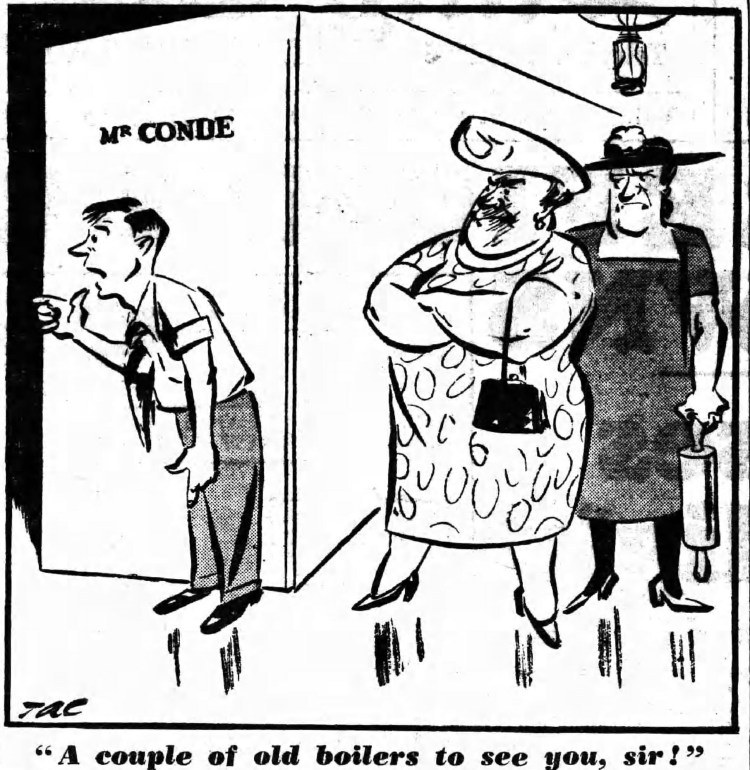
5-: From the column Life with Fatchen, by Max Fatchen, published in The News (Adelaide, South Australia, Australia) of Friday 16th January 1953 [Vol. 60, No. 9,185, page 10, column 5]:
It’s all so very fowl
SCIENTISTS report that fowls talk in a cluck-and-squawk code of remarkable meaning.
They can say “Hawk coming,” “Danger about,” or “Dinner’s ready.” How do we know they don’t say a whole heap of things.
Here’s a selection of possible chook chatter:—
[…]
“. . . Well, we all warned her about putting on weight and then along came Christmas. . . .”
“. . . If you ask me, she’s in with a lot of bad eggs. She’s been sitting on that nest for weeks.”
“. . . The way he thinks he can rule the roost. . . .”
“. . . And do you know what that hussy called me to my beak? She called me an old boiler. . . .”
6-: From The wrong place: Jimmy Derwent and I were in the rock-lifting business, a short story by D. McKinlay, published in the Daily Mirror (Sydney, New South Wales, Australia) of Wednesday 13th January 1954 [No. 3,934, page 27, columns 2 & 3]:
Jimmy was always a sucker for dames, but that didn’t worry me. What he did with his spare time and money was none of my business, and the dames didn’t interfere with his work. If anything, they made him keener because they kept him broke.
This Annie was Lady Mayview’s personal maid, it turned out.
“Boy,” Jimmy said to me one day over a schooner, “has that old boiler got some ice! Annie, she is always telling me about the rocks, the sparklers this old lady has. It ain’t right.”
[…]
His money ran out sooner than mine, what with the dames and the grog, and he was eager to do another job.
“What happened to Annie?” I asked.
“Just like all the rest,” he said. “We decided to be good friends and never see each other. I was a bit crooked on her because I gave her one of the old boiler’s necklaces worth about a grand or two at least.”
7-: From the column Society, published in The Bulletin (Sydney, New South Wales, Australia) of Wednesday 25th March 1959 [Vol. 80, No. 4,128, page 8, column 1]:
Lady bowlers are, as a rule, not in the first bloom of youth, but it’s sort of a tradition that, on the greens at any rate, they are referred to as “The Girls.” They have, on occasion, been referred to as cats, old hens and sergeant-majors—too often the boys and the girls are at loggerheads; some clubs have been rent asunder . . . But to get back to name-calling: a few of the girls were sitting in the ladies’ lounge at one licensed club, quietly and inoffensively chewing their beer, when the steward put his head through the serving-hatch and inquired in the most genial and matey way possible, “How are all my old boilers getting on? Ready for another round?” If, with “round,” he was thinking in boxing terms, he certainly came near to buying into a first-class bout. Some of the old boilers are still simmering, but not getting any more tender in their regard for that steward.—“Kitty Kat.”
8-: From Form in the fashion stakes, about fashion at Royal Ascot, a horse-race meeting held at Ascot, in Berkshire, by Katharine Whitehorn, published in The Observer (London, England) of Sunday 24th June 1962 [page 26, column 4]:
There were, of course, the usual horrors: the vast woman in shiny pink damask, the green suit with the orange hat with the brown shoes with the mink with the earrings with the handbag with the binoculars, and a good old boiler in a brown mac with a random assortment of nasturtiums secured to her head.
9-: From a review of Alfie (1966), a British film directed by Lewis Gilbert and starring Michael Caine—review by Russell Claughton, published in The Kensington News & West London Times (London, England) of Friday 9th December 1966 [No. 5,110, page 2, column 5]:
Alfie. Michael Caine as a selfish, insensitive womaniser, who cheerfully causes a lot of unhappiness to single birds, married birds, teenage scrubbers and old boilers, before idly philosophising that there isn’t much percentage for him in that sort of life.
10-: From a review of Tiger Trap in the Street, a television play by Michael Craig, broadcast on ITV on Saturday 22nd February 1969—review by Michael Beale, published in the Evening Chronicle (Newcastle-upon-Tyne, Northumberland, England) of Monday 24th February 1969 [No. 28,563, page 2, column 6]:
The play […] brought out certain frustrations of marriage, a partnership which had to continue, and which in the long run proved to be a not unsatisfactory arrangement. “You’re not a bad old boiler,” said Alan to his wife, when the party was over, and passions had subsided.
11-: From a review, by Colin Vann, of the television sitcom Nearest and Dearest, published in the Leicester Mercury (Leicester, Leicestershire, England) of Friday 15th May 1970 [page 8, column 3]:
Personally, I have found each and every episode irritating, including last night’s, the first of the new series.
The dialogue was trite in the extreme and the imbecilic facial expressions of Hylda coupled with such profound utterances as “knickers” uttered by Jewel served only to emphasise this unfortunate fact.
Possibly backchat liberally sprinkled with endearments like “you four-eyed twollop” [sic] and “you brainless, bow-legged old boiler” may still have some mysterious appeal I have yet failed to appreciate.
12-: From Swiss holiday: so much in so little time…, by Jean Pitts, published in the Worthing Herald (Worthing, Sussex, England) of Friday 19th June 1970 [No. 2,614, page 15, column 5]—French poulet à la grand-mère translates as chicken (prepared) in the style of grandmother:
Giggling with table companions at the menu which announced “poulet a la Grandmere”—does that mean we are going to have an “old boiler” (it does not, the food was excellent!).
13-: From How to Stay Young, by Mary Elen Coleman, published in The Australian Women’s Weekly (Sydney, New South Wales, Australia) of Wednesday 10th October 1973 [Vol. 41, No. 19, page 46, column 5]:
Even if you’re naturally thin, poor muscle tone will prevent your body looking trim because slack, soft flabby muscles give you that haggard, scrawny “old boiler” tag.
14-: From Notebook…, by Gibby Irvine, published in The Shetland Times (Lerwick, Shetland, Scotland) of Friday 22nd November 1974 [No. 47, page 10, column 5]:
Cut to interior of the Twit family’s palace. Edward reels unsteadily into the room after a busy day at the boardroom. He addresses an old boiler sitting on the sofa.
Edward: “Wooja lika drink, Mother?”
Mother: “New thenk yew, deah.”
15-: From the Liverpool Echo (Liverpool, Lancashire, England) of Tuesday 25th March 1975 [No. 29,600, page 1, column 1]:
A DECISION by Australia’s 1,600 domestic air hostesses to continue a strike over pay, has brought a swift retort from airline magnate, Sir Reginald Ansett. He branded the strike leaders as “a batch of old boilers” and said of the girls: “Frankly we don’t need them. They are only glorified waitresses . . . We can bloody well do without them.”
16-: From Air hostesses remain out, published in The Canberra Times (Canberra, Australian Capital Territory, Australia) of Wednesday 26th March 1975 [Vol. 49, No. 14,023, page 7, column 4]:
The hostesses were particularly infuriated yesterday at a reported reference to them by Sir Reginald Ansett as “a batch of old boilers”, a remark which led to the appearance of a sign outside the hostesses room at the Ansett terminal at Tullamarine, Melbourne, designating it “the Boiler Room”.
17-: From the column All their own work, published in The Bulletin (Sydney, New South Wales, Australia) of Saturday 5th April 1975 [Vol. 97, No. 4,951, page 11, column 3]:
They are a batch of old boilers sitting on their executive. Frankly I’ve had them. We can run our airline without people to serve drinks.
Sir Reginald Ansett on the striking air hostesses.
18-: From the column People, by Ron Saw, published in The Bulletin (Sydney, New South Wales, Australia) of Saturday 26th November 1977 [Vol. 99, No. 5,085, page 46, column 3]:
The good old IBS [i.e., International Bachelors’ Society] issued its list of the Ten Most Exciting Women of 1977: Princess Grace of Monaco, Mireille Mathieu, Chris Evert, Jacqueline Onassis, Ali MacGraw, Melina Mercouri, Lady Antonia Fraser, Tina Turner, Empress Farah Diba of Iran and Regine. And that list revealed little but, possibly, incipient necrophilia. Because apart from Mathieu, the French singer, who is 31, and Evert, 22, the other ladies are, well, the nettle must be grasped—old boilers. Grace is 48, MacGraw 38, Mercouri 54, Farah 37, Onassis 48, Turner 37, Fraser 45 and Regine has been around long enough, and is now rich enough, to be able to keep her age to herself. Nobody was suggesting that middle age reduced a woman’s exciting qualities—it just cuts down the field of potential excitees.
 word histories