Like Jack, pet form of John, Joe, familiar abbreviation of Joseph, is colloquially used as a generic term for a lad, a fellow, a chap. And, like Joe Blow, Joe Citizen, Joe Doakes and Joe Six-Pack in American English, Joe Soap and Joe Bloggs in British English are generic names for an average man. —Cf. also Onion Johnny. These are the earliest […]
The word cheese is from Old English cēse, cȳse, of West-Germanic origin; it is related to its Dutch and German equivalents kaas and Käse respectively. Those words are ultimately derived from Latin caseus, cheese, which is also the origin of: – Spanish queso – Portuguese queijo – regional Italian cacio – Romanian: caș. Based on […]
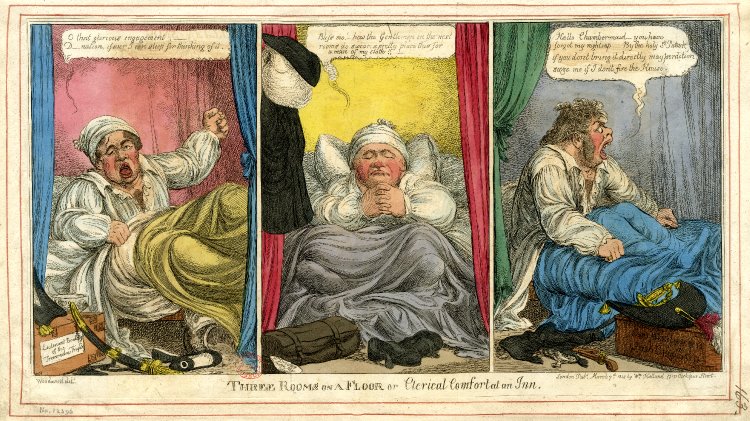
A nightcap is a cap worn in bed to keep one’s head warm. The word is first recorded in the description and valuation, made in 1378, of the articles that were in the shop of Thomas Trewe, haberdasher of London: one dozen of white caps, called “nightcappes”, was worth 2s. 3d.. The figurative […]
MEANING The phrase (straight) from the horse’s mouth refers to information and means from the person directly concerned or another authoritative source. ORIGIN This phrase is from horse racing, and alludes to the presumed ideal source for a racing tip. The earliest instance that I have found is from Bell’s Life in […]
Tip-Cat in A Little Pretty Pocket-Book, Intended for the Instruction and Amusement of Little Master Tommy, and Pretty Miss Polly (1787 edition) The phrase to see which way the cat jumps means to see what direction events are taking before committing oneself. One of its earliest instances is from The Berkshire Chronicle […]
Aunt Sally – from The Modern Playmate: A book of games, sports, and diversions for boys of all ages (new revised edition – 1875?), by John George Wood (1827-89) The Oxford English Dictionary (first edition – 1885) thus defined Aunt Sally: a game much in vogue at fairs and races, in which […]
MEANING in the open; without dishonesty, concealment or fraud ORIGIN The adverb above board originally meant with one’s cards visible above the level of the board (that is, the playing table), so as to avoid suspicion of cheating. In A Dictionary of the English Language (1755), Samuel Johnson wrote: Above-board. In open […]
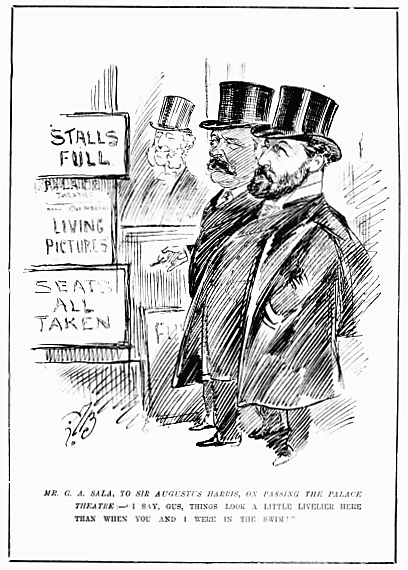
G. A. SALA, TO SIR AUGUSTUS HARRIS, ON PASSING THE PALACE THEATRE:—“I SAY, GUS, THINGS LOOK A LITTLE LIVELIER HERE THAN WHEN YOU AND I WERE IN THE SWIM!” — from The Entr’acte and Limelight (London) of 10th March 1894 (Augustus Harris (1825-73) was a British actor and theatre manager. George Augustus Sala (1828-95), was an […]
MEANINGS – attractive articles of little value or use – practices or beliefs that are superficially or visually appealing but have little real value or worth ORIGIN The noun trumpery, first recorded in the mid-15th century, is from the French noun tromperie, which means deception, trickery. This was one of the original meanings in […]
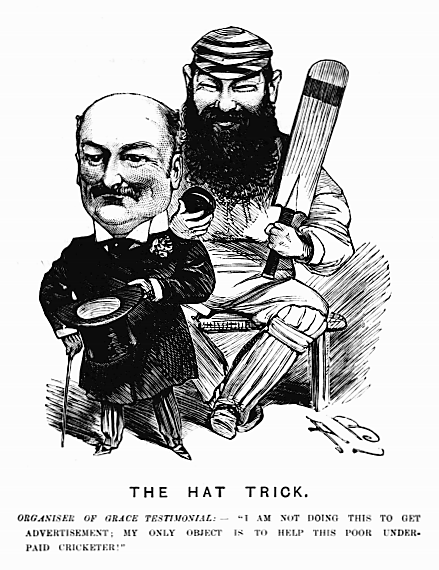
THE HAT TRICK. ORGANISER OF GRACE TESTIMONIAL: — “I AM NOT DOING THIS TO GET ADVERTISEMENT; MY ONLY OBJECT IS TO HELP THIS POOR UNDERPAID CRICKETER!” caricature from The Entr’acte & Limelight (London) – 22nd June 1895 In 1895, a testimonial fund was set up for W. G. Grace (1848-1915), the Grand Old Man […]