“HUNS KILL WOMEN AND CHILDREN!” “TELL THAT TO THE MARINES!” First-World-War US recruiting poster by James Montgomery Flagg image: Disappearing Idioms This poster, which attracted a great deal of attention, portrays an angry-looking young man in the act of pulling off his coat as though he were anxious to get into a fight. The […]
The French phrase cherchez la femme, search for the woman, is used to indicate that the key to a problem or mystery is a woman, and that she need only be found for the matter to be solved. It first appeared as a catchphrase used by M. Jackal, a police detective, in Les Mohicans de Paris, […]
The phrase far from the madding crowd is used in reference to a private or secluded place. It is an allusion to An Elegy wrote in a Country Church Yard (published in 1751), by the English poet Thomas Gray (1716-71). When he composed this poem, Thomas Gray was living near St Giles’ parish church at Stoke Poges in Buckinghamshire. Meditating […]
The expression knight in shining armour denotes a person regarded as a medieval knight in respect of his chivalrous spirit, especially towards women. In A Concise Dictionary of Phrase and Fable (1993), B. A. Phythian explained: Despite its medieval feel, this is a twentieth-century phrase, first recorded in print in Victor Canning’s Whip Hand (1965). […]
The noun fly-by-night, or fly-by-nighter, denotes an unreliable or untrustworthy person. As an adjective, fly-by-night means unreliable or untrustworthy, especially in business or financial matters. However, the term seems to go back to the idea of witches flying on their broomsticks by night. At least, its first recorded instance is as a term of contempt […]
The compound apple-pie order means perfect order or neatness. Its first known user was a British Royal Navy officer, Admiral Sir Thomas Pasley (1734-1808), in his journal in 1780: Exercised Great Guns and small Arms as I constantly do every Tuesday and Friday, and fired Volleys; Wash and Fumigate, Wednesdays and Saturdays, Air Spare Sails […]
The phrase a skeleton at the feast, or at the banquet, denotes a person or event that brings gloom or sadness to an occasion of joy or celebration. This was originally an allusion to the practice of the ancient Egyptians, as recorded by the Greek biographer and philosopher Plutarch (circa 46-circa 120) in The Dinner of the Seven Wise […]
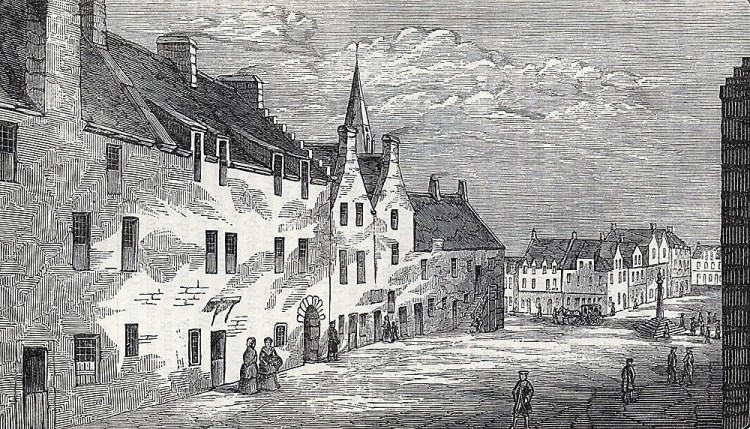
the Rotten-row in Glasgow, circa 1570 image: The Glasgow Story The street name Rotten Row occurs in many different towns. For example, The Caledonian Mercury (Edinburgh) of 10th December 1728 published the following advertisement: There is just come to Leith, a Parcel of fine Figs both in Casks and Frails [= baskets], […]
The phrase at sixes and sevens means in a state of total confusion or disarray. Based on the language of dicing, the phrase was originally to set (all) on six and seven. It denoted the hazard of one’s whole fortune, or carelessness as to the consequences of one’s actions. From this earlier association with reckless behaviour came the idea that things in […]