MEANINGS – attractive articles of little value or use – practices or beliefs that are superficially or visually appealing but have little real value or worth ORIGIN The noun trumpery, first recorded in the mid-15th century, is from the French noun tromperie, which means deception, trickery. This was one of the original meanings in […]
The phrase to teach one’s grandmother to suck eggs means to presume to advise a more experienced person. Raw eggs, with or without a little seasoning, used to be a popular food and were regarded as healthy. Grandmothers obviously needed no instruction about how to drink them. The phrase is first recorded in a translation from Spanish by […]
MEANING the depths of one’s conscience or emotions ORIGIN This anatomically curious but firmly established expression is a variant of the older and more comprehensible heart of heart, meaning very centre of the heart, which was coined by the English poet and playwright William Shakespeare (1564-1616) in The Tragicall Historie of Hamlet, […]
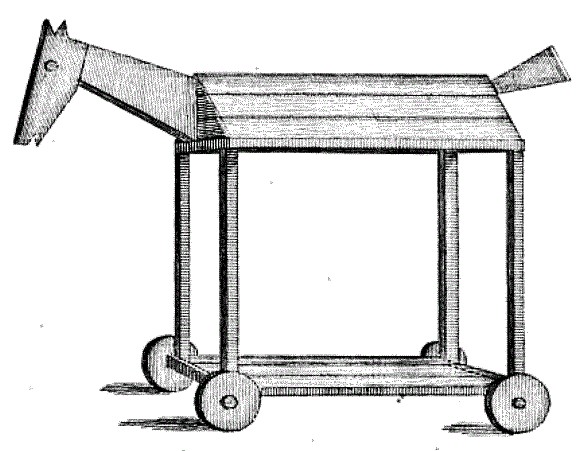
The phrase a horse that was foaled of an acorn denoted the gibbet, sometimes also called triple tree. In A Collection of English Proverbs (1678), the English naturalist and theologian John Ray (1627-1705) wrote: You’ll ride on a horse that was foal’d of an acorn. That is the gallows. Pelham; or, The Adventures […]
MEANING of payments: without delay ORIGIN This expression refers to the fingernail and might originally have alluded to drinking fair and square. A clue might be provided by the French phrase payer rubis sur l’ongle (literally to pay ruby on the fingernail), which means to pay exactly what is due. (A variant, used by prostitutes, was rubis sur pieu, […]
The expression short shrift means brief and unsympathetic treatment, and to make short shrift of means to dispose of quickly and unsympathetically. A short shrift was originally a brief space of time allowed for a criminal to make his or her confession before execution. The expression is first recorded in The Tragedy of King Richard […]
Witham is the name of several villages in Lincolnshire and Essex. With a pun on wit, the expression little, or small, Witham was used proverbially for a place of which the inhabitants were remarkable for stupidity. For example, the following, from A fourth hundred of epygrams (1560) by the English playwright and epigrammatist John Heywood […]
Among other figurative meanings, the adjective thick has the sense of close in confidence and association, intimate, familiar. In Literary Anecdotes of the Eighteenth Century, published in 1812, John Nichols quoted Edmund Law (1703-87), Bishop of Carlisle: “Yes,” said he, “we begin now, though contrary to my expectation, and without my seeking, to be pretty thick; and I thank God, who reconciles me to […]
The phrasal verb shell out means to pay a specified amount of money, especially one regarded as excessive. It is first recorded in Moral tales for young people (1801), by the Anglo-Irish novelist and educationist Maria Edgeworth (1768-1849): “One of you, it’s plain, must shell out your corianders.” (The word coriander (or coliander), short for coriander-seed (or coliander-seed), was slang for coin, money. The form coliander-seed, […]
The obsolete adjective hail meant free from injury, infirmity or disease. It is from Old Norse heill, meaning whole, hale, sound. This Old Norse word is related to the English adjectives whole and hale, which are doublets, as they are both from Old English hāl. The current spelling of whole, which first appeared in the […]