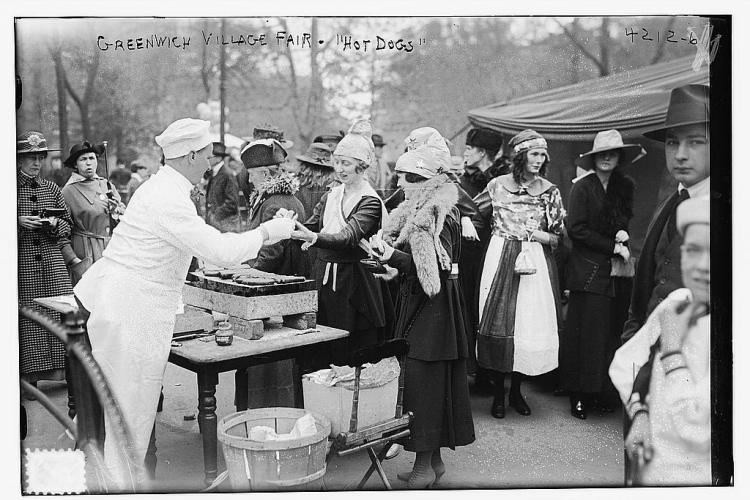
Greenwich Village Fair – “Hot Dogs” – June 1917 photograph: Library of Congress The term hot dog denotes a sausage, especially a frankfurter, served hot in a long roll split lengthways. In US slang, the noun dog has been used to denote a sausage since the late 19th century. This usage is first recorded […]
A blend of turkey, duck and chicken, the noun turducken designates a poultry dish consisting of a boned chicken inside a boned duck which is in turn placed inside a partially boned turkey, along with seasoned stuffing between the layers of meat and in the central cavity, the whole typically being cooked by roasting. It […]
Eastern Vaudeville Bans Unseemly Slang A general order has been sent out from the Keith office to all Keith, Moss and Proctor vaudeville houses, instructing resident managers to hereafter bar the use by artists of the current slang phrases, “That’s the Cat’s Meow,” “Cat’s Pajamas,” “Hot Dog,” “Hot Cat,” etc. This means the phrases […]
In the USA, cocked hat denoted a game similar to ninepins, except that only three pins were set up, in triangular position. It took its name from cocked hat in the sense of a hat with the brim permanently turned up (i.e. cocked), especially the three-cornered hat of this shape worn at the end […]
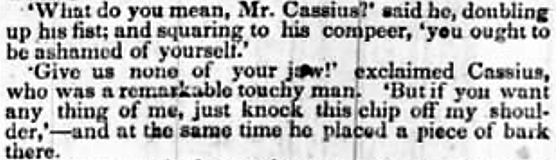
The phrase a chip on one’s shoulder means a challenging or belligerent attitude. In A Concise Dictionary of Phrase and Fable (1993), B. A. Phythian explains: There is an unusual degree of unanimity about the provenance of have a chip on one’s shoulder (bear a grudge; behave anti-socially). Unlikely as it may seem, […]
Of American-English origin, the phrase to look, or to feel, like something the cat has brought in means to look, or to feel, exhausted or bedraggled. The earliest instances of the form, if not of the phrase, that I have found are in, and as the title of, a story published in The Perrysburg Journal (Perrysburg, Ohio) of 2nd February 1877 […]
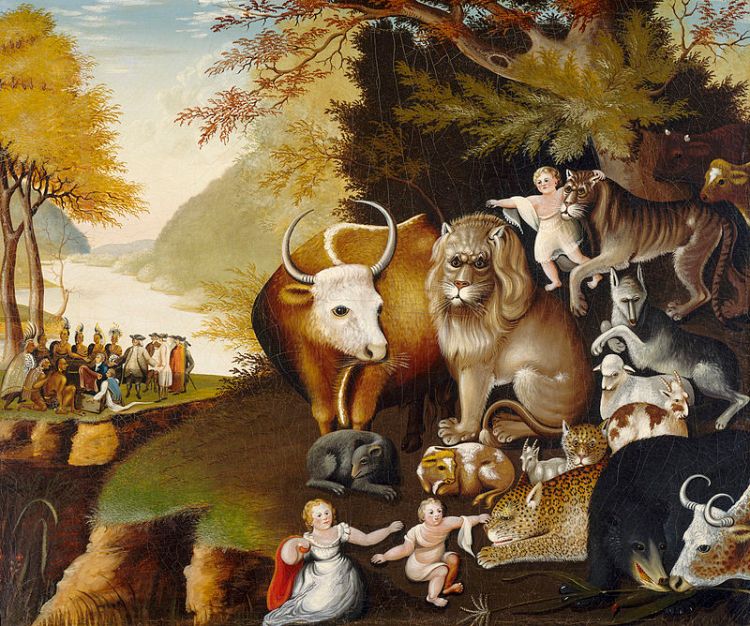
one of the versions of The Peaceable Kingdom (circa 1834), by Edward Hicks image: National Gallery of Art (Washington DC) The expression peaceable kingdom, in the sense of a state of harmony among all creatures as prophesied in the Book of Isaiah, 11:1-9, first appeared in the King James Version (1611): […]
The phrase like a cat on hot bricks and its American-English equivalent like a cat on a hot tin roof mean very agitated or anxious. An earlier form of the phrase was recorded by the English naturalist and theologian John Ray (1627–1705) in A Collection of English Proverbs (2nd edition – 1678): To go like […]
Of American-English origin, the expression to have an axe to grind (American-English spelling ax) means to have a private reason for doing, or being involved in, something. It has often been attributed to Benjamin Franklin [note 1]. For example, the New English Dictionary (NED – 1888), as the Oxford English Dictionary was known, mentions “a […]
MEANING The phrase to be barking up the wrong tree means to be pursuing a mistaken or misguided line of thought or course of action—cf. also origin of ‘gone coon’. ORIGIN In Americanisms, Old and New. A Dictionary of Words, Phrases and Colloquialisms peculiar to the United States, British America, the West Indies, […]