The phrase trick or treat is a traditional formula used at Hallowe’en by children who call on houses threatening to play a trick unless given a treat or present. In early use, the phrase was also tricks or treats, treat or trick, and variants. This phrase seems to have originated in Ontario (capital: Toronto), a province of […]
The phrase (as) happy as a clam means well pleased, quite contented—cf. also happy as a sandboy and happy as Larry. In Dictionary of English Phrases (2008), Robert Allen explains: This American simile is more understandable in its full form, happy as a clam in high water (or at high tide). In these conditions, clams […]
“HUNS KILL WOMEN AND CHILDREN!” “TELL THAT TO THE MARINES!” First-World-War US recruiting poster by James Montgomery Flagg image: Disappearing Idioms This poster, which attracted a great deal of attention, portrays an angry-looking young man in the act of pulling off his coat as though he were anxious to get into a fight. The […]
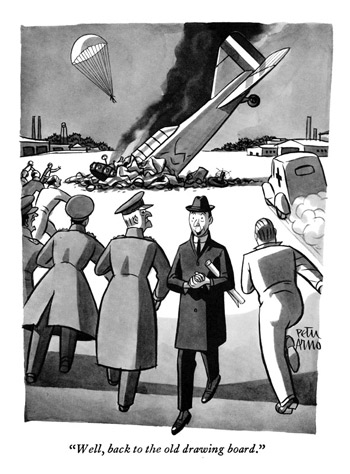
MEANING The phrase back to the drawing board is used to indicate that an idea, scheme or proposal has been unsuccessful and that a new one must be devised. ORIGIN This phrase originated in a cartoon by the U.S. cartoonist Peter Arno (Curtis Arnoux Peters, Jr – 1904-68), published in The New […]
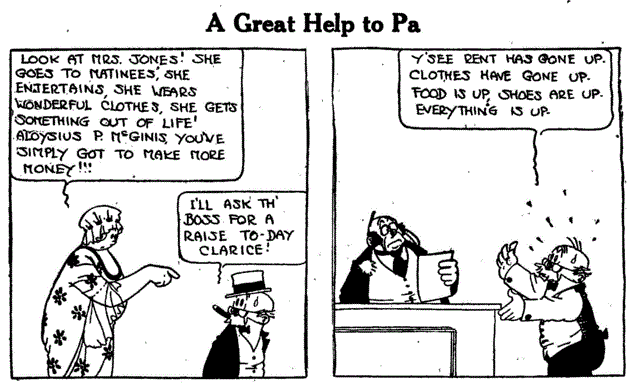
from Keeping Up With The Joneses (Cupples & Leon Company – New York, 1920) by ‘Pop’ Momand MEANING If you say that someone is keeping up with the Joneses, you mean that they are doing something in order to show that they have as much money as other people, rather than because […]