In British slang, the noun ‘piss-up’ denotes ‘a heavy drinking bout’, and the phrase ‘couldn’t organise a piss-up in a brewery’ and variants mean ‘is’, or ‘are’, or ‘am’, ‘incapable of organising the simplest event, task, etc.’—phrase first recorded in 1980.
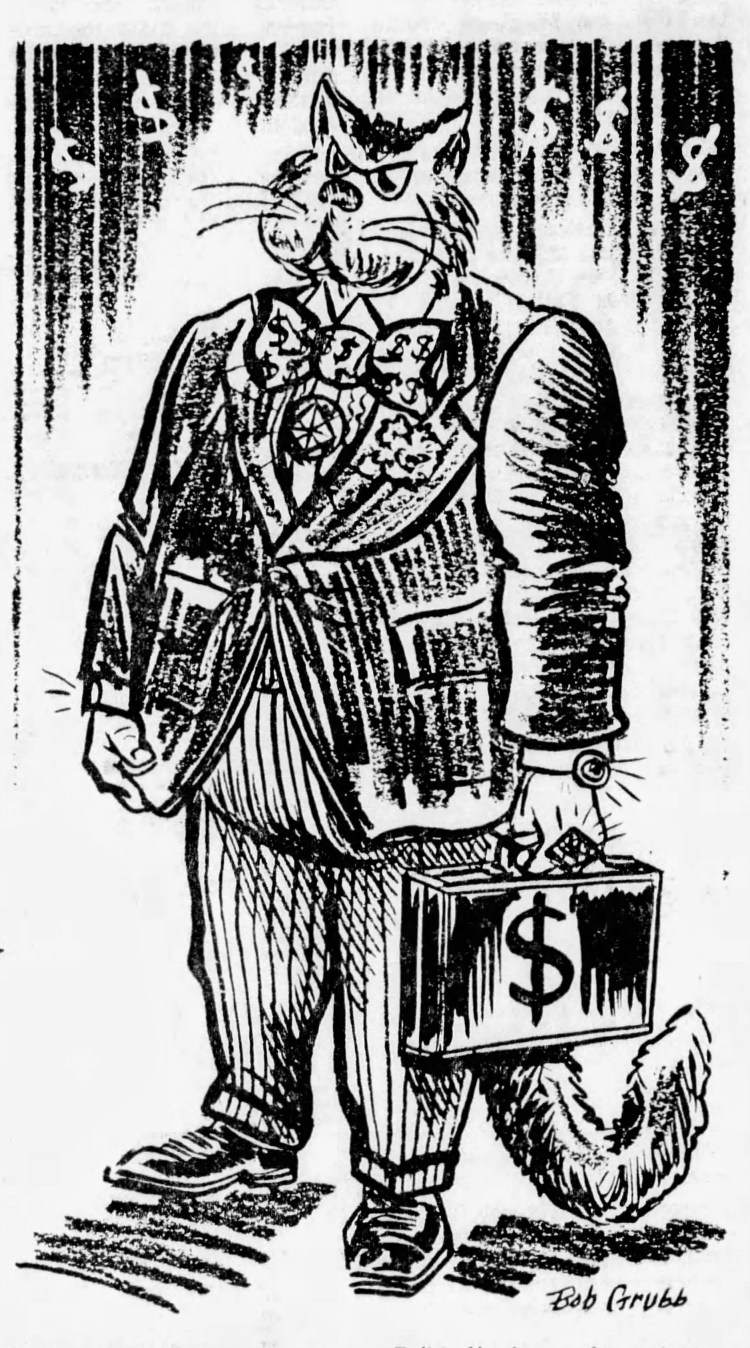
Of American-English origin, the slang term fat cat denotes a wealthy, influential person, especially one who is a heavy contributor to a political party or campaign. The earliest occurrence that I have found is from an article published in The Sun (Baltimore, Maryland) of 1 November 1925.
The noun red tape, meaning excessive bureaucracy or adherence to official rules and formalities, refers to the use of woven red tape to tie up bundles of legal documents and official papers; the literal meaning is first recorded in 1658, the figurative meaning in 1736.
The phrase to chop and change means to change one’s opinions or behaviour repeatedly and abruptly. Here, chop originally meant to barter, and change meant to make an exchange with; in other words, this was an alliterative repetitive expression, the two verbs having roughly the same meaning (cf. also, for example, the alliterative phrase to be part and […]
The phrase ‘to go to pot’ means ‘to be ruined or destroyed’, ‘to go to pieces’, ‘to deteriorate through neglect’. The allusion is to the cutting up of meat into pieces ready for the cooking-pot, as several 16th-century texts make clear.
First recorded in The Bystander (London) on 24 January 1906, this French phrase means ‘hobby, pastime’; it refers to the passion that the French painter Jean Auguste Dominique Ingres (1780-1867) had for playing the violin.
‘Hobby’, diminutive of ‘Hob’, pet form of ‘Robert’, was used to denote a small horse, hence a child’s toy with a horse’s head, hence a favourite occupation—cf. French ‘dada’, child’s word for horse, used to denote a favourite pastime
Twelfth Day denotes the twelfth day after Christmas, i.e. 6th January, on which the festival of the Epiphany is celebrated, and which was formerly observed as the closing day of the Christmas festivities. (Epiphany denotes the festival commemorating the manifestation of Christ to the Gentiles in the persons of the Magi; via Old-French and Anglo-Norman forms such as epyphane (Modern […]
early 20th century—‘Zeppelins in a cloud’ and variants mean ‘sausage and mash’—during World War One, the phrase was used as a manner of disregarding the fear caused by the bombing raids carried out by Zeppelin airships



 word histories