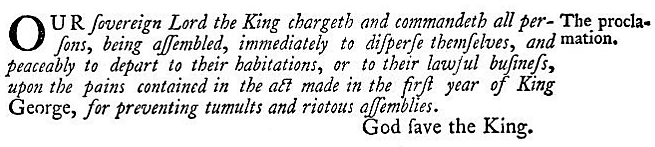
Our sovereign Lord the King chargeth and commandeth all persons, being assembled, immediately to disperse themselves, and peaceably to depart to their habitations, or to their lawful business, upon the pains contained in the act made in the first year of King George, for preventing tumults and riotous assemblies. […]
The colloquial terms bag of mystery and mystery bag denote a sausage, a saveloy. The British lexicographer John Stephen Farmer (1854-1916) gave the following explanations in Slang and its Analogues Past and Present ([London]: Printed for subscribers only, 1890): Bags of mystery (common).—Sausages and saveloys are so called—from the often mysterious character of their compounds. Presumably composed […]
The expression to amputate one’s mahogany is a jocular elaboration on to cut one’s stick, which means to take one’s departure. The following definition is from A Dictionary of Modern Slang, Cant, and Vulgar Words (2nd edition – 1860), by the English publisher and author John Camden Hotten (1832-1873): Cut one’s stick, to be off […]
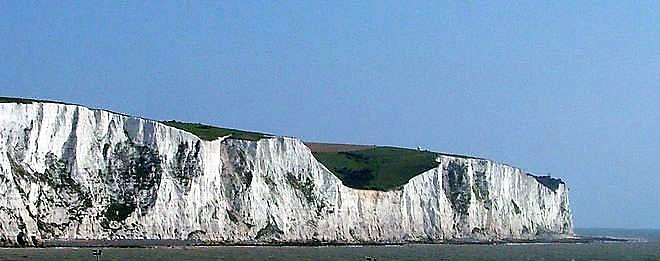
The white cliffs of Dover— to which the name Albion did not originally refer [cf. note]. (photograph: Wikimedia Commons/Fanny) The name Albion first appeared in English in the very first sentence of the first Book of the 9th-century translation of Historia ecclesiastica gentis anglorum (The Ecclesiastical History of the English People) originally written by the English monk, […]
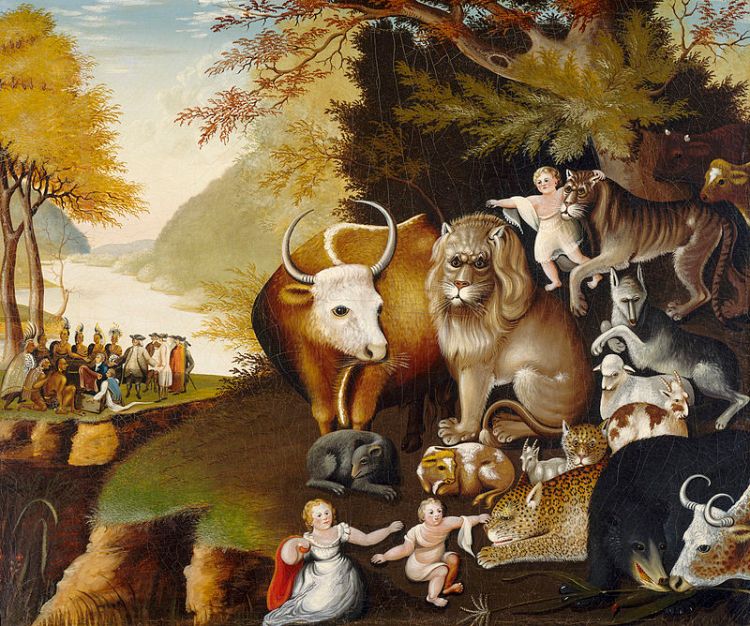
one of the versions of The Peaceable Kingdom (circa 1834), by Edward Hicks image: National Gallery of Art (Washington DC) The expression peaceable kingdom, in the sense of a state of harmony among all creatures as prophesied in the Book of Isaiah, 11:1-9, first appeared in the King James Version (1611): […]
A New Song, sung by Mr. Champness in Harlequin’s Invasion from The Universal Magazine of Knowledge and Pleasure – March 1760 The phrase heart of oak denotes a person with a strong, courageous nature, especially a brave and loyal soldier or sailor, and a courageous or valorous spirit. Its literal meaning is the heartwood of the oak. The heartwood […]
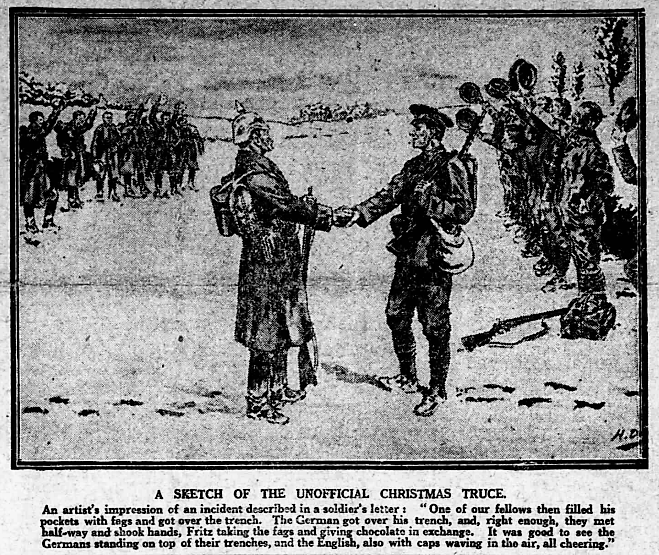
A SKETCH OF THE UNOFFICIAL CHRISTMAS TRUCE. An artist’s impression of an incident described in a soldier’s letter: “One of our fellows then filled his pockets with fags and got over the trench. The German got over his trench, and right enough, they met half-way and shook hands, Fritz taking the fags and giving […]
the Prisoners (Temporary Discharge for Ill-health) Act, 1913 – image: http://www.parliament.uk The Prisoners (Temporary Discharge for Ill-health) Act, 1913 was rushed through Parliament by Herbert Henry Asquith’s Liberal government in order to deal with the problem of hunger-striking suffragettes, who were force-fed, which led to a public outcry. The Act allowed for the […]
The phrase not a cat in hell’s chance means no chance at all—synonyms: a snowball’s chance (in hell) and a Chinaman’s chance. It is a shortening of the more explicit no more chance than a cat in hell without claws. The earliest instance of this phrase that I have found is from Jackson’s Oxford Journal of 29th September 1753: Poor […]
The Italian noun gianduia (improperly gianduja) appeared in the 19th century to denote a soft confection made with chocolate and ground hazelnuts, first produced in Turin, the capital of Piedmont, a region in north-western Italy, in the foothills of the Alps. (The Italian name is Piemonte, from piede, foot, and monte, mount.) This confection was […]


 word histories