a violent street gang armed with razors—in extended use, a group or body responsible for making cutbacks—in particular: 1) (British English, railway slang): a team of investigators seeking ways of improving economy and productivity; 2) (Australian English) a parliamentary committee charged with investigating and reducing government spending
with reference to the Jewish prohibition of the eating of pork—‘as scarce as pork chops in a Jewish boarding house’ (USA, 1907) means ‘extremely rare’—‘like a pork chop in a synagogue’ (USA, 1915) means ‘out of place’; also ‘unwelcome’ or ‘unpopular’
Australia, 1985—a person who espouses socialist ideals while enjoying a wealthy lifestyle—coined after the synonymous expression ‘champagne socialist’—popularised by Emerald City (1987), by the Australian playwright David Williamson
Australia, 1930—a humorous extended form of ‘flat out’, meaning ‘with the maximum speed or effort’ (apparently with wordplay on ‘flat out’, meaning ‘lying stretched out’)—has occasionally been used in the opposite sense
Australia, 1972—a person, usually a man, who, in spite of a superficial smartness, is untrustworthy—‘rat’ refers to a deceitful or disloyal man—the image is that, despite the gold tooth, a rat’s basic nature cannot change
Australia, 1928—an outstandingly good person or thing—variant of the synonymous jocular expressions, of U.S. origin, based on various parts of animals’ real or fanciful anatomy and other attributes, such as ‘the bee’s knees’ and ‘the cat’s whiskers’
Australia, 1935—meaning: ‘to deliberately ignore someone’s presence, request, etc.’—has erroneously been said to have originated in army slang during the Second World War
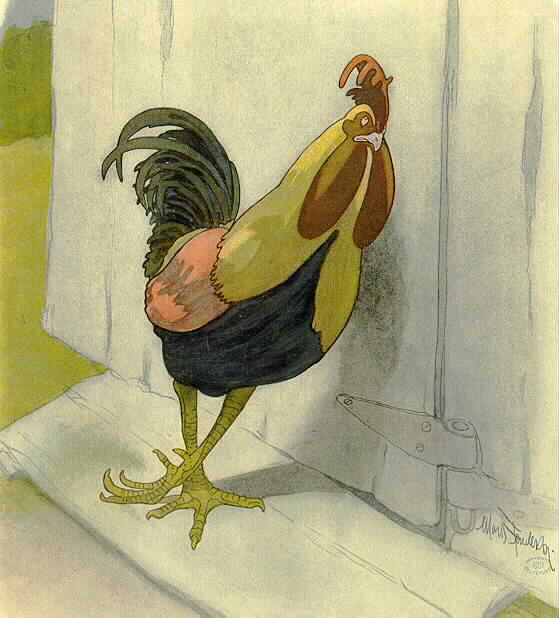
USA 1907—used of the inanity of life and of the transitoriness of success—originated in the captions to a cartoon known as ‘The Dejected Rooster’, by Mark Fenderson, published by the weekly magazine Life (New York City) in 1907