
[A humble request: If you can, please donate to help me carry on tracing word histories. Thank you.]
The noun corkscrew is used as a modifier, with the sense spirally twisted, in the expressions corkscrew curl and corkscrew ringlet.
—Cf. also the expressions beau-catcher, kiss-curl, kiss-me-quick (curl) and kiss-me-quick (bonnet).
The expression corkscrew curl occurs, for example, in the following from Oliver Twist ; Or, The Parish Boy’s Progress (London: Richard Bentley, 1838), by the English novelist Charles Dickens (1812-1870) [volume 2, chapter 22, page 35]:
He was dressed in a smartly-cut snuff-coloured coat with large brass buttons, an orange neckerchief, a coarse, staring, shawl-pattern waistcoat, and drab breeches. Mr. Crackit (for he it was) had no very great quantity of hair, either upon his head or face, but what he had was of a reddish dye, and tortured into long corkscrew curls, through which he occasionally thrust some very dirty fingers ornamented with large common rings.
These are, in chronological order, the earliest occurrences of the expressions corkscrew curl and corkscrew ringlet that I have found:
1-: From an account of the reception that was given at St. James’s Palace, London, on Saturday 4th June 1803, for the birthday of George III (1738-1820), King of Great Britain and Ireland from 1760 to 1820—account published in The Morning Post (London, England) of Monday 6th June 1803 [page 3, column 4]:
—Note: The expression corkscrew curl was already in usage since this text specifies that “the corkscrew curls […] are abolished”:
NEW FASHIONS.
The prevailing colours were lilac and pale blue: more white than usual was worn, and flowers were in extraordinary abundance; much British lace was also seen, which, for beauty, surpasses Brussels. The head dresses almost universally consisted of feathers and jewels, few caps being worn. The feathers were large ostrich ones, drooping on the side of the head, the ends falling on the neck: the hair is still dressed in the Grecian stile, long beads and bows of hair; the corkscrew curls and round beads are abolished.
2-: From Extracts of a Letter from Paris, published in The St. James’s Chronicle: Or, British Evening-Post (London, England) of Saturday 7th January 1804 [page 2, column 2]:
As for our fashions, they are so changeful, that one can hardly detect them. Our young bucks have laid by their pantaloons; and a few have adopted their old spencers. A full dress for the ladies is muslin, embroidered with gold or silver; black crape, or white satin. Ninon head-dresses sometimes are worn; they shew the forehead partially, and hanging down in long corkscrew curls. There are some pretty diadems composed of rose leaves, studded with roses.
3-: From Opera Observations, in a Letter from Eliza to Julia, published in La Belle Assemblée, or, Bell’s Court and Fashionable Magazine (London, England) of December 1806 [page 614, column 1]:
My hair was dressed in a full but plain band on the forehead, so as entirely to expose my ears; the hind part was braided, and formed in a knot; the ends falling in corkscrew curls on the left side of my neck; a row of fine pearl was twisted once through the band in front, and finished by being entwined in the braid behind.
4 & 5-: From Explanation of the Prints of Fashion, published in La Belle Assemblée, or, Bell’s Court and Fashionable Magazine (London, England) of January 1807:
4-: [page 49, column 1]:
ENGLISH COSTUME.
[…]
No. 2.—Full Dress.[…] The hair twisted in a fanciful form, and short corkscrew curls flowing at the temples, and in various directions from the crown of the head; a tiara of fine pearl blended with the hair, and placed rather towards the left side.
5-: [page 49, column 2]:
PARISIAN COSTUME.
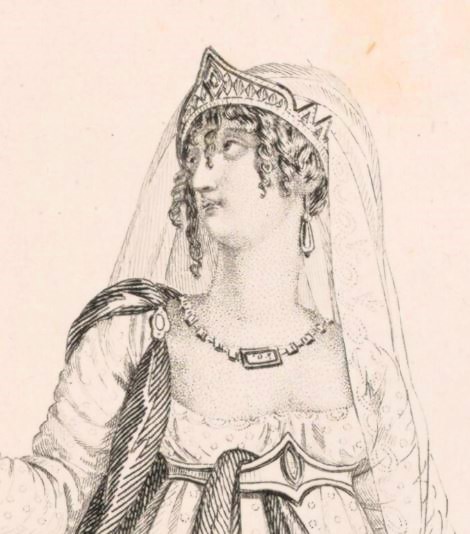
No. 3.—Madame Catalani.[…] A Grecian diadem, of gold, and brilliants. A square Brussels veil of the most transparent texture, lightly embroidered in gold, fixed at the back of the diadem, and flowing negligently over the left arm. Hair close cropt behind, falling in irregular corkscrew ringlets in front and on the sides.
The following is a detail from the “print of fashion” that the above-quoted description of Madame Catalani’s costume refers to—from La Belle Assemblée, or, Bell’s Court and Fashionable Magazine (London, England) of January 1807 [page unnumbered]:
6-: From Fashions for December, 1807. Ladies’ Dresses, published in Le Beau Monde, or, Literary and Fashionable Magazine (London, England) of November 1807 [page 214, column 1]:
The hair in a plain band on the left side of the forehead, with a few loose waves on the other; two large corkscrew curls, falling from the front of the right side of the head towards the shoulder; with coronet combs of pearls to secure the hair behind in separate forms.

