
[A humble request: If you can, please donate to help me carry on tracing word histories. Thank you.]
In soccer (i.e., the game of football as played under the rules of the Football Association), the expression bicycle kick designates an overhead kick, typically executed with the feet off the ground and often involving a shot at goal.
This expression occurs, for example, in the caption to the following from the long-running Playboy! series, by the British cartoonist David Rowe (1924-2004), published in the Daily Mirror (London, England) of Monday 20th December 1976 [page 26, column 6]:
“He didn’t know he could do the bicycle kick either until he got on that icy patch!”
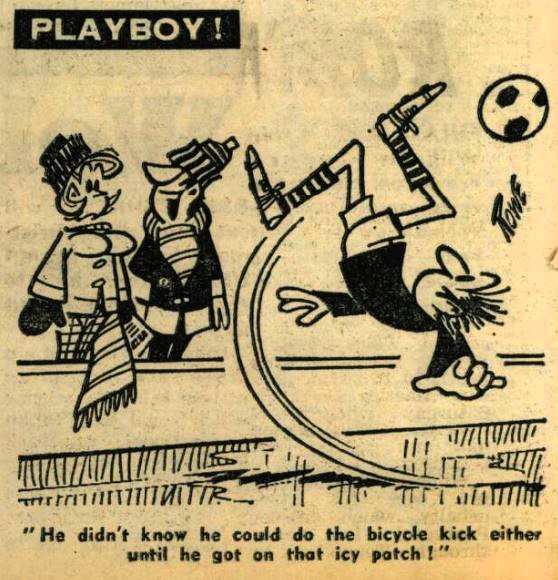
—Cf. also the soccer expression Cruyff turn.
These are, in chronological order, the earliest occurrences of the soccer expression bicycle kick that I have found:
—Note: The expression was originally aerial bicycle kick:
1-: From Sports Review, published in the Newcastle-under-Lyme Times (Newcastle-under-Lyme, Staffordshire, England) of Friday 18th May 1951 [page 7, column 3]:
Two football tricks which were new to the Victoria Ground were brought by the Dutch team from Schiedam. One was “the aerial bicycle kick” and the other was the long-range free-kick hit “across the seam.”
[…]
The aerial bicycle kick is a South American invention which turns bad centres into goals. We have some players who, when a ball is passing in front of them, can dive torpedo-fashion and connect with their heads when horizontal in mid-air, face downwards.
This trick is exactly the opposite. A too-square centre may be passing behind a forward. He launches himself into the air until he is horizontal, face upwards, and with a scissors kick hooks the ball over his body in the direction his head is pointing—which is goal.
Leonidas, centre-forward of Brazil, scores goals with this effort nearly every week. The “Athletic News” has a remarkable picture of him, snapped in the act of scoring such a goal.
On Saturday, Buytenhek, outside-left, suddenly used this trick to bring a centre, which had seemed well behind him, whizzing goalwards and force [sic] Herod to a quick save. It won an ovation.
2-: From Too Heavy Ball Takes Tricks Out Of British Football, by Brian Glanville, published in the Liverpool Echo (Liverpool, Lancashire, England) of Saturday 19th November 1955 [Sports Special: page 3, column 7]:
The jugglery of the Brazilians can sometimes be fantastic. One remembers Leonidas, “The Black Diamond,” with his aerial bicycle kick, so called because he trapped the ball in mid-air with one foot, then turned an aerial somersault to hit it like a thunderbolt with the other.
3-: From an account of the soccer match between Portugal and Brazil that took place in Lisbon on Sunday 8th April 1956—account by Bob Pennington, published in the Daily Express (London, England) of Monday 9th April 1956 [page 12, column 1]—the British schoolmaster Reg Leafe (1914-2001), of Nottingham, was refereeing that match:
There was an uproar from the crowd as centre forward Gino scored for Brazil after 12 minutes with a spectacular overhead kick—the bicycle kick.
Every Portuguese present shouted that the bicycle kick was an outrage, a menace to Portuguese players.
Leafe brushed away protesting Portuguese players as he marched back to the middle, but they continued to demonstrate for two minutes.
It was, as Leafe described it to me later, “a brilliant goal without question. The bicycle kick is perfectly legal so long as there is nobody near when it is being executed.”
4-: From Brazil name probable XI to meet England, published in the Liverpool Daily Post (Liverpool, Lancashire, England) of Saturday 5th May 1956 [page 9, column 2]:
The Brazilian football team showed their paces and tricks yesterday in their first practice on the Dulwich Hamlet ground, and then named their probable team for Wembley […].
[…]
It is the team which beat Turkey, except for the centre-forward position, now filled by Gino, their crack goalscorer, who demonstrated his skill during the practice with the “bicycle kick.”

