
[A humble request: If you can, please donate to help me carry on tracing word histories. Thank you.]
The original meaning of the uncountable noun musical chairs is: a party game in which players walk around chairs while music is played, there being one fewer chair than players; whenever the music stops, the player who fails to find a chair is eliminated.
The texts containing the earliest occurrences of the noun musical chairs that I have found seem to indicate that the game this noun designates originated in the United Kingdom and was initially played during the Christmas season. Interestingly, although the first mention that I have found dates from 1865, musical chairs was already considered a “time-worn game” in 1869—cf., below, quotation 4.
These are, in chronological order, the earliest occurrences of the noun musical chairs that I have found:
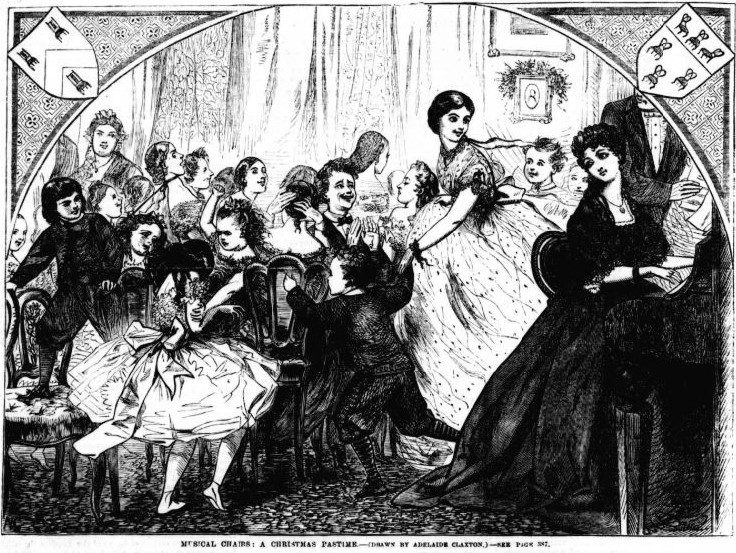
1 & 2-: From the following article, and the caption to a drawing illustrating that article, published in the Illustrated Times (London, England) of Saturday 23rd December 1865:
1-: [page 387, column 2]:
MUSICAL CHAIRS.
This is a scientific age, when instruction is artfully combined with amusement, as a powder is concealed by a spoonful of jam, and young people are inveigled into a lesson by a game in disguise. There are geometrical, geographical, geological, historical, arithmetical, chronological, biographical, ethnological, anthropological, botanical, horticultural, vertical, horizontal, and even teetotal games, “for the family circle and young persons;” and it may be confidently anticipated that the toymakers will have invented for the new year a method of learning the principles of political economy and the whole science of statistical tabulations by means of a winter-evening pastime.
Well, we, for our parts, would rather not. If all work and no play makes Jack a dull boy, it is equally obvious that something which is neither work nor play will make Master John a conceited young—well, monkey isn’t the word; for the monkeys have some sense of humour and the natural advantages of a real good gambol.
[…] We are off to join the real children, the merry little ones, who go in for “Oranges and Lemons,” or “I had a little dog.” Then we will all have a jolly round game at “One old Ox opening Oysters,” just to rest ourselves for “My Lady’s Toilet.” Somebody says that “Musical Chairs” is more lively, and that then we shan’t have the bother of spinning the plate. Ah, well, there’s something in that; for, to tell the truth, we’re a little stiff in the back since that last touch of lumbago, and stooping double, either to spin a plate or to catch a plate already spinning, is apt to give one “a crick,” to say nothing of the danger of splitting the knee of one’s best dress trousers.
“Musical chairs” be it then. Come, Miss Claxton, sit down at the piano. And now let us put the chairs straight, and everybody take a seat.
Off we go—
“Hokey pokey wankey fum,
Ri too looral looral lum,
Fol de riddledy doo de dum,
The King of the — Organ Grinder.
Da de doo, doo de dum.”
Change! change! Now then, Master Tom, don’t be quite so rough. Run, Kitty, run! Oh, you little puss, to pop down in the chair before me! Oh, fie! Miss Blank, fie! to see a young lady sit down on a gentleman’s knee when she thought nobody was looking! Oh! I never!
Poor Mary Anne! Who tied her streamers to the back of the chair? Never mind, Master Willy, you’ve pricked your own fingers with a hairpin, and serve you right!
“In the Strand! In the Strand!”
What a thing it is that I should have felt that twinge of lumbago again, just at the wrong moment! And so here I am, left out, and a forfeit to pay:—
“I wish I was with Nancy!”
“Heigho! says Rowley.
With a Rowley, Poley, Gammon, and Spin-again.”
Hi! hi! Off we go again! Keep up the tune, Miss Claxton. Here we are all tumbling together in a heap of torn muslins, tangled ringlets, flying tresses, broken combs, and flushed young faces, from which come such peals of ringing laughter that the other music—that at the piano—is drowned altogether.
“Hurrah for musical chairs!” say we. They’re a capital remedy for lumbago. And now, who’s for a game at “Birds, Beasts, and Fishes?”
2-: [page 392]:
MUSICAL CHAIRS: A CHRISTMAS PASTIME.—(DRAWN BY ADELAIDE CLAXTON.)—SEE PAGE 387.
3-: From an account of “the annual gathering in aid of the funds of the “Young Men’s Christian Association”” that was held at Swindon, Gloucestershire, on Wednesday 10th January 1866—account published in the Wilts and Glo’stershire Standard and Cirencester and Swindon Express (Cirencester, Gloucestershire, England) of Saturday 13th January 1866 [page 8 (misnumbered 6), column 4]:
The providing of amusements for the evening had been allotted to Mr. C. A. Wheeler and Mr. L. Tibbetts; and they were certainly of a nature to give great fun to the youngsters. […] These frolics, added to the games played (for the first time at the soiree), including “Hissing and Clapping,” “Musical Chairs,” “Zoological Garden,” &c., and, may safely be added, the endeavour of each to make the other happy, caused the general expression that the meeting in question excelled all former ones in the thorough enjoyment afforded the guests.
4-: From Pastimes. Notes and Queries, published in The Queen, The Lady’s Newspaper & Court Chronicle (London, England) of Saturday 18th December 1869 [page 368, column 2]:
CHRISTMAS GAMES.—Can any reader of The Queen suggest any new games, quiet or noisy, suitable for Christmas time, for grown-up boys and girls? We have played at “Blind Man’s Buff,” “Musical Chairs,” “Forfeits,” and other time-worn games, and would like to try something new this year.—An Old Girl.
The French plural noun chaises musicales seems to be a loan translation from English musical chairs. The earliest occurrence of this French noun that I have found is from Jeux anglo-français (i.e., Anglo-French Games), by Caroline de Barrau, published in L’Ami de l’enfance. Organe de la méthode française d’éducation maternelle (Paris: Hachette et Cie) of Wednesday 15th June 1887—after describing the game, the author wrote the following [page 291, column 1]:
Les petits Anglais appelent [sic] leur jeu : les chaises musicales.
translation:
The little English call their game: musical chairs.

