
[A humble request: If you can, please donate to help me carry on tracing word histories. Thank you.]
The colloquial phrase not the only onion in the hash, also not the only onion in the stew, means: not the only person or thing to be taken into consideration.
This phrase occurs, for example, in Independence is the key to orchestral excellence, by Peter Lockley, published in The Sydney Morning Herald (Sydney, New South Wales, Australia) of Wednesday 9th November 1994 [page 19, column 2]—ABC stands for Australian Broadcasting Corporation, the name of Australia’s principal public-service broadcaster:
There is extensive concert activity beyond the pale of the ABC. Think of Musica Viva, the Australian Chamber Orchestra, the Sydney Philharmonia Choir, the Australia Ensemble, the Adelaide and Perth Festivals together with the many lesser festivals, and the activities of the various arts centre trusts and other organisations and private promoters. I do not deny that the ABC plays a large part in Australian concert life, but it is far from being the only onion in the hash.
These are, in chronological order, the earliest occurrences of the phrase not the only onion in the hash, also not the only onion in the stew, that I have found:
1-: From Plain Water: Being the Further Adventures of Ed Harmon, First Lieutenant, A. E. F., by the U.S. author Harry Charles Witwer (1890-1929), published in Collier’s: The National Weekly (New York City, New York, USA) of Saturday 9th November 1918 [page 34, column 3]:
Well, Joe, everybody on the ship is wild over Jeanne and my baby. Every time they come up on deck and sit down you’d think they was runnin’ a crap game, they is so many people gets around them. […] Well, I went and hired a stewardess to mind my baby so’s Jeanne would have three seconds to herself now and then, not that they’s anywheres to go, and what does Jeanne do but fire her. She says she wouldn’t let nobody look after my baby but herself, and I must be unhuman to even think of it. Well, Joe, I ain’t jealous of my baby, or nothin’ like that, but I must say I am bein’ made to feel that I ain’t the only onion in the hash right now.
2 & 3-: From reviews of Sally, a U.S. musical comedy first produced in 1920 on Broadway, New York City, New York, USA:
2-: From a review of Sally, as produced at Her Majesty’s Theatre, Sydney, New South Wales, Australia—review by W. J. O’Neill, published in The Daily Telegraph (Sydney, New South Wales, Australia) of Monday 8th January 1923 [page 3, column 6]:
George Gee has been cast as Otto [sic] Hooper, a theatrical agent, and is not to quote his dainty partner’s estimate of him, “the only onion in the hash.” It is worth while looking at George Gee’s dancing at any time, and his comedy is effervescent, occasionally too much so; but as he is a cheerful old—or young—person, his presence would be welcome anywhere.
3-: From one of the drawings from Tribe’s Impressions at Kiwanis Musical Show, by Reginald V. Tribe (died 1956), illustrating a review of Sally, as produced at the Kiwanis Club, Springfield, Massachusetts, USA—review by A. L. S. Wood, published in The Springfield Union (Springfield, Massachusetts, USA) of Tuesday 20th November 1928 [page 6]:
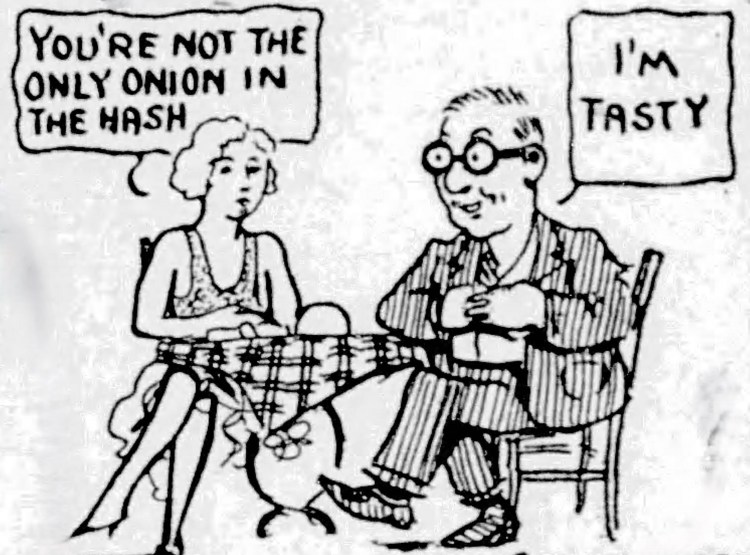
—This drawing depicts Mrs Barry Ross as “Rosie” Rafferty, saying “You’re not the only onion in the hash” to “Bob” Pepper as Otis Hooper, theatrical agent, who says “I’m tasty”.
The phrase not the only onion in the hash, therefore, certainly occurs at some point in this musical comedy. But it seems to be absent from the vocal score that was published by T. B. Harms Co., New York City, New York, USA, copyright 1920 & 1921, under the title Sally. A New Musical Play in three Acts. Book & Lyrics by Guy Bolton and Clifford Grey. Music by Jerome Kern.
4-: Interestingly, the English author Pelham Grenville Wodehouse (1881-1975) wrote some of the additional lyrics for Sally, and he used the phrase not the only onion in the hash in the following from Right Ho, Jeeves—as published in the Evening Despatch (Birmingham, Warwickshire, England) of Monday 3rd September 1934 [page 2, column 6]:
“It is true that in the past I have sometimes seen fit to seek Jeeves’ advice. It is possible that in the future I may seek it again. But I claim the right to have a pop at these problems, as they arise, in person, without having everybody behave as if Jeeves was the only onion in the hash. I sometimes feel that Jeeves, though admittedly not unsuccessful in the past, has been lucky rather than gifted.”
 word histories