‘not the only onion in the hash’: meaning and origin
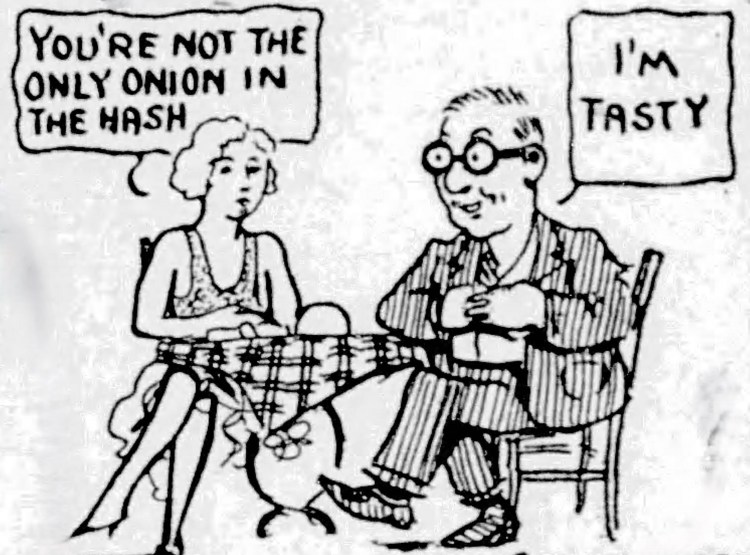
not the only person or thing to be taken into consideration—USA, 1918, in a story by Harry Charles Witwer—later popularised by P. G. Wodehouse
Read More
“ad fontes!”
not the only person or thing to be taken into consideration—USA, 1918, in a story by Harry Charles Witwer—later popularised by P. G. Wodehouse
Read MoreUK, 1935—a humorous self-contradictory phrase which includes the clichéd phrase ‘to avoid like the plague’ in order to express the necessity of avoiding clichés—as a piece of advice for writers, has itself become a cliché
Read Moreis used of a miserly person—Australia, 1929—UK, 1934
Read Moreof, or relating to, or characteristic of, or resembling, Jeeves—UK, 1934—refers to Jeeves, the perfect valet in stories by P. G. Wodehouse
Read MoreCanada, 1928—resembling Jeeves, the perfect valet in stories by the English author Pelham Grenville Wodehouse (1881-1975); this fictional character first appeared in 1915
Read Morefine, all right—UK, 1923 (perhaps coined by P. G. Wodehouse)—perhaps an alteration of ‘oojah capivvy’ after ‘cum’ and ‘spiffy’
Read More1890s—to use extravagant words or language not substantiated by fact; to talk nonsense—occurs in particular in stories by the British authors Ernest William Hornung (1866-1921) and Pelham Grenville Wodehouse (1881-1975)
Read Morea dentist—World War Two—slang of the British armed forces—was soon adopted into (and came to be regarded as) Australian English—earlier synonyms: ‘fang-faker’ and ‘fang-wrencher’
Read Morefrom 1924 onwards in stories by English author P. G. Wodehouse—a facetious appellation for a medical practitioner specialising in the diagnosis and treatment of mental illness—‘loony’: shortened form of ‘lunatic’
Read More‘to have two left feet’: to be clumsy or awkward—postdates synonymous ‘to have two left hands’ (1815), loan translation of French ‘avoir deux mains gauches’—‘left’ has long been associated with inferior performance, awkwardness and insincerity
Read More
