
[A humble request: If you can, please donate to help me carry on tracing word histories. Thank you.]
The phrase there’s life in the old dog yet (and variants) is an assertion of continuing competence, strength, etc., notwithstanding evidence to the contrary.
A variant of this phrase occurs, for example, in a review of The Randolph Hotel, located at Oxford, Oxfordshire, England—review by Annabelle Thorpe, published in The Observer (London, England) of Sunday 12th June 2022 [page 37, column 4]:
Oxford’s grande dame got a much-needed facelift during lockdown […]. The location is unbeatable, breakfast is gluttonously good, and there’s a delightful, old-fashioned bustle—proving there’s plenty of life in the old girl yet.
All the earliest occurrences that I have found of there’s life in the old dog yet indicate that this phrase was first used—if not coined—as the title of a painting by the British artist Edwin Landseer (1802-1873). Called The Life’s in the Old Dog Yet, also There’s Life in the Old Dog Yet, this painting was first exhibited in 1838.
The following description of this painting is from Sir Edwin Landseer, by Richard Ormond with contributions by Joseph Rishel and Robin Hamlyn (Philadelphia Museum of Art, 1981) [page 167]:
Unlike Landseer’s earlier picture of a mountain disaster entitled Alpine Mastiffs Reanimating a Distressed Traveler, in this picture the victims are animals, and man here befriends the dog. In the impetuosity of the hunt, a royal stag and two deerhounds have pitched over a precipice. Wedged somewhat improbably in a narrow crevice, the stag lies dead, together with one of the dogs, whose shattered body, twisted neck, and bared teeth forcefully evoke the violence of death. A ghillie has descended into the abyss, his rope swooping dramatically across, and he cradles the head of the injured dog in his hand, while calling to the rescuers above. The study of this second dog shows Landseer’s sensitivity as a painter of animals; it is clear from its translucent skin and protruding ribs that the dog is not only old but also that it is in shock.
The following detail of The Life’s in the Old Dog Yet, by Edwin Landseer, is from Sir Edwin Landseer (Philadelphia Museum of Art, 1981) [frontispiece]:
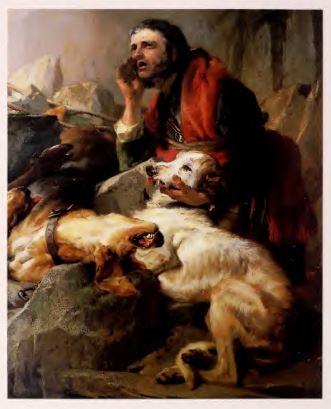
This painting was first mentioned in several reviews of the seventieth annual exhibition of the Royal Academy, at Trafalgar Square, London, which opened to the public on Monday 7th May 1838—the following, for example, is from The Morning Post (London, England) of Tuesday 8th May 1838 [page 3, column 5]:
One of the earliest numbers, and one of the best pictures in the exhibition, is No. 21, “Life’s in the old dog yet,” by E. Landseer. The hound in pursuit has gone over a precipice, together with the stag, and his master is carefully nursing and restoring him. The expression of suffering in the poor brute is finely portrayed, and the tenderness which marks the rugged features of the man is worthy of the artist.
I have found an early allusive use of the title of the painting (i.e., of the phrase there’s life in the old dog yet) in the following account of a debate that took place in the House of Commons on Thursday 19th July 1838—account published in the Weekly True Sun (London, England) of Sunday 22nd July 1838 [page 2045, column 3]:
AN EXPIRING EFFORT.
In a clever picture, Edwin Landseer has drawn two deer hounds, which have fallen over a precipice, and their anxious master having reached the place, is exclaiming to his companions on the distant rock “There is life in the old dog yet.” So it would seem from Thursday night’s debate to be with the Liberal party in Parliament. Radicalism is just alive and that’s all. However, the conjoint proposition of Peel and the ministers to give 240,000l to the Irish parsons excited an expiring effort amongst the once earnest Parliamentary Radicals. If they shall soon be deemed dead it cannot be said they have died and left no sign. Their expiring effort of Thursday proved utterly useless. Lord John Russell told them it was made too late, and though he approved of their views he asked why they had not been announced earlier—and the people also will ask why?
The phrase then occurred (with allusion to Edwin Landseer’s painting) as the title of, and in, a poem by Sandie Grey, published in The New Sporting Magazine (London, England) of February 1840 [pages 75 & 76]:
THE LIFE’S IN THE OLD DOG, YET.
Written on seeing the Picture in the Royal Academy, painted by Edwin Landseer, R. A. 1838.My brave old hound, my bonny old hound,
Here’s a health, here’s a health to thee;
And as years roll round, may thou still be found
In chase of the deer with me.Many is the day we have hunted away,
And many is the track we have set;
And now I am told that thou art grown old,
“But the life’s in the Old Dog yet.”[…]
Thou leapt that crag with the dying stag,
And methought a hard fate thou had met;
But we found thee below, on thy prostate foe,
“And the life’s in the Old Dog yet.”[…]
Men are to be found who would kill the old hound,
And his long years of service forget;
But a hand I’ll ne’er lend to destroy my old friend,
“For the life’s in the Old Dog yet.”
 word histories