
[A humble request: If you can, please donate to help me carry on tracing word histories. Thank you.]
Dating back to the First World War (1914-1918), the colloquial British-English derogatory noun conchie (also conchy, conshy, etc.) designates a conscientious objector.
Pronounced /ˈkɒnʃi/, this noun is from:
– the initial syllable of the noun conscientious objector (pronounced /ˌkɒnʃiˈɛnʃəs əbˈdʒɛktə/);
– the suffix -ie (also ‑y), used to form familiar diminutives.
The noun conchie occurs, for example, in All quiet on the whingeing front…, by Frank Entwistle, published in the Sunderland Echo (Sunderland, Tyne and Wear, England) of Thursday 15th November 2001 [page 24, column 3]:
I have known a few very brave servicemen. I also knew a few conscientious objectors to military service, “conchies” as they were vulgarly called. They were brave men too. Very brave.
Some proved their gallantry on the battlefield as stretcher-bearers. Others bravely faced the disapproval, even contempt, of fellow citizens or colleagues over years.
The conchies I came across—though in my view mistaken—were not political objectors. Some simply objected to killing, or even being trained to kill. Some objected for religious reasons. Many were Quakers.
These are, in chronological order, the earliest occurrences of the noun conchie (also conchy, conshy, etc.) that I have found:
1-: From a letter from France, dated Monday 17th July 1916, that the British poet and songwriter Ivor Gurney (1890-1937) wrote to the British musician Marion Scott (1877-1953)—as published in Ivor Gurney: Collected Letters (The Mid Northumberland Arts Group (Ashington, Northumberland) & Carcanet Press (Manchester) – 1991), edited by R. K. R. Thornton [page 120]:
—Note: the current online edition of the Oxford English Dictionary erroneously dates this letter to Thursday 27th July 1916:
So wags the world, with ladies eager to fight, or conches,4 and gentlemen who would (Like Happy Starkey) play pretty music, bored to an abysmal melancholy by the mere thought of a bayonet; and yet in trenches with the rats and family friends. It provokes the thought that the world is a jigsaw puzzle that the L.A.5 has not managed quite to success.
4 i.e. conscientious objectors.
5 Presumably the Lord Almighty rather than Literary Agent.
2-: From the following letter to the Editor, written by William Cecil (1863-1936), Bishop of Exeter (1916-1936), published in The Times (London, England) of Monday 8th October 1917 [page 10, column 3]:
ANARCHIC DARTMOOR.
A HOTBED OF MALCONTENTS.
TO THE EDITOR OF THE TIMES.Sir,—I have just returned from visiting at Princetown, the settlement of the conscientious objectors. If the Government desire a revolution after the war they could hardly have proceeded in a more efficient manner. Eleven hundred men who have a grievance, fancied or real, against society, are assembled from all parts of England and there have ample time and opportunity to organize resistance, armed or passive, against the existing order of affairs. Meetings are held constantly which are terminated, not by the National Anthem, but by the singing of the “Red Flag.” Many of the “Conchys,” to use the local appellation, are men of ability and education, many are anarchists and Socialists, some have deep, if morbid, religious views, many have that mixture of madness and sanity which has always furnished the most dangerous because the most daring instrument of revolution. Ample opportunity is given to these people for correspondence, of which they make the fullest use. Sacks of letters come and go, no doubt conveying instructions for those plans of bloodshed which may at some future time bring, according to their view, liberty, and, to our view, ruin, to England. […].
[…]
Nothing is so unjust as to treat Marat 1 and John Bunyan 2 as people of similar opinions, or so foolish as to enable the former to convert the latter to his revolutionary ideas, or, at least, to get from him the countenance and support that comes of his religious character. The religious “Conchy” should be sought out wherever he is, whether in prison or in the settlement, and treated as a good citizen with fanatic views. No one asks the Mahomedan to eat pork, or the Hindu to kill the sacred cow, and so no sane man would suggest that either a Quaker or a Christadelphian or any other Nonconformist pacifist should have anything to do with war. Let them go free.
But the political “Conchys” surely deserve quite a different treatment. They should never be allowed to be in big bodies; they should be treated, as indeed they are, as enemies to our commonwealth, and they should be required, like enemy aliens, to report at the police stations of those districts where their labour would prove profitable to the community.
1 Jean-Paul Marat (1743-1793) was a French revolutionary leader and journalist. He was stabbed to death in his bath by Charlotte Corday.
2 John Bunyan (1628-1688) was an English preacher and author, noted particularly for his allegory, The Pilgrim’s Progress (1678).
3-: From the following editorial, published in The Evening News (London, England) of Monday 8th October 1917 [page 2, column 3]:
THE CODDLING OF THE CONCHYS.
Judging by the letter of the Bishop of Exeter the same old game is still being played at Dartmoor, where the so-called “Conscientious Objectors” are still being pampered and petted. We agree with the bishop that it is a dangerous game, and that unless it comes to an end it is likely to have serious consequences.
A good many people are still under the impression that the “Conchys,” as they are called in Devon, are a body of mild-mannered but determined Quakers and Christadelphians who would sooner perish at the stake than shed a single drop of a fellow creature’s vital fluid, even though that fellow-creature might be a Boche caught red-handed in the slaughter of women and children. The bishop disposes of that idea, for he tells us that three-fourths of the “Conchys” have no religious scruples at all—many of them are Anarchists and Revolutionaries, and their objection to defending their country is based on purely political grounds. […]
[…]
The coddling of “Conchys,” the protection of disloyal Pacifists, the tenderness shown to Hun firms in many cases—all these things are of a piece, and they are steadily breeding a dangerous state of public opinion.
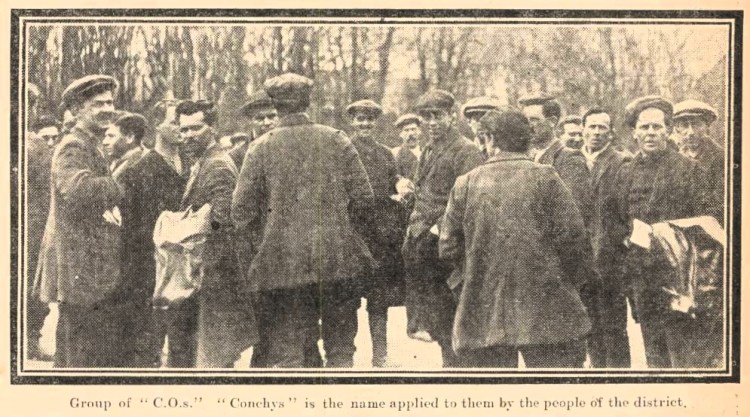
4-: From the caption to the following photograph, referring to the above-quoted letter by William Cecil, published in The Daily Mirror (London, England) of Tuesday 9th October 1917 [page 1, column 2]:
Group of “C.O.s.” “Conchys” is the name applied to them by the people of the district.
 word histories