
[A humble request: If you can, please donate to help me carry on tracing word histories. Thank you.]
The expression gunpowder tea designates a fine kind of green tea, each leaf of which is rolled up into a pellet.
This expression refers to the resemblance of the pellets to granules of gunpowder.—Cf., below, quotation 1.
The Chinese expression for this kind of tea is zhū chá 1, literally: pearl tea.
1 Cf., below, the transcription tio té in quotations 5 and 6.
These are, in chronological order, the earliest occurrences of the expression gunpowder tea that I have found:
1-: From Berrow’s Worcester Journal (Worcester, Worcestershire, England) of Thursday 6th August 1767 [page 3, column 2]:
A Species of fine Tea, called Gunpowder Tea, from the Roundness of the Grain, is brought home in some of the East Indiamen, valued at the Rate of Thirty-six Shillings per Pound.
2-: From The Canterbury Journal (Canterbury, Kent, England) of Tuesday 22nd May 1770 [page 3, column 3]:
Friday a valuable seizure of gunpowder tea, valued at thirty shillings per pound, was made at Woolwich, to the amount of 270l. and lodged in the King’s warehouses.
3-: From The Kentish Gazette (Canterbury, Kent, England) of Tuesday 19th June 1770 [page 3, column 2]:
Friday night three hundred weight of gunpowder tea, was seized at Blackwall, on an information, and secured in the King’s warehouses.
4-: From an advertisement placed by “John Gregg, Dealer in Teas, Coffee, and Chocolate”, published in The Bath Chronicle (Bath, Somerset, England) of Thursday 11th October 1770 [page 2, column 4]:
per Pound, s. d.
Fine Gunpowder Tea, 16 0
Very fine ditto, 21 0
5-: From A Voyage to China and the East Indies (London: Printed for Benjamin White, 1771), a translation by the German naturalist John Reinhold Forster (1729-1798) of the German translation of Dagbok öfwer en Ostindisk resa åren 1750, 1751, 1752 (Stockholm: Tryckt hos Lor. Ludv. Grefing, 1757), by the Swedish explorer and naturalist Pehr Osbeck (1723-1805) [Vol. 1, page 250]:
Of Green Teas, there are
[…]
Tio té is rolled up like pease h. [Tab. xiii. f. 10. 2]
h This sort is rolled up between the hands in a rounder shape than the others. A smaller kind is called Gunpowder tea.
2 This is Tab. xiii. f. 10. [page unnumbered]:
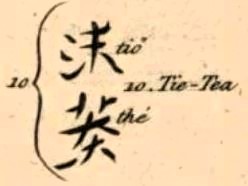
6-: From The Natural History of the Tea-Tree; With Observations on the Medical Qualities of Tea. And Effects of Tea-Drinking (Dublin: Printed by R. Marchbank for J. Williams, T. Walker, and C. Jenkins, 1772), by the British physician and philanthropist John Coakley Lettsom (1744-1815) [Section VIII. Varieties of Tea, page 32]:
III. There has also been imported a sort of Tea, of a different form from any of the preceding, made up into cakes or balls of different sizes.
I. The largest kind of this cake Tea that I have seen, weighs about two ounces […].
II. Another sort, which is a kind of green Tea, is called tio té: it is rolled up in a round shape, about the size of peas.
III. The smallest kind done in this form is called gunpowder Tea.
7-: From an advertisement placed by Brian Cape, importer of goods “suitable for the summer season, which will be sold on the most reasonable terms, at his store”, published in The South-Carolina Gazette; and Country Journal (Charleston, South Carolina, USA) of Tuesday 8th June 1773 [page 4, column 3]:
A chest of very fine hyson tea, just opened, commonly called gunpowder tea, which is of a much finer flavour than what is usually imported, being designed for home consumption.
8-: From Observations and Experiments on the Poison of Copper (London: Printed for Joseph Johnson, 1774), by the British physician William Falconer (1744-1824) [page 77]:
Tea, if noxious, by an impregnation of Copper.
Some have attributed the pernicious effects of tea on the nervous system to an impregnation of this kind, which it acquires in the course of its preparation. It is commonly imagined, that in order to give tea leaves the curl which they have when they come to us, they are rubbed with the hand on Copper * plates heated, and from thence acquire an impregnation of this metal; and some have even attributed the fine colour of the green tea to the same cause. In order to determine if this conjecture was justly founded, I made the following experiments.
I took two drachms of green tea of twenty-one shillings per pound, the like quantity of gunpowder tea, the like quantity of tea of eighteen shillings, of sixteen shillings, and of twelve shillings [&c.].
* Neumann says iron plates are used for this purpose, and I have lately had undoubted authority for the truth of this assertion from other hands.
 word histories