
Of American-English origin, the colloquial phrase to hang (also to leave) someone out to dry means: to put someone in a difficult, vulnerable or compromising situation, especially by exposing them to blame.
This phrase occurs, for example, in the title of an article that the British journalist and author Jonathan Freedland (born 1967) wrote on the rivalry between the British politicians Boris Johnson and Rishi Sunak—article published in The Guardian (London and Manchester, England) of Friday 2nd June 2023:
Not for the first time, Sunak has been hung out to dry by Johnson—how much more can he take?
In the phrase to hang (also to leave) someone out to dry, the image is of suspending wet washing in the open, on a clothesline or on a fence, so that it can dry.
Most of the texts containing the earliest occurrences of to hang (also to leave) someone out to dry that I have found indicate that this phrase was originally used of sports.
These early occurrences are as follows, in chronological order:
1-: From the account of a baseball match between the Red Sox and the Athletics, published in the Evening Courier (Camden, New Jersey, USA) of Monday 23rd April 1945:
It was the third straight victory for the A’s in this inclement village and the sixth straight time the Sox has been hung out to dry.
2-: From the following advertisement for the war bonds issued by the U.S. Government—advertisement sponsored by Sachter’s Cut Rate Crown Liquors, published in The Daily Sentinel (Grand Junction, Colorado, USA) of Wednesday 23rd May 1945:
There He Is—Hung Out to Dry
There he is . . . Hitler all washed up. And who put him there? Well it’s a long story . . . but your bond buying didn’t hurt it any. In fact he wouldn’t be there without those bonds you bought last year.
What About This Guy Hirohito?
Now there’s another guy we got to hang on the fence to dry. That’s this bird Hirohito, the poop de kakiac and imperial potentate of the ring tails. Those bonds you bought last year ain’t going to give him no skin irritation. We have got to pull the string on him . . . the quickest way to do it is put this 7th War Loan over. Put it over with individual purchases.
Over a Million in “E” Bonds
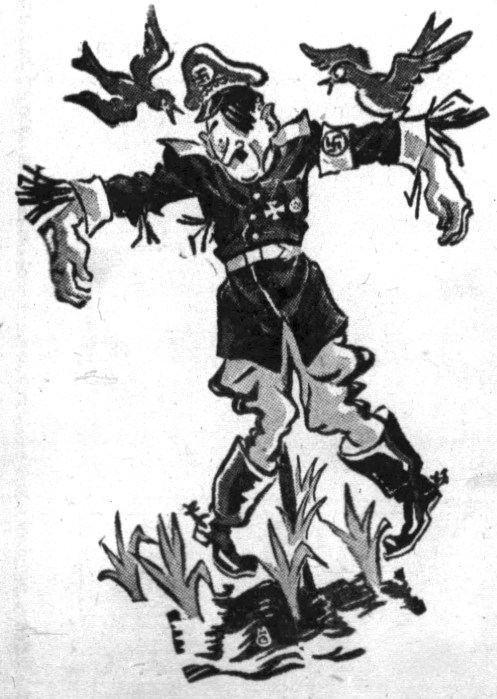
3-: From the account of a baseball match between Joplin and St. Joseph, published in the St. Joseph News-Press (St. Joseph, Missouri, USA) of Friday 21st June 1946:
Second game: Johnny Bakay went behind the plate for the Cards with Curtis Darnell going to right field . . . Dale Hackett could have hung Nelson out to dry in the fourth, when Glenn had to pull into the base path to take Eisiminger’s throw; but the Joplin shortstop did the sporting thing.
4-: From the account of a baseball match, by John McMullan, published in the Miami Daily News (Miami, Florida, USA) of Tuesday 9th July 1946:
The Sox were hanging out to dry and the Cubans convalescing today after Havana wrung a 3-0, 12-inning victory out of Miami last night.
5-: From a story by Whitney Martin, of the Associated Press, published in several newspapers on Friday 23rd August 1946—for example in the Bangor Daily News (Bangor, Maine, USA):
NEW YORK, Aug. 22 (AP)—There was a time when a football player who had been detoured somewhere en route to his education and found himself on a college team when he was 25 years old had an automatic nickname waiting for him. He was “Pappy.”
This year the gridirons will be loaded with Pappys, and quite a few grand Pappys, figuratively speaking. The boys as a whole are older, bigger, tougher, stronger, and, possibly, smarter, so we can expect a type of game that is a cross between a head-on collision of two trucks and a slight case of tornado. That is, it will be a little rough for all concerned.
The kids in their teens will be hung out to dry while the older lads take over, and as the teen agers will be very much in the minority there’s not much they can do about it.
6-: From the column Calling the Turn, by Curt Noyes, published in the Daily Evening Item (Lynn, Massachusetts, USA) of Tuesday 17th September 1946:
Picked up at our short wave listening post.
Tonight the Long Island Indians, a professional football team of assorted major league castoffs, will be led to the gallows at Manning Bowl. The Indians are the proving ground or the dumping ground, for Ted Collins’ Boston Yanks. And tonight the Yanks, with Boley Dancewicz turning the crank, will put their farmhands through the wringer and hang them out to dry.
7-: From The Boston Daily Globe (Boston, Massachusetts, USA) of Sunday 20th October 1946:
Boston Yanks Hope to Stop Baugh, Redskins
There are a couple of things that would madden any Bostonian—(1) have somebody ask him what happened to the Red Sox, and (2) have George Preston Marshall enjoy himself.
But the latter seems almost a positive thing today, as the cleaning chap, who was hung out to dry when he owned a team here, leads the league-leading Washington Redskins against the Yanks at Fenway Park.
8-: From The Charlotte News (Charlotte, North Carolina, USA) of Friday 15th November 1946:
THE Hornet Bowling League, with half its membership made up of teams representing laundries in Charlotte, went through the mangler last night and when the standings were hung out to dry they were hardly recognizable.
9-: From a story by Lawton Carver, of the International News Service, published in several newspapers on Thursday 10th April 1947—for example in the Evening World-Herald (Omaha, Nebraska, USA):
Durocher was accused of conduct detrimental to baseball because of a series of incidents spicing his career and reaching a climax recently at Havana when he became embroiled in a feud with MacPhail.
Durocher charged that MacPhail was host to alleged gamblers in his box at an exhibition game. MacPhail was cleared and Durocher finally was hung out to dry.
10-: From the column Pitching Horseshoes, by the U.S. theatrical impresario and lyricist Billy Rose (1899-1966), published in The Cushing Citizen (Cushing, Oklahoma, USA) of Thursday 4th December 1947:
A few weeks back, I wrote a column about an old lady whose corpse got mixed up with the corpse of a two-star general. I didn’t try to palm it off as an original story or a true one. I started my piece by saying, “A daffy story popped up on my desk this morning.”
That Saturday evening, one of Time’s research girls telephoned me.
“Is it true,” she asked in a station-wagon voice, “that the desk in your office is kidney-shaped?”
“What’s it to you,” I asked cautiously, “whether my desk is shaped like a small intestine or a big toe?”
“Oh, we just wanted to know,” said Miss Station Wagon. “We’re doing a little piece about that switched-corpse story you wrote. It’s been around for quite a while, you know.”
“I GET IT,” I said. “Your magazine is going to hang me out to dry again. This will make the third time in as many months that you’ve used me for the back end of a shooting gallery.”
11-: From an interview of Harry Gasper, executive secretary to Albert G. Feeney, Mayor of Indianapolis—interview by Cornell W. Acheson, published in The Indianapolis News (Indianapolis, Indiana, USA) of Thursday 12th February 1948:
He [i.e., Harry Gasper] worked against Feeney in the 1936 sheriff race, he says. But then, Harry, who had worked in the county registration office since 1933, ran into trouble when a court fight over nonpartisan composition of the office threatened to “hang me out to dry.” Feeney then sheriff, called him in and offered to help him over the interim.
12-: From the column On Broadway, by Walter Winchell (1897-1972), published in several newspapers on Monday 1st March 1948—for example in The Post-Star (Glens Falls, New York, USA):
An excerpt from an article in the June (1941) World Digest is still pertinent. To wit: “Much has been written about Winchell and most of it is wholly inaccurate, dished up by boresome scribes who might seek to cash in on the publicity it obviously would create” . . The current Americanmerk hits bingo. It has a piece declaring that Czech democratic leaders eager to appease Russia will discover that the rope they’re giving Communists will turn into a noose for their nation . . . Life’s editorialist is put through the wringer via Congress Weekly and hung out to dry.
13-: From the review of To the Victor, a 1948 U.S. drama film—review by Karl Krug, published in the Pittsburgh Sun-Telegraph (Pittsburgh, Pennsylvania, USA) of Friday 23rd April 1948:
The acting is almost as blurry as the cross-section of social and political messages blowing interminably through the action. […]
Which goes to show you that even actual locales and settings won’t help such a nondescript plot as has been hung out to dry in “To the Victor.”
14-: From The Indianapolis Star (Indianapolis, Indiana, USA) of Thursday 27th May 1948:
‘Voice of America’ Broadcasts ‘Laundered’ In Capehart Speech
By JACK REED
INDIANAPOLIS STAR BUREAU
1397 National Press BuildingWashington, May 26—Senator Homer E. Capehart of Indiana today laundered the $27,000,000 Voice of America broadcasts in a vat of sarcasm and hung it out to dry on a cross of its own making.
15-: From the review of Mr. Blandings Builds His Dream House, a 1948 U.S. comedy film—review by Gilbert Kanour, published in The Evening Sun (Baltimore, Maryland, USA) of Monday 2nd August 1948:
THEY have to tear down this sprained architectural landmark, and begin building from scratch. Whereupon they run into an oddly assorted group of pirates, from the architect down to the well-digger.
Costs mount to proportions they had not figured in the budget, and they are put through the wringer and hung out to dry before the house is ready for occupancy.
16-: From the review of Deep Waters, a 1948 drama film directed by Henry King—review by Karl Krug, published in the Pittsburgh Sun-Telegraph (Pittsburgh, Pennsylvania, USA) of Wednesday 4th August 1948:
There was the makings, probably, of a good emotional wallop in “Deep Waters.” However, Mr. King’s inept handling has given it the conventional tired look of something hung out to dry on the studio clothesline.
17-: From a portrait of Rev. Floyd Bennett, a preacher at Star and Oak Valley and Columbia Missions, published in the Logan County News (Crescent, Oklahoma, USA) of Thursday 27th January 1949—here, the image is of drying meat:
He doesn’t criticise the other churches but he sometimes skins the Baptists and hangs them out to dry. One time some gave him some hens. He said he hoed around them and watered them (remember—he works in a green house) and they still didn’t lay. He said surely they must have been Baptist hens. They were good hens, but weren’t bearing much fruit.
 word histories