
[A humble request: If you can, please donate to help me carry on tracing word histories. Thank you.]
The British-English phrase (as) dim as a Toc H lamp means dim-witted.
The following from Soldier and Sailor Words and Phrases (London: George Routledge and Sons, Ltd., 1925), by Edward Fraser and John Gibbons, explains the meaning and origin of Toc H:
TOC H: The War name for Talbot House, Poperinghe, “Toc” being the signallers’ vernacular for the letter “T”. The original “Toc H” was opened on December 15th, 1915, being named in memory of Lieutenant Gilbert Talbot of the Rifle Brigade, killed at Hooge in the previous July. A second “Toc H” was opened at Ypres in 1916. The purpose was to provide a place of rest and a social centre for all ranks; an institution equipped with a “quiet room”, library, attractive tea-room, a chapel, and a garden. Church of England in foundation and ideals, the resident chaplain and superintendent welcomed all new comers, of whatever form or belief, and the chapel ever stood open to all, regardless of creed, unobtrusively offering its restful consolation. Poperinghe, as the military metropolis of the Salient during upwards of two years, was visited by thousands of officers and men, for practically every one of whom “Toc H”, with its unique atmosphere and surroundings, proved alike a club and a home from home. [The writer of this entry, for one, well remembers tramping into Poperinghe one Sunday afternoon from Dirty Bucket Camp, and how at “Toc H”, with a book from the library on “English Cathedrals”, as he sat reading on the lawn, he experienced the first respite from war conditions he had been able to obtain for many months. For that he will ever be grateful for Talbot House]. After the Armistice, “Toc H” was transferred by its founder, the Rev. P. H. Clayton, to London, establishing headquarters as “Mark I” at All Hallows, Barking. There it maintains itself as an association pledged “to conquer hate and consecrate humour, its members drawn from all classes of society and devoting themselves to carry into everyday practice the straightforward standard of fairmindedness, unselfishness, helpfulness, and Christian outlook—termed the four points of our Compass”. Toc H. obtained its Royal Charter as a self-governing body in 1922. Its chaplains (padres) are of all Christian denominations. The Prince of Wales is patron, and its groups and branches have spread over Great Britain and are spreading over the Empire.
A Toc H lamp—© The Trustees of the British Museum:
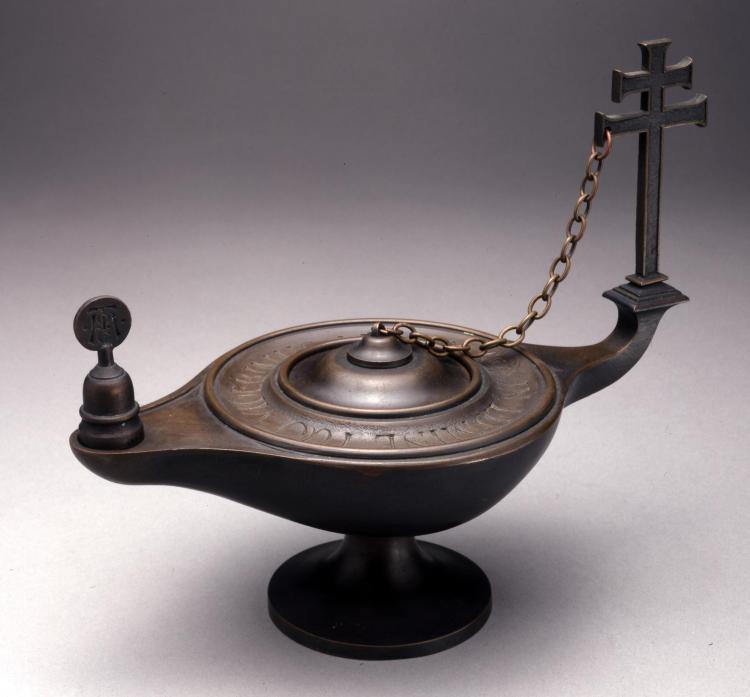
The earliest occurrences of the phrase (as) dim as a Toc H lamp that I have found are as follows, in chronological order:
1-: From The Observer (London, England) of Sunday 11th December 1955 [page 5, columns 2 & 3]:
PROFILE: ‘TUBBY’ CLAYTON
“As dim as a Toc H lamp,” they used to say in the R.A.F. It is exactly forty years ago to-day since such a lamp was first lighted in an old mansion in Poperinghe, then the railhead for the mud saucer and slaughter-ground of the Ypres salient. To-morrow the founder of Toc H, the Rev. Philip Thomas Byard Clayton, C.H., M.C., celebrates his seventieth birthday at the London church—All Hallows, Barking-by-the-Tower—where he has been Vicar since 1922.
[…]
Clayton […] seems as permanent a part of Tower Hill as the Tower itself […]. The future of Toc H, in a Welfare State, seems more in doubt. “Branches rise up to meet an emergency and then tend to die away a little,” Clayton remarked last week. But Toc H has been so brave a movement that it would be unwise to predict that the phrase “as dim as a Toc H lamp” will ever be very accurate.
2-: From the column Chimes: Comments on Men and Matters, by ‘Onlooker’, published in the Evening News & Times (Worcester, Worcestershire, England) of Wednesday 4th April 1956 [page 4, column 3]:
The Toc H Lamp
“As dim as a Toc H lamp” is an expression sometimes heard—and well may the lamp be described as dim, for, as one local citizen was heard to say recently, “they hide their light under a bushel.”
3-: From the column Echoes of the Day, by ‘Richmond’, published in the Bournemouth Daily Echo (Bournemouth, Hampshire, England) of Wednesday 10th October 1956 [page 10, column 2]:
AS DIM AS A TOC H LAMP
But Bournemouth helps to keep it burning brightHow often during the war did we hear that affectionate denigration of a friend, “As dim as a Toc H lamp?”
Dim as the lamps were in the days of the blackout, they are burning brightly today. Many people in Bournemouth are helping to keep them alight.
Toc H moves everywhere in the town. Members visit the sick in hospital and in their homes, provide books for patients, help old folk, escort blind women to church.
4-: From the Newmarket Journal (Newmarket, Suffolk, England) of Thursday 13th April 1961 [page 5, column 4]:
Thingummies and whatsits
Isn’t it surprising how, in casual, unself-conscious conversation people tend to fall back on old and often obscure phrases?
You have, for instance, the lively outspoken fellow who is so frequently described as “crazy as a coot” or “nutty as a fruit cake” or “mad as a hatter” when some act of his seems unusual.
If, on the other hand, someone is not noted for his sparkling contributions to witty chatter he may be called “as dim as a Toc-H lamp.”
Then you hear all those well-thumbed phrases which are applied to people who have had too much to drink. They are “as full as a goog”, “as tight as a drum”, or deplorably—their “back teeth are awash!” We’ve heard their noses stated to be “as red as a rear lamp.”
Honestly, it’s thingummies, whatsits and oojakapivvies like these that make us “laugh like a drain.”
5-: From The Millionaire Mentality (London: Secker & Warburg, 1961), by Michael Pearson—as quoted by Howard Spring in a review of this book, published in Country Life (London, England) of Thursday 15th June 1961 [page 1447, column 3]:
The men who make these fortunes “may be shrewd. They may be observant. They may be sharp and quick-witted. But they are rarely brainy. This is a view shared by every single one of the big cross-section of men who have been interviewed for this book.” One of them, asked about his school-days, said: “I was as dim as a TOC H lamp.”
6-: From Can you still remember what the Durham miner used to be like?, by J. Coley, published in the Sunday Sun (Newcastle-upon-Tyne, Northumberland, England) of Sunday 21st October 1962 [page 5, column 2]:
The Durham pitman had always had a flair for turning a neat phrase. A brass bandsman might speak of his trombone as having “a creamy silk note”; he might growl at a youngster in the pit and remark that he was “as dim as a Toc H lamp.”
7-: From an article about the international movement Toc H, published in the Illustrated Chronicle (Leicester, Leicestershire, England) of Friday 20th September 1963 [page 2, column 4]:
Toc H, born out of the first World War, is still doing good work . . . and is celebrating its Jubilee with an appeal.
Its symbol is a lamp. […]
“Our lamps may have a small flame, but our spirit is bright as ever,” said Mr. C. Stevenson, Secretary of Leicester Toc H when the “Illustrated Chronicle” called in at the local organisation’s headquarters and hostel at 44, Princess Road.
“Actually, the saying ‘As dim as a Toc H lamp’ is quite accurate. A lamp is our symbol. We always have one lit at our meetings. But those old-fashioned oil and wick lamps only have a small flame.”
[…]
[The movement] began in the shattered Belgium town of Poperinghe during the First World War. The Rev. Tubby Clayton and the Rev. Neville Talbot, both Army chaplains, were asked to open a club for soldiers.
The club was to be inter-denominational and designed to provide an informal atmosphere where the men could relax. At first, the two chaplains were going to call it “Church House” but their suggestion received a curt military reply: “You’ll never get any customers if you have a name like that. Call it something else.”
The centre was named after Neville Talbot’s brother, Gilbert, who was killed in the first German flame attack on Sanctuary Wood. Both Neville and Gilbert were sons of the Bishop of Winchester.
Talbot House, refuge of thousands of war-weary British Tommies of all ranks and backgrounds, became in the signallers’ abbreviations of the time “Toc H.”
Since those days, the organisation has extended its activities, and there are Talbot Houses all over the world.
 word histories
I understood that Toc H distributed special low-light reading lamps to soldiers, so that they would have something bright enough to read by, but not so bright that they would provide a target to enemy snipers.
LikeLike
I really don’t know.
If what you’ve written is true, I suppose that Edward Fraser and John Gibbons would have mentioned it in their dictionary, Soldier and Sailor Words and Phrases (London: George Routledge and Sons, Ltd., 1925).
But they only mention Talbot House. Toc H lamps seem to have appeared after the First World War.
LikeLike
If you had been in the army, one of the first things you would have been shown was how bright the light of a cigarette shines out in the pitch darkness. Even in a cupped hand, the light would still show. And striking a match would have been far worse!
There is no way that Tommies would have been allowed to have a light of any kind in the trenches unless they were inside deep cover.
LikeLike
I first heard that expression from my step-father, late 1940s. I had not a clue what it meant,
LikeLike
My father used this expression in my 60s childhood onwards ,I found myself using it yesterday and got to wondering about its origin.
LikeLike