history of the word ‘soccer’ (football)

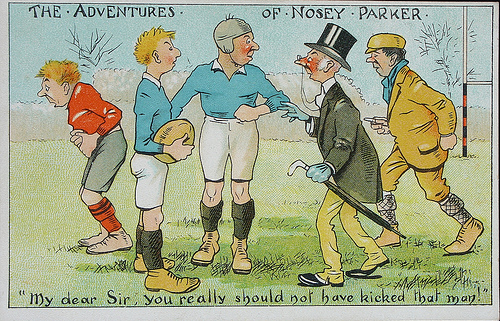
  This important match was played on Saturday, November 30, on the ground of the West of Scotland Cricket Club, at Partick, near Glasgow, and was the first international match played in Scotland according to the Association rules. Four matches had been previously played in London between London Scotchmen and Englishmen. (The illustration, from Sketches […]

Read More

history of ‘MAMIL’ (middle-aged man in Lycra)

  photograph from When exercise is dangerous: Endurance races risky for group sometimes called ‘middle-aged men in Lycra’ – the Chicago Tribune (Chicago, Illinois) – 17th July 2013     The word MAMIL is an acronym from the initial letters of middle-aged man in Lycra, probably punningly after mammal. Humorous and somewhat depreciative, it denotes a middle-aged […]

Read More

meaning and origin of the phrase ‘to lose one’s marbles’

    The noun marble, denoting a hard crystalline metamorphic rock resulting from the recrystallization of a limestone, is from Anglo-Norman forms such as marbre and marbelle, and from Old-French forms such as marbre, maubre and mabre, from classical Latin marmor. This Latin noun is from ancient Greek μάρμαρος (= mármaros), shining stone, marble, of […]

Read More

origin of the phrase ‘Simon says’

Of American-English origin, Simon says denotes a children’s game in which players must obey the leader’s instructions only if they are prefaced with the words Simon says; it also denotes the command itself. The name Simon was probably chosen for alliterative effect (Simon says). —Synonymous phrase: O’Grady says. The earliest instance of the phrase Simon […]

Read More

the authentic origin of ‘doolally’

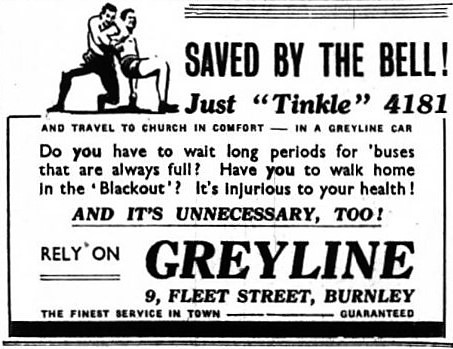
Four’s a Crowd.—A merry, irresponsible farce that dips frequently into pure crazy comedy. For this they have chosen to give Errol Flynn and Olivia de Havilland a “break” from their usual story book hero and heroine types. These two lovely young people do very well, but I cannot think that crazy comedy suits them best. […]

Read More

meaning and origin of the phrase ‘to chance one’s arm’

    The informal British phrase to chance one’s arm means to undertake something although it may be dangerous or unsuccessful. Its origin is unclear. The earliest use that I have found is from How our blue-jackets are fed, an article about the “diet of the British sailor at sea” published in The Weekly Telegraph […]

Read More

meaning and origin of the term ‘charley horse’

  The Charley Horse. The charley horse is abroad in the land and wasteth not at noonday. He is to a baseball player as the dingbat of commerce or the Indian to a St. Louis man. He stalketh seeking what player’s reputation he may devour. He is an iconoclast. He bats the pitcher out of […]

Read More

meaning and origin of the phrase ‘to toe the line’

    The phrase to toe the line means to accept the authority, policies or principles of a particular group, especially unwillingly. Its literal sense is to stand or crouch with the toes touching the line, especially at the start of a race or fight. The current meaning is an extension of a figurative usage, […]

Read More

history of the word ‘hot dog’

  Greenwich Village Fair – “Hot Dogs” – June 1917 photograph: Library of Congress     The term hot dog denotes a sausage, especially a frankfurter, served hot in a long roll split lengthways. In US slang, the noun dog has been used to denote a sausage since the late 19th century. This usage is first recorded […]

Read More

meaning and origin of ‘to leave no stone unturned’

The phrase to leave no stone unturned means to try every possible course of action in order to achieve something. (The equivalent French phrase has a cosmic dimension since it is remuer ciel et terre, literally, to move heaven and earth.) The image of turning every stone was already proverbial over 2000 years ago in […]

Read More