India, 1958—euphemistic appellation for verbal or physical sexual harassment of a woman by a man in a public place—refers to Eve, the first woman in the biblical account of the creation of the world, who is seen as a temptress
USA, 1975—to hastily or furtively leave a restaurant, cafe, etc., in order to avoid paying for one’s bill—also used as a noun, especially as a modifier—has also been used of meals eaten quickly
Lancashire, England, 1939—used in similative and comparative phrases such as ‘as —— as soft Mick’ and ‘more —— than soft Mick’, the noun ‘soft Mick’ (also ‘Soft Mick’) indicates a great quantity or degree
‘999’ denotes the telephone number used to contact the emergency services in the United Kingdom. This telephone number was introduced in 1937 by Walter Womersley, who was then the Assistant Postmaster-General.
USA, 1893—utterly despicable—jocular extension of ‘lower than a snake’—refers to the use of ‘low’ to mean ‘despicable’, and to the use of ‘snake’ to denote ‘a treacherous or deceitful person’
USA, 1963—a female police officer or a female traffic warden—puns on ‘dick’, slang for a man’s penis, and the name of Dick Tracy, a comic-strip detective created in 1931 by the U.S. cartoonist Chester Gould
Australia, 1970—a Melbourne City Council parking officer—the adjective ‘grey’ refers to the colour of those officers’ uniform; the noun ‘meanie’ refers to the nastiness displayed by those officers in the accomplishment of their duties
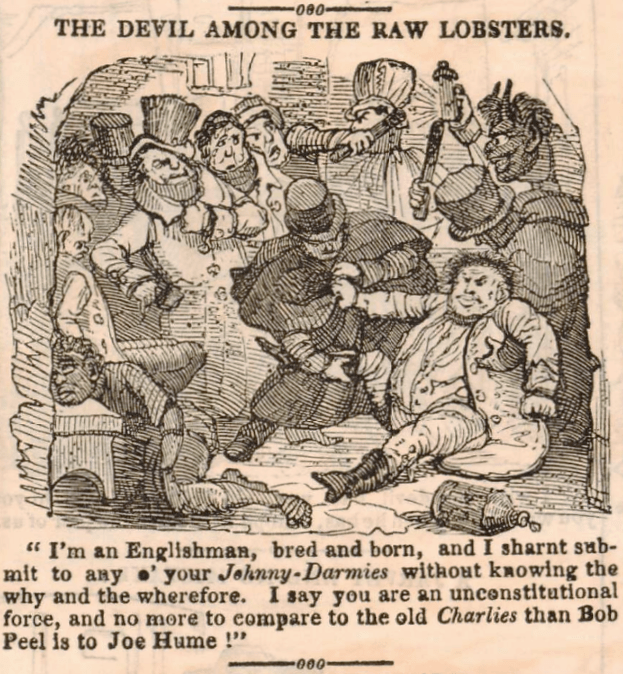
UK, 1830—‘Jenny Darby’, ‘Johnny Darm’, and variants, were originally opprobrious names for any member of the new Metropolitan Police introduced in 1829 by Robert Peel—alterations of ‘gendarme’, with full or partial folk-etymological remodelling variously after the female forename ‘Jenny’, the male forename ‘Johnny’, and the surname ‘Darby’

 word histories