The phrase curate’s egg means something that has both good and bad characteristics or parts. This phrase was popularised by True Humility, a cartoon by George du Maurier *, published in Punch, or the London Charivari (London, England) of Saturday 9th November 1895. This cartoon depicts a meek curate who, having been served a stale egg while […]
The phrase hell hath no fury like a woman scorned is a misquotation from The mourning bride, a tragedy by the English playwright and poet William Congreve (1670-1729), produced and published in 1697: Vile and ingrate! too late thou shalt repent The base Injustice thou hast done my Love. Yes, thou shalt know, spite of thy past Distress, […]
Literally denoting a mouse which lives in a church, the noun church mouse has long been used figuratively and allusively of a person likened to such a mouse, in terms of its proverbial attributes, especially in being impoverished or quiet. For example, the Anglo-Welsh historian and political writer James Howell (circa 1594-1666) recorded the following […]
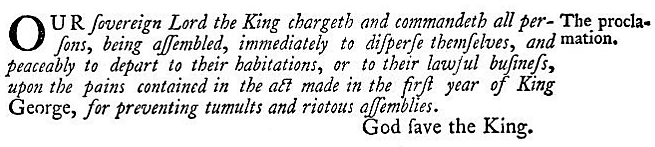
Our sovereign Lord the King chargeth and commandeth all persons, being assembled, immediately to disperse themselves, and peaceably to depart to their habitations, or to their lawful business, upon the pains contained in the act made in the first year of King George, for preventing tumults and riotous assemblies. […]
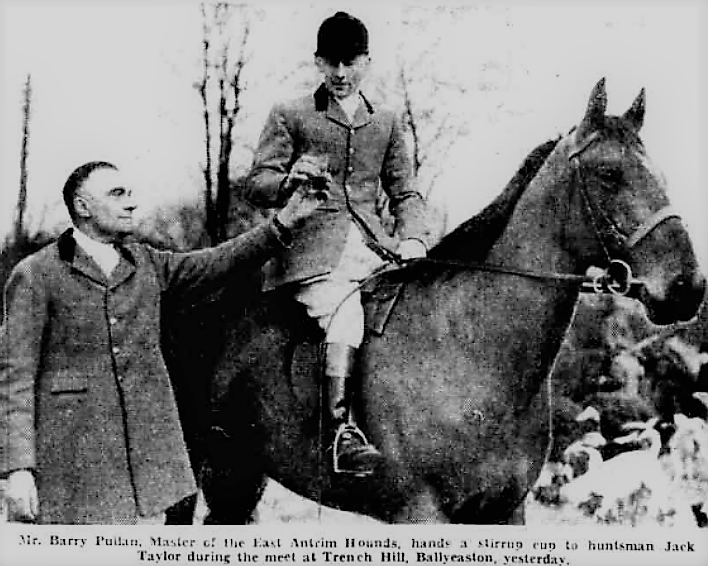
Huntsmen still use stirrup cup to designate an alcoholic drink offered to riders either as they are about to depart or when they return. Mr. Barry Puilan, Master of the East Antrim Hounds, hands a stirrup cup to huntsman Jack Taylor during the meet at Trench Hill, Ballyeaston, yesterday. from The Northern Whig and Belfast […]
To make (both) ends meet means to earn just enough money to live on. It is first recorded in The History of the Worthies of England (1662), by the Church of England clergyman Thomas Fuller (1607/8-61). The author wrote the following about the English Protestant leader Edmund Grindal (1519-83) – in the original text, to […]
The phrase money for old rope has various meanings: a profitable return for little or no trouble; a very easy job; a person or thing easy to profit from or to beat. The earliest occurrence of this phrase that I have found is from Driffield Coursing Club. “Peter Delmas” in the genial crowd, published in The Daily Mail (Hull, Yorkshire, England) […]
The English adjective imbecile is, via French, from the Latin imbecillus, or imbecillis, meaning weak, feeble, in body or mind. In his etymological encyclopaedia Originum sive Etymologiarum (The Origins or Etymologies), the Spanish archbishop and Doctor of the Church St Isidore of Seville (circa 560-636) wrote that the literal meaning of the Latin adjective is quasi sine baculo, as though (walking) without a supporting staff. The […]
The expression to amputate one’s mahogany is a jocular elaboration on to cut one’s stick, which means to take one’s departure. The following definition is from A Dictionary of Modern Slang, Cant, and Vulgar Words (2nd edition – 1860), by the English publisher and author John Camden Hotten (1832-1873): Cut one’s stick, to be off […]
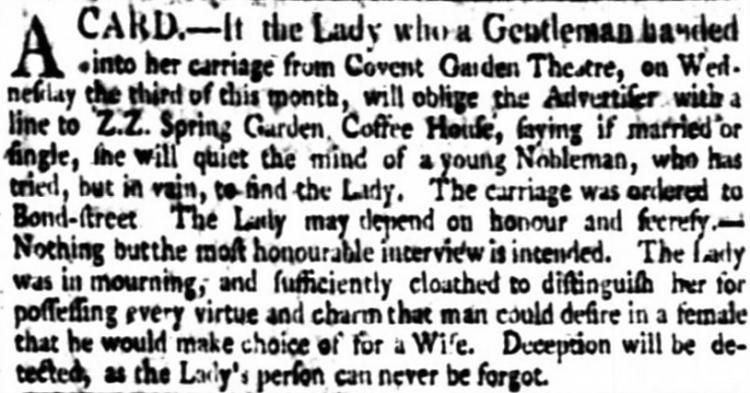
advertisement published in The Times (London) on 18th December 1800: A CARD.—If the Lady who a Gentleman handed into her carriage from Covent Garden Theatre, on Wednesday, the third of this month, will oblige the Advertiser with a line to Z. Z., Spring Garden Coffee House, saying if married or single, she will […]