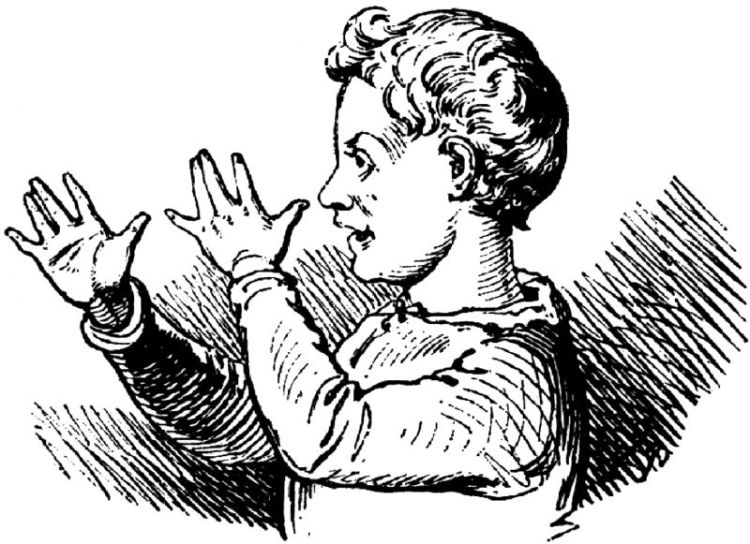
The phrase to cock (also to cut, to pull) a snook, or snooks, means: – literally: to make a gesture of derision by putting one’s thumb to one’s nose and outspreading the fingers; this gesture can be intensified by joining the tip of the little finger to the thumb of the other hand, whose fingers are […]
In the USA, cocked hat denoted a game similar to ninepins, except that only three pins were set up, in triangular position. It took its name from cocked hat in the sense of a hat with the brim permanently turned up (i.e. cocked), especially the three-cornered hat of this shape worn at the end […]
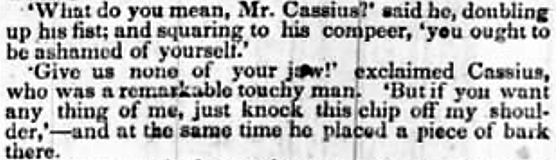
The phrase a chip on one’s shoulder means a challenging or belligerent attitude. In A Concise Dictionary of Phrase and Fable (1993), B. A. Phythian explains: There is an unusual degree of unanimity about the provenance of have a chip on one’s shoulder (bear a grudge; behave anti-socially). Unlikely as it may seem, […]
The phrase cock-and-bull story denotes an implausible story used as an explanation or excuse. The French expression sauter du coq à l’âne, literally to jump from the cock to the (male) ass, means to skip from one subject to another, the image being that incoherent talking is like switching abruptly from the topic of the cock to that of […]
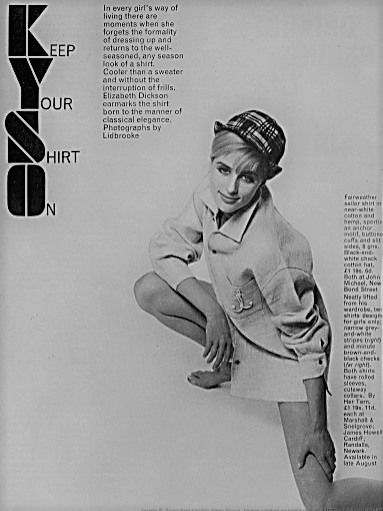
Keep your shirt on In every girl’s way of living there are moments when she forgets the formality of dressing up and returns to the well-seasoned, any season look of a shirt. Cooler than a sweater and without the interruption of frills. Elizabeth Dickson earmarks the shirt born to the manner of classical elegance. advertisement […]
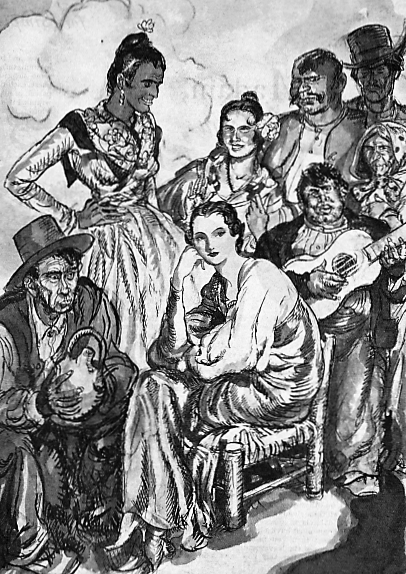
We’ll show her dressed to the nines, posing with a tribe of gypsies in the Pyrenees illustration by Steven Spurrier for The Vanishing Star. A Comedy of Love and Strategy in Hollywood, by Reita Weiman, published in Britannia and Eve (London) of December 1932 The phrase dressed to the nines means dressed […]
Of American-English origin, the phrase to look, or to feel, like something the cat has brought in means to look, or to feel, exhausted or bedraggled. The earliest instances of the form, if not of the phrase, that I have found are in, and as the title of, a story published in The Perrysburg Journal (Perrysburg, Ohio) of 2nd February 1877 […]
The word daisy is from Old English dæges éage, meaning day’s eye. This name alludes to the fact that the flower of this plant opens in the morning and closes at night, as the human eye does. Perhaps its petals, which close over its bright centre at the end of the day, were also thought to resemble human eyelashes. But the […]
Several colloquial phrases associate daisies with being dead: under the daisies, which means dead and buried, to push up (the) daisies and to turn one’s toes up to the daisies, which mean to be in one’s grave, to be dead. The Clare Journal, and Ennis Advertiser (Ireland) of 9th August 1838 published this poem: […]
The phrase the cup that cheers but not inebriates and its variants refer to tea as a drink which invigorates a person without causing drunkenness. It is from The Winter Evening, the fourth book of The Task. A Poem, in six Books (1785), by the English poet and letter-writer William Cowper (1731-1800): Now stir the fire, and close the […]