origin of the adjective ‘barmy’ (crazy)
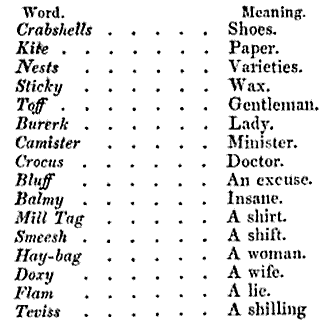
A ‘barmy’ person has a ‘frothy top’, insubstantial brains, from ‘barm’, the froth that forms on the top of fermenting malt liquors.
Read More
“ad fontes!”
A ‘barmy’ person has a ‘frothy top’, insubstantial brains, from ‘barm’, the froth that forms on the top of fermenting malt liquors.
Read More
plate 19: La Trénis, Contredanse source: gallica.bnf.fr / Bibliothèque Nationale de France from the 1931 reprint of the caricatures published under the title of Le Bon Genre (1827 edition), including Observations sur les modes et les usages de Paris; the following comment about La Trénis accompanies this plate: (Année 1805.) Cette danse porte le […]
Read More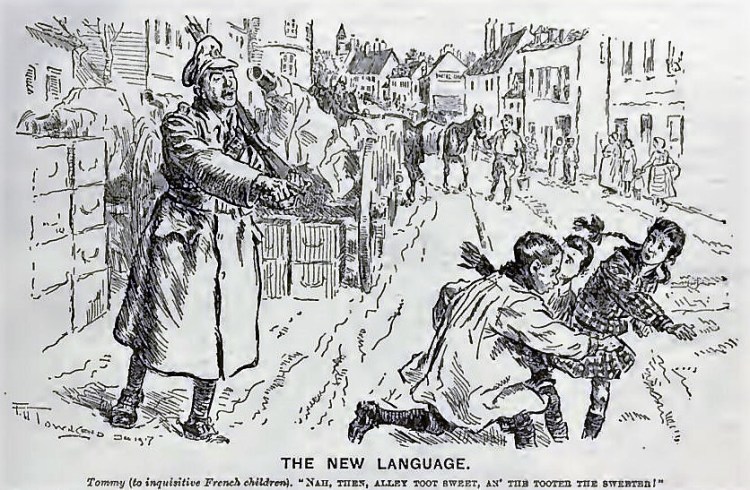
The adverb toot sweet means straight away, immediately. Humorously after the English words toot and sweet, it represents an anglicised pronunciation of the synonymous French adverb tout de suite. Before the First World War, it was only used in representations of French speech. For example, an article titled Galloglossia, published in Sharpe’s London Magazine […]
Read More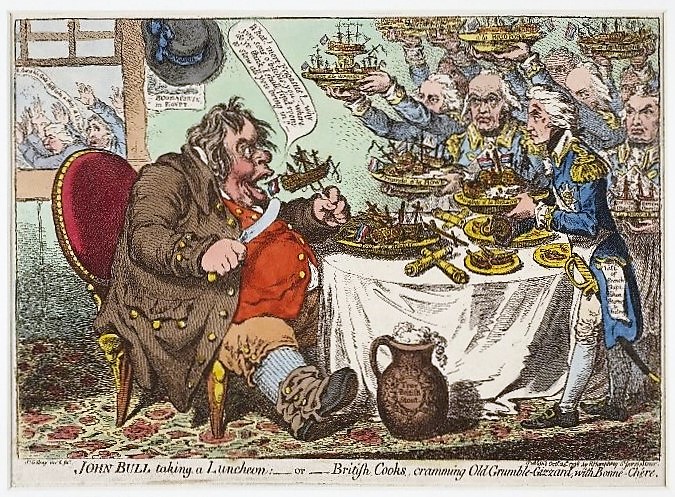
John Bull taking a Luncheon:—or—British Cooks, cramming Old Grumble-Gizzard, with Bonne-Chère. hand-coloured etching by James Gillray, published on 24th October 1798 — © Trustees of the British Museum This print was published just after Nelson’s victory at the Battle of the Nile. He is shown in the forefront of British admirals and naval heroes, serving up […]
Read MoreThe noun clue appeared as a variant spelling of clew, of same pronunciation. Not frequent until the 17th century, clue has become the prevailing form of the word in the sense of a fact or idea that serves to reveal something or solve a problem. The word is from Old English cliwen, cleowen, meaning a ball formed by winding yarn, twine or thread (it is still one […]
Read Moreadvertisement for Blotto brothers’ triporteurs Le Jardin des Modes nouvelles – 15th October 1913 The adjective blotto, which means drunk [however, cf. note 1], originated in British military slang during the First World War. It is first recorded in this sense in the chapter Slang in a War Hospital of Observations of an Orderly: […]
Read More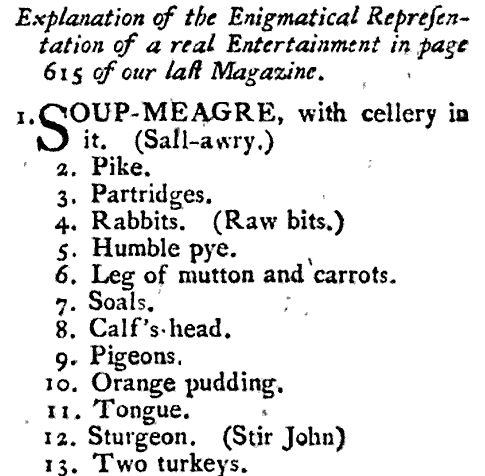
A puzzle published in The Hibernian Magazine, or, Compendium of Entertaining Knowledge (Dublin, Ireland) in 1774 punned on the humble of humble pie, which may indicate that the latter term was already used figuratively at that time. The following is from the October issue: […]
Read More
The noun marble, denoting a hard crystalline metamorphic rock resulting from the recrystallization of a limestone, is from Anglo-Norman forms such as marbre and marbelle, and from Old-French forms such as marbre, maubre and mabre, from classical Latin marmor. This Latin noun is from ancient Greek μάρμαρος (= mármaros), shining stone, marble, of […]
Read More
photograph: Farm Shop The noun mayonnaise denotes a thick, creamy sauce consisting of egg yolks emulsified with oil and seasoned, used as a cold dressing or accompaniment for salad, eggs, fish, etc., or as the base for other sauces. It is used in two French phrases: la mayonnaise prend, literally, the mayonnaise […]
Read More
Eastern Vaudeville Bans Unseemly Slang A general order has been sent out from the Keith office to all Keith, Moss and Proctor vaudeville houses, instructing resident managers to hereafter bar the use by artists of the current slang phrases, “That’s the Cat’s Meow,” “Cat’s Pajamas,” “Hot Dog,” “Hot Cat,” etc. This means the phrases […]
Read More word histories