origin of ‘eavesdrop’
‘To eavesdrop’ originally referred to standing within the eavesdrop (the ground on to which water drips from the eaves of a house) in order to overhear what is going on inside.
Read More
“ad fontes!”
‘To eavesdrop’ originally referred to standing within the eavesdrop (the ground on to which water drips from the eaves of a house) in order to overhear what is going on inside.
Read More‘maudlin’: tearfully sentimental – from the Middle-English name ‘Maudelen’, designating Mary Magdalene, a follower of Jesus, customarily represented as weeping
Read More‘The straight and narrow’: allusion to the Sermon on the Mount. ‘Straight’ is an alteration of ‘strait’, meaning ‘so narrow as to make transit difficult’.
Read MoreThe word ‘slave’ is from Medieval Latin ‘Sclavus’, ‘Slav’, because the Slavic peoples were frequently reduced to a servile condition by the Germanic conquest.
Read More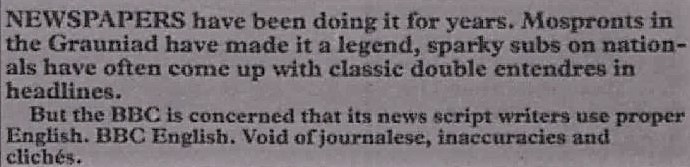
‘Grauniad’, the nickname for the Guardian, was reportedly given to this British newspaper by the magazine Private Eye because of its typesetting errors.
Read MoreThe verb ‘sneeze’ is an alteration of the obsolete verb ‘fnese’ due to misreading or misprinting it as ‘ſnese’ (= ‘snese’).
Read More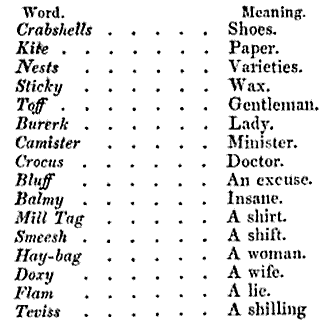
A ‘barmy’ person has a ‘frothy top’, insubstantial brains, from ‘barm’, the froth that forms on the top of fermenting malt liquors.
Read More
plate 19: La Trénis, Contredanse source: gallica.bnf.fr / Bibliothèque Nationale de France from the 1931 reprint of the caricatures published under the title of Le Bon Genre (1827 edition), including Observations sur les modes et les usages de Paris; the following comment about La Trénis accompanies this plate: (Année 1805.) Cette danse porte le […]
Read More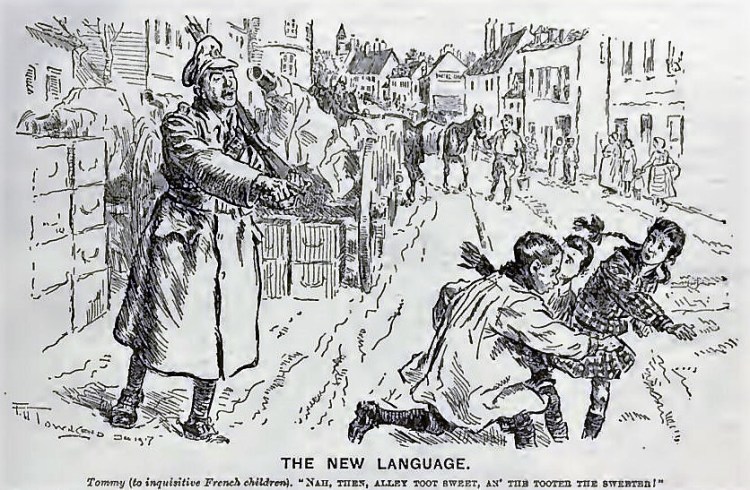
The adverb toot sweet means straight away, immediately. Humorously after the English words toot and sweet, it represents an anglicised pronunciation of the synonymous French adverb tout de suite. Before the First World War, it was only used in representations of French speech. For example, an article titled Galloglossia, published in Sharpe’s London Magazine […]
Read More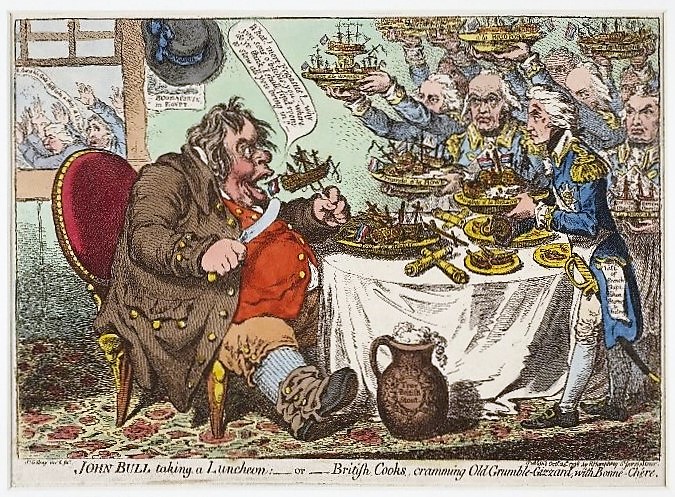
John Bull taking a Luncheon:—or—British Cooks, cramming Old Grumble-Gizzard, with Bonne-Chère. hand-coloured etching by James Gillray, published on 24th October 1798 — © Trustees of the British Museum This print was published just after Nelson’s victory at the Battle of the Nile. He is shown in the forefront of British admirals and naval heroes, serving up […]
Read More word histories