The phrase to miss the bus, or the boat, etc., means to be too slow to take advantage of an opportunity. In A Concise Dictionary of Phrase and Fable (1993), B. A. Phythian explained: This expression is said to originate in an Oxford story of the 1840s about John Henry Newman, fellow of Oriel College, […]
The French phrase cherchez la femme, search for the woman, is used to indicate that the key to a problem or mystery is a woman, and that she need only be found for the matter to be solved. It first appeared as a catchphrase used by M. Jackal, a police detective, in Les Mohicans de Paris, […]
The phrase far from the madding crowd is used in reference to a private or secluded place. It is an allusion to An Elegy wrote in a Country Church Yard (published in 1751), by the English poet Thomas Gray (1716-71). When he composed this poem, Thomas Gray was living near St Giles’ parish church at Stoke Poges in Buckinghamshire. Meditating […]
The expression knight in shining armour denotes a person regarded as a medieval knight in respect of his chivalrous spirit, especially towards women. In A Concise Dictionary of Phrase and Fable (1993), B. A. Phythian explained: Despite its medieval feel, this is a twentieth-century phrase, first recorded in print in Victor Canning’s Whip Hand (1965). […]
The noun fly-by-night, or fly-by-nighter, denotes an unreliable or untrustworthy person. As an adjective, fly-by-night means unreliable or untrustworthy, especially in business or financial matters. However, the term seems to go back to the idea of witches flying on their broomsticks by night. At least, its first recorded instance is as a term of contempt […]
The phrase a skeleton at the feast, or at the banquet, denotes a person or event that brings gloom or sadness to an occasion of joy or celebration. This was originally an allusion to the practice of the ancient Egyptians, as recorded by the Greek biographer and philosopher Plutarch (circa 46-circa 120) in The Dinner of the Seven Wise […]
The term Richard Snary is an alteration, with humorous substitution of Richard for the pet-form Dick, of Dick Snary, itself a humorous remodelling of dictionary. These terms are first recorded in Apollo shrouing composed for the schollars of the free-schoole of Hadleigh in Suffolke. And acted by them on Shrouetuesday, being the sixt of February, 1626, by William Hawkins (died 1637): – I […]
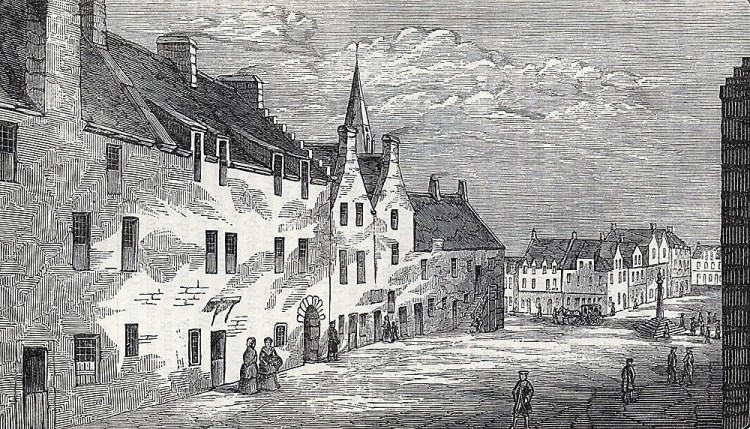
the Rotten-row in Glasgow, circa 1570 image: The Glasgow Story The street name Rotten Row occurs in many different towns. For example, The Caledonian Mercury (Edinburgh) of 10th December 1728 published the following advertisement: There is just come to Leith, a Parcel of fine Figs both in Casks and Frails [= baskets], […]
The noun pastis designates an aniseed-flavoured aperitif, while pastiche, or pasticcio, denotes a work of art that imitates the style of another artist or period and a work of art that mixes styles, materials, etc. Unlikely as it may seem, these words are doublets, or etymological twins: although they differ in form and meaning, they go […]
MEANINGS – the last part of something, especially when regarded as less important or interesting – British, informal: a cigarette end ORIGIN The obsolete adjective flag, attested in the late 16th century, meant flabby, hanging down. It was either an onomatopoeic formation or, via Middle French flac, from Latin flaccus, of same […]