The word kidney, which is attested around 1325, is of unclear origin. The second element of the Middle-English form kidenei, plural kideneiren, is apparently ey, plural eyren, meaning egg (cf. German Eier, literally eggs, used to mean testicles). The first element remains uncertain; it is perhaps identical with cud. The Anglo-Saxon name for kidney was […]
James Crichton of Clunie (circa 1560-1582) was a Scottish prodigy of intellectual and knightly accomplishments, and the epithet admirable became traditionally applied to him. The Scottish scholar John Johnston (circa 1565-1611) used the Latin adjective admirabilis in Heroes ex omni historia Scotica lectissimi (1603), a collection of biographies and eulogies in elegiac couplets of great […]
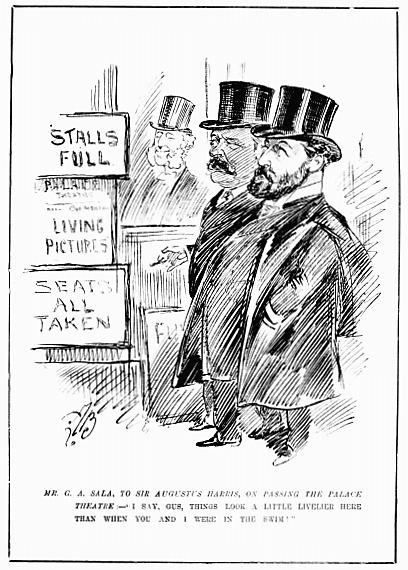
G. A. SALA, TO SIR AUGUSTUS HARRIS, ON PASSING THE PALACE THEATRE:—“I SAY, GUS, THINGS LOOK A LITTLE LIVELIER HERE THAN WHEN YOU AND I WERE IN THE SWIM!” — from The Entr’acte and Limelight (London) of 10th March 1894 (Augustus Harris (1825-73) was a British actor and theatre manager. George Augustus Sala (1828-95), was an […]
In A Dictionarie of the French and English Tongues (1611), Randle Cotgrave gave the following definition of the French word gazette: A certaine Venetian coyne scarce worth our farthing; also, a Bill of Newes; or, a short Relation of the generall occurrences of the Time, forged most commonly at Venice, and thence dispersed, euery month, into most parts of Christendome. […]
Figuratively, a loose cannon is an unpredictable or uncontrolled person who is liable to cause unintentional damage. But in practice, it was one inadequately lashed in place on the deck of a ship, which caused havoc by rolling dangerously and unpredictably. The first known mention of a loose cannon being tossed about the deck of […]
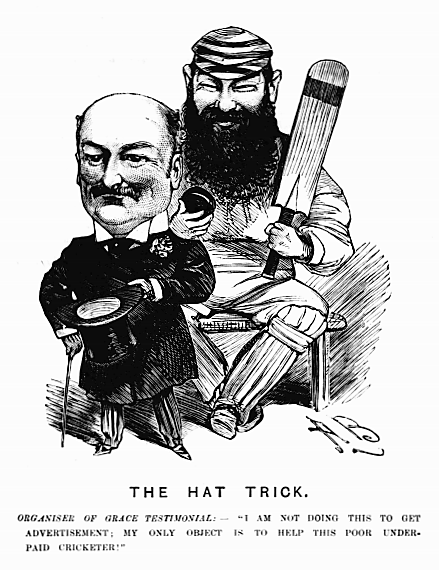
THE HAT TRICK. ORGANISER OF GRACE TESTIMONIAL: — “I AM NOT DOING THIS TO GET ADVERTISEMENT; MY ONLY OBJECT IS TO HELP THIS POOR UNDERPAID CRICKETER!” caricature from The Entr’acte & Limelight (London) – 22nd June 1895 In 1895, a testimonial fund was set up for W. G. Grace (1848-1915), the Grand Old Man […]
According to the National Museum of the Royal New Zealand Navy, in 1731 rum was made an official issue to seamen and the daily half pint was issued in two equal parts, one in the morning and the other in the evening. This was neat spirit and drunkenness became rife especially on the West Indies […]
The phrase (as) happy as a clam means well pleased, quite contented—cf. also happy as a sandboy and happy as Larry. In Dictionary of English Phrases (2008), Robert Allen explains: This American simile is more understandable in its full form, happy as a clam in high water (or at high tide). In these conditions, clams […]
The phrase (as) happy (or jolly) as a sandboy means extremely happy or carefree—cf. also happy as a clam and happy as Larry. A sandboy was a boy hawking sand for sale. It seems that the earliest use of the word is The Rider and Sand-boy: a Tale, the title of a poem written by a certain Mr Meyler and published in Harvest-Home in 1805: […]
The verb nail is used to mean to expose or reveal the falsehood of an allegation, assertion, etc., especially to prevent further dissemination. This use is first recorded in An Oration delivered at the Celebration in Philadelphia of the 106th Anniversary of the Birthday of Thomas Paine, by John Alberger, published in The North American […]