the coinage of an Irish political term: ‘whataboutery’
1974—coined by the Irish journalist John Healy with reference to the Troubles in Northern Ireland
Read More
“ad fontes!”
1974—coined by the Irish journalist John Healy with reference to the Troubles in Northern Ireland
Read More
Fundamentally, I object to the will of any group to artificially modify language in order to impose their world view.
Read Morecoined by Thomas Jefferson in Notes on the State of Virginia, first published in Paris in 1785—literal meaning: ‘to make little’ (composed of the prefix ‘be-’ and the adjective ‘little’)—criticised in The European Magazine, and London Review of August 1787 when the book was published in London
Read More‘eggcorn’: alteration of a word or phrase through the mishearing or reinterpretation of one or more of its elements as a similar-sounding word—coined in 2003 on the website Language Log with reference to a misinterpretation of ‘acorn’ as ‘eggcorn’
Read More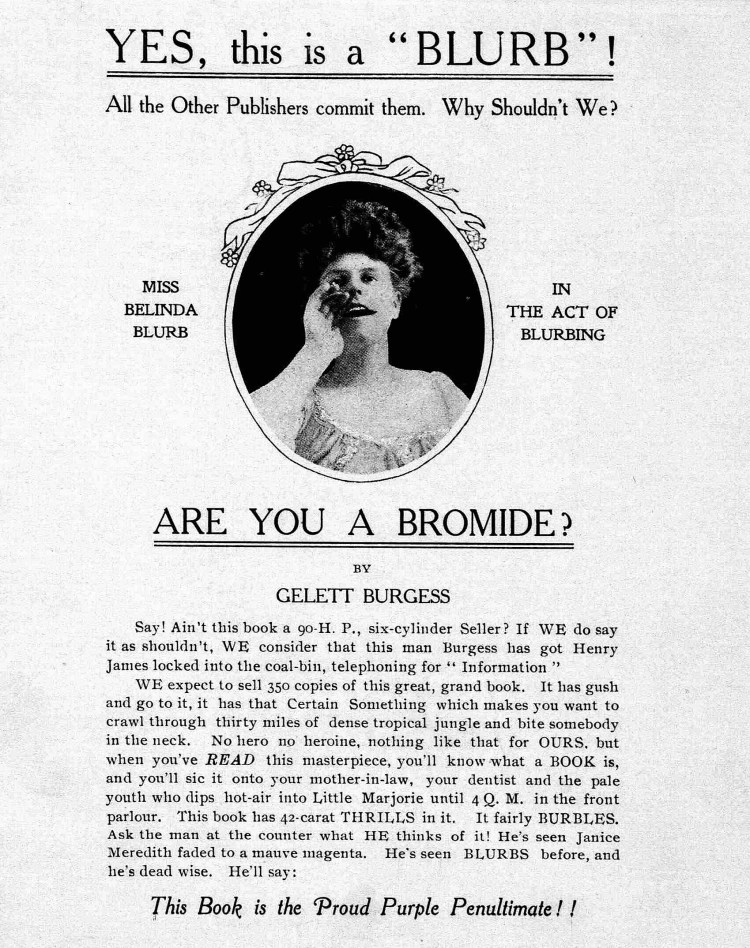
For a limited edition of his book ‘Are You a Bromide?’ sent to the guests of the 1907 annual dinner of the American Booksellers’ Association, Gelett Burgess devised a jacket showing a young lady whom he facetiously dubbed Miss Belinda Blurb.
Read More
UK, ‘greengrocer’s apostrophe’ – ‘apostrofly’: the mistaken use of an apostrophe, especially its insertion before the final ‘s’ of an ordinary plural form
Read More
blend of ‘adult’ and ‘adolescent’: adult who has retained the interests, behaviour or lifestyle of adolescence — origin USA, first attested in 1945
Read MoreThe word ‘slave’ is from Medieval Latin ‘Sclavus’, ‘Slav’, because the Slavic peoples were frequently reduced to a servile condition by the Germanic conquest.
Read More
‘Gorgeous Wrecks’ (UK, WWI): members of the Volunteer Training Corps, from the letters ‘G.R.’ (‘Government Recognition’) interpreted as meaning ‘Georgius Rex’
Read More
The pharmaceutical firm Burroughs, Wellcome & Company was founded in London in 1880 by the American-born entrepreneurs Silas Burroughs (1846-95) and Henry Wellcome (1853-1936). They registered the name Tabloid (with capital initial) on 14th March 1884, as a trademark for concentrated drugs and medicines in tablet form. (It remains a proprietary name to this day.) The firm applied the […]
Read More word histories