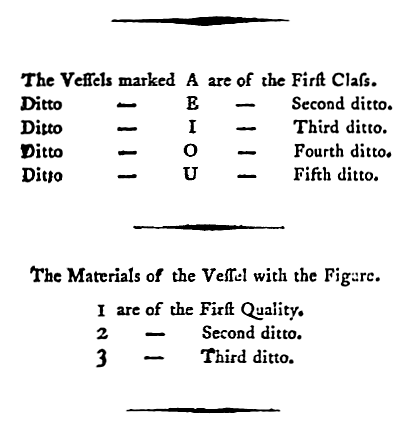
MEANING first class, outstanding ORIGIN Lloyd’s Register, historically Lloyd’s Register of Shipping, is an independent society formed in 1760 by a group of merchants operating at Lloyd’s coffee house in London, which surveys ships to ensure compliance with standards of strength and maintenance. The name also denotes an annual publication giving details […]
The word Mayday, which dates from 1923, is used as an international radio distress signal, especially by ships and aircraft. It was supposedly coined by Frederick Stanley Mockford (1897-1962), a senior radio officer at London’s Croydon Airport, but this has not been substantiated: the fact that this story has often been repeated gives it a semblance […]
The phrase ‘pour encourager les autres’ (‘in order to encourage the others’) was coined by Voltaire with reference to the execution of Admiral John Byng in 1757.
Figuratively, a loose cannon is an unpredictable or uncontrolled person who is liable to cause unintentional damage. But in practice, it was one inadequately lashed in place on the deck of a ship, which caused havoc by rolling dangerously and unpredictably. The first known mention of a loose cannon being tossed about the deck of […]
According to the National Museum of the Royal New Zealand Navy, in 1731 rum was made an official issue to seamen and the daily half pint was issued in two equal parts, one in the morning and the other in the evening. This was neat spirit and drunkenness became rife especially on the West Indies […]
“HUNS KILL WOMEN AND CHILDREN!” “TELL THAT TO THE MARINES!” First-World-War US recruiting poster by James Montgomery Flagg image: Disappearing Idioms This poster, which attracted a great deal of attention, portrays an angry-looking young man in the act of pulling off his coat as though he were anxious to get into a fight. The […]
The compound apple-pie order means perfect order or neatness. Its first known user was a British Royal Navy officer, Admiral Sir Thomas Pasley (1734-1808), in his journal in 1780: Exercised Great Guns and small Arms as I constantly do every Tuesday and Friday, and fired Volleys; Wash and Fumigate, Wednesdays and Saturdays, Air Spare Sails […]
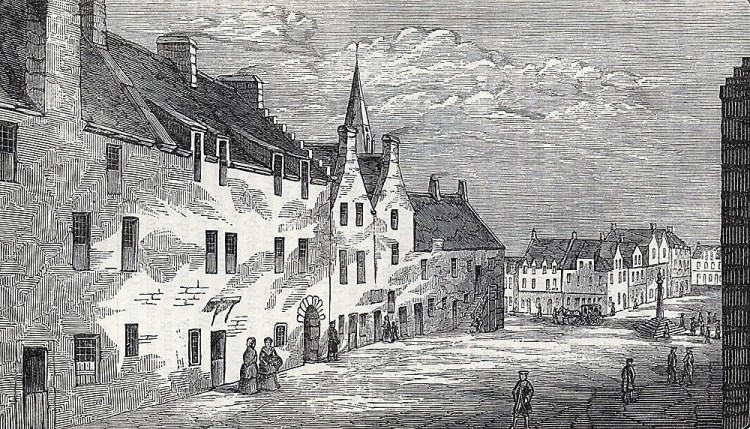
the Rotten-row in Glasgow, circa 1570 image: The Glasgow Story The street name Rotten Row occurs in many different towns. For example, The Caledonian Mercury (Edinburgh) of 10th December 1728 published the following advertisement: There is just come to Leith, a Parcel of fine Figs both in Casks and Frails [= baskets], […]
MEANING a persistent or desperate hope that is unlikely to be fulfilled, a faint hope, a ‘hope against hope’ ORIGIN On the face of it, this is a curious expression, because the adjective forlorn does not normally mean faint but miserable, lonely, forsaken or sad. The current sense of forlorn hope derives […]
The noun ‘gongoozler’, denoting a person who stares protractedly at anything, originally designated an idler who stares at length at activity on a canal.