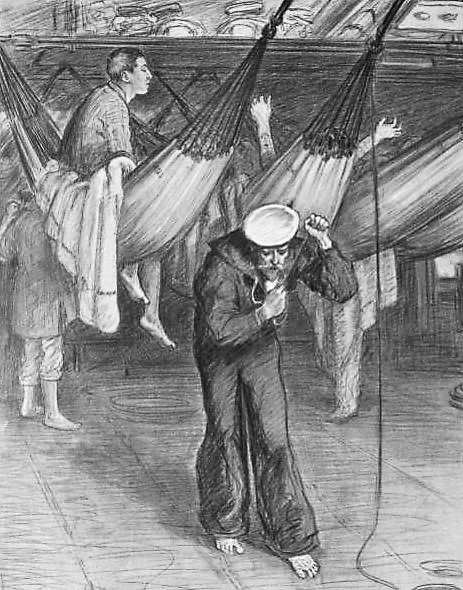
HOW A SAILOR BEGINS HIS DAY’S WORK A Scene on board H.M.S. “Trafalgar.” The boatswain blows his whistle at 5 o’clock in the morning and cries, “All hands.” Diving in and out beneath the hammocks he goes with bent head calling the same old cry of Nelson’s day: “Rise and shine. Show a leg—show […]
It has often been said that the noun banger appeared as British slang for sausage in the World War One trenches (cf. also Zeppelin). But, in fact, it was in use in the British Navy before the outbreak of the war. On 27th July 1904, The Tatler (London) published The real letters of […]
This advertisement for the second season (2014) of comedienne Amy Schumer’s sketch show, Inside Amy Schumer, highlighted both the “hot” and “mess” sides of her personality — photograph: Jamey Welch Creative The primary meanings of the noun mess are a serving of food, a course, a meal, a prepared dish of a specified […]
The informal British phrase to chance one’s arm means to undertake something although it may be dangerous or unsuccessful. Its origin is unclear. The earliest use that I have found is from How our blue-jackets are fed, an article about the “diet of the British sailor at sea” published in The Weekly Telegraph […]
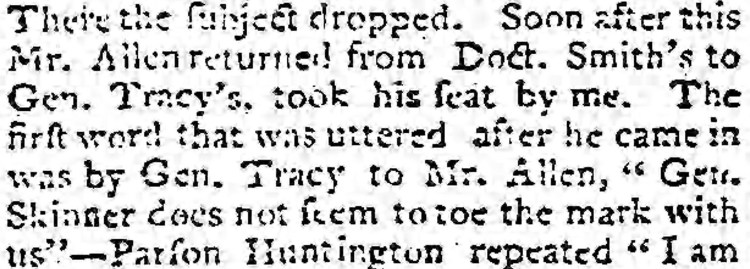
The phrase to toe the line means to accept the authority, policies or principles of a particular group, especially unwillingly. Its literal sense is to stand or crouch with the toes touching the line, especially at the start of a race or fight. The current meaning is an extension of a figurative usage, […]
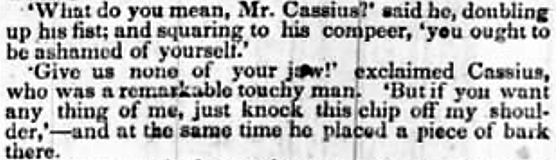
The phrase a chip on one’s shoulder means a challenging or belligerent attitude. In A Concise Dictionary of Phrase and Fable (1993), B. A. Phythian explains: There is an unusual degree of unanimity about the provenance of have a chip on one’s shoulder (bear a grudge; behave anti-socially). Unlikely as it may seem, […]
The phrase money for old rope has various meanings: a profitable return for little or no trouble; a very easy job; a person or thing easy to profit from or to beat. The earliest occurrence of this phrase that I have found is from Driffield Coursing Club. “Peter Delmas” in the genial crowd, published in The Daily Mail (Hull, Yorkshire, England) […]
A New Song, sung by Mr. Champness in Harlequin’s Invasion from The Universal Magazine of Knowledge and Pleasure – March 1760 The phrase heart of oak denotes a person with a strong, courageous nature, especially a brave and loyal soldier or sailor, and a courageous or valorous spirit. Its literal meaning is the heartwood of the oak. The heartwood […]
In the chapter Our lunatic contributor of Words and names (1933), the British philologist Ernest Weekley (1865-1954) wrote: The correspondence columns of our middlebrow weeklies and of our two Sunday papers are the happy hunting-ground of the amateur etymologist. A few years ago he published the discovery that ‘nap,’ ‘a short sleep,’ was derived from Napoleon’s power of sleeping […]
image: nageur-sauveteur MEANINGS The noun starboard denotes the side of a ship or aircraft that is on the right when one is facing forward, while port denotes the opposing side. ORIGINS From the Germanic bases of the nouns steer and board, starboard, which appeared in Old English as steorbord, denotes literally the steer board, the steer side. This side of the ship […]