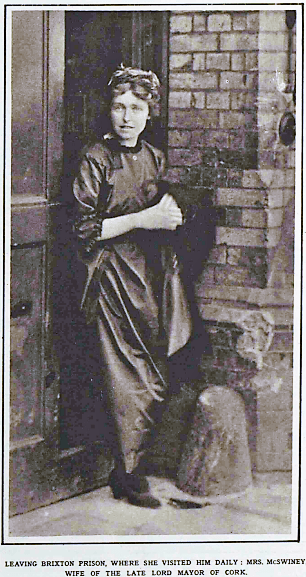
the Prisoners (Temporary Discharge for Ill-health) Act, 1913 – image: http://www.parliament.uk The Prisoners (Temporary Discharge for Ill-health) Act, 1913 was rushed through Parliament by Herbert Henry Asquith’s Liberal government in order to deal with the problem of hunger-striking suffragettes, who were force-fed, which led to a public outcry. The Act allowed for the […]
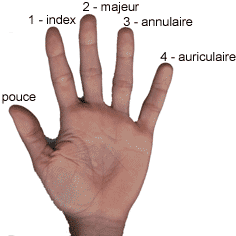
In the Etymologies (Etymologiarum sive Originum libri viginti), compiled between around 615 and the early 630s in the form of an encyclopaedia arranged by subject matter, St Isidore (circa 560–636), bishop of Seville and Doctor of the Church, wrote the following about the names of the fingers (the original Latin words are […]
The French masculine noun sanglier denotes a full-grown wild boar. It literally means a boar living on its own, separated from the herd, since, via Old and Middle French forms such as sengler and senglier, it is from the popular Latin singularis (porcus), solitary (pig) – cf. Middle-French terms such as porc sanglier, and in the Vulgate, the Latin version of the Bible, singularis ferus, the noun ferus meaning wild animal (cf. the […]
The Latin noun lupus/-pi meant wolf. It is kindred with ancient Greek λύκος (lukos). —Cf. lycanthrope, which originally designated a person who believes that he or she is a wolf, and which, via the modern Latin noun lycanthrōpus, is from Greek λυκάνθρωπος (lukanthropos), literally wolf-man, from λύκος and ἄνθρωπος (anthropos), man. The Latin lupus has sometimes been used in English in the sense of wolf; for instance, a Scottish […]
This Latin expression is composed of virtus, virtue, and dormitiva, feminine of dormitivus, dormitive. It first appeared in the following lines in dog Latin of Le Malade imaginaire (The Imaginary Invalid – 1673), in which the French playwright Molière (Jean-Baptiste Poquelin – 1622-73) satirised the circular explanations sometimes used in early medicine: (original edition) BACHELIERVUS. Mihi à docto Doctore Domandatur causam & rationem, […]
MEANING any plant of the European genus Reseda, including mignonette and dyer’s rocket, which has small spikes of greenish, yellowish or whitish flowers ORIGIN Through translations of Naturalis Historia (Natural History – 77), a vast encyclopaedia of the natural and human worlds by the Roman statesman and scholar Pliny the Elder […]
MEANINGS – the last part of something, especially when regarded as less important or interesting – British, informal: a cigarette end ORIGIN The obsolete adjective flag, attested in the late 16th century, meant flabby, hanging down. It was either an onomatopoeic formation or, via Middle French flac, from Latin flaccus, of same […]
the 1905 edition of Le Petit Larousse illustré, a French-language encyclopaedic dictionary published by the Éditions Larousse In 1890, Eugène Grasset (1845-1917) designed the image of la Semeuse (the Sower) blowing dandelion seeds, which accompanies the motto of the Éditions Larousse, Je sème à tout vent (I sow to the four winds). The word […]