It is a circumstance rather remarkable, that the answer to Sir George Rodney’s summons of surrender, given by the respective Dutch Governours of the Islands of St. Eustatius and St. Martin’s, should be couched exactly in the same form of words without the smallest variation; from this we are either to suppose, that the […]
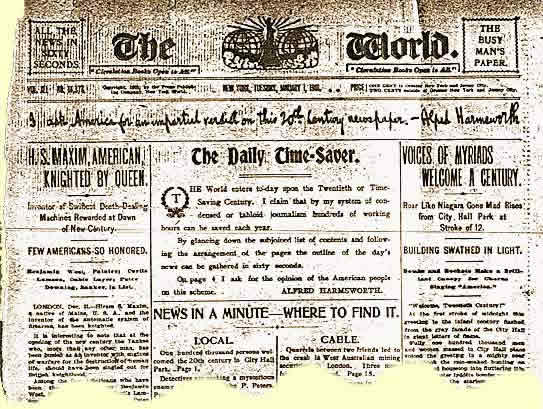
TABLOID DRAMA. SHAKESPEARE “BOILED DOWN” FOR THE MUSIC HALLS. Mr. Cecil Raleigh is in favour of Shakespeare being “boiled down” for the music-hall stage. It was after Mr. George Fuller Golden’s lecture on the influence of theatres upon the music-halls, to the members of the O.P. Club at the Criterion Restaurant, last night, […]
The pharmaceutical firm Burroughs, Wellcome & Company was founded in London in 1880 by the American-born entrepreneurs Silas Burroughs (1846-95) and Henry Wellcome (1853-1936). They registered the name Tabloid (with capital initial) on 14th March 1884, as a trademark for concentrated drugs and medicines in tablet form. (It remains a proprietary name to this day.) The firm applied the […]
Four’s a Crowd.—A merry, irresponsible farce that dips frequently into pure crazy comedy. For this they have chosen to give Errol Flynn and Olivia de Havilland a “break” from their usual story book hero and heroine types. These two lovely young people do very well, but I cannot think that crazy comedy suits them best. […]
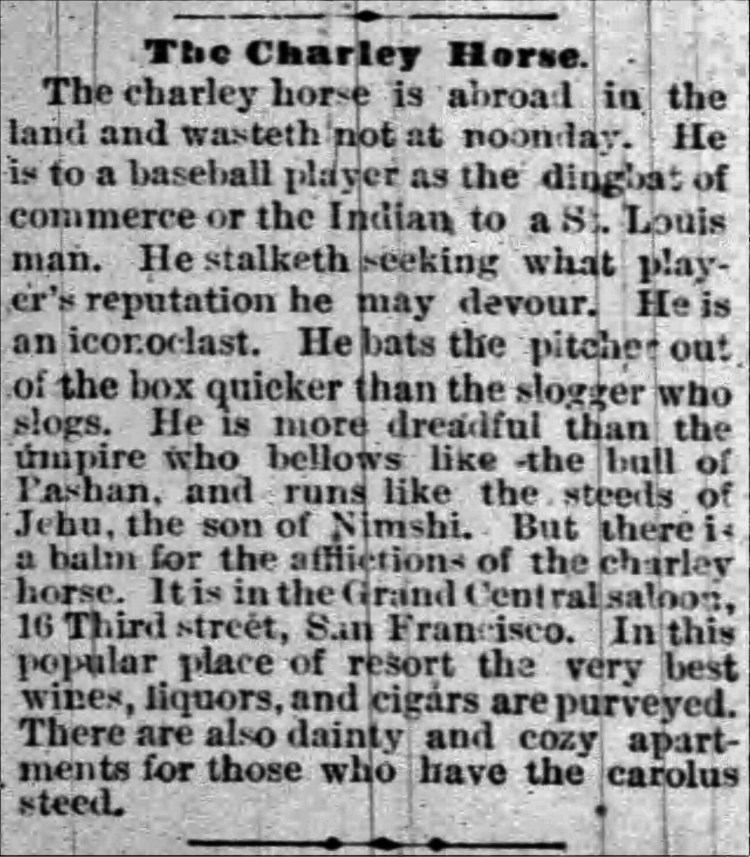
The Charley Horse. The charley horse is abroad in the land and wasteth not at noonday. He is to a baseball player as the dingbat of commerce or the Indian to a St. Louis man. He stalketh seeking what player’s reputation he may devour. He is an iconoclast. He bats the pitcher out of […]
The phrase cock-and-bull story denotes an implausible story used as an explanation or excuse. The French expression sauter du coq à l’âne, literally to jump from the cock to the (male) ass, means to skip from one subject to another, the image being that incoherent talking is like switching abruptly from the topic of the cock to that of […]
Sir John Herschel The announcement last Friday of the death, at the age of 81, of the Rev. Sir John Herschel, Bart., which occurred at Observatory House, Slough, revives a host of memories of 18th century Bath. Sir John Herschel was the great-grandson of Sir William Herschel, the famous astronomer, who discovered from his scientific […]
The noun marrowsky, which has also been spelt Marouski, Marowsky, morowski and mowrowsky, denotes a variety of slang, or a slip in speaking, characterised by the transposition of the initial letters or syllables of two words. The more usual term is spoonerism (cf. also malapropism and eggcorn). The word is first recorded in the verbal form Marrowskying in […]
photograph of William Archibald Spooner in The Leeds Mercury (Yorkshire) of Monday 1st September 1930 There is a rather awkward moment in “An Italian Straw Hat” when Laurence Payne, as a young bridegroom, looking desperately into the auditorium of the Old Vic, cries: “The thick plottens!” Hearing this elementary Spoonerism, graver members of the […]
photograph: Google+ Communities The noun philtrum denotes the vertical groove between the base of the nose and the border of the upper lip. The literal and obsolete signification of this word, which appeared in the early 17th century, is love potion, from classical Latin philtrum, of same meaning. In post-classical Latin, philtrum came to also denote the dimple in the upper lip. It […]