There have been, since the early 20th century a number of colourful variants of the U.S. phrase ‘as busy as a one-armed paperhanger’—for example, in Australian English, ‘as busy as a one-armed taxi-driver with crabs’ and ‘as busy as a brickie in Beirut’.
USA, 1963—a female police officer or a female traffic warden—puns on ‘dick’, slang for a man’s penis, and the name of Dick Tracy, a comic-strip detective created in 1931 by the U.S. cartoonist Chester Gould
informal and often humorous: denotes the explicit or most intimate details of something—originally (USA, 1859) referred to accounts or representations of acts of violence and bloodshed
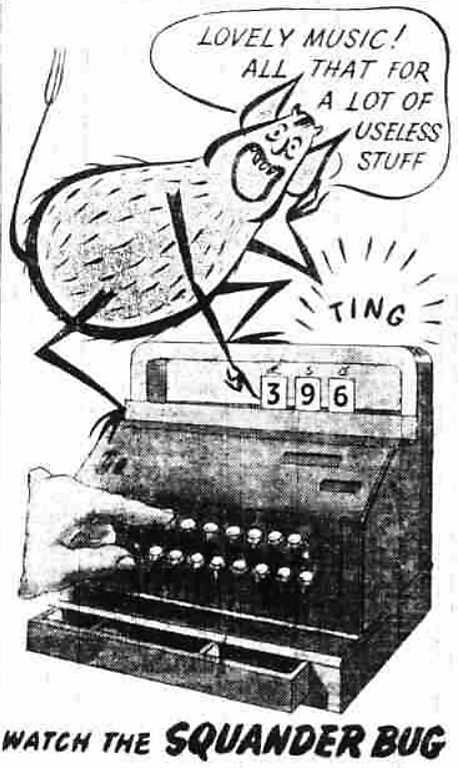
1943—a devilish insect symbolising reckless extravagance and waste—introduced by the National Savings Committee in a government publicity campaign promoting economy—hence: one who is profligate with money or resources
Scotland, 1825 (as ‘bane idle’)—England, 1839—utterly lazy or indolent—‘bone’ seems to be used as an intensifier with adverbial force in the sense ‘through to the bone’, i.e., ‘deeply and fundamentally’
USA, 1927—denotes male vigour, especially sexual—with wordplay on ‘penis’—interestingly, via an alteration of the Latin diminutive ‘pēnĭcillus’, denoting literally a little tail, hence a painter’s brush or pencil, ‘pencil’ is derived from Latin ‘pēnis’, denoting literally a tail, hence the penis
USA (New England), 1868—alternately sunny and cloudy conditions usually indicate rain—the adjective ‘shet’ is a variant of ‘shut’—it was perhaps in order to provide a rhyme for the adjective ‘wet’ that the variant ‘shet’ was chosen in the proverb
USA, 1837—to make assumptions about someone or something based on appearance or on superficial characteristics—the metaphor occurs in the preface to ‘Truth in Fiction: Or, Morality in Masquerade. A Collection of Two hundred twenty five Select Fables of Æsop, and other Authors’ (London, 1708), by Edmund Arwaker
The following slang expressions have been used to designate the mouth: ‘box of ivories’ (also ‘ivory-box’); ‘box of dominoes’ (also ‘domino-box’); ‘bone-box’; ‘potato-box’; ‘potato-jaw’; ‘potato-trap’; ‘kissing-trap’.
British, 1907—denotes considerable talent or ability to grow plants—in this phrase, the adjective ‘green’ refers to the colour of growing vegetation—1921: ‘green-thumbed’ (adjective)