Pig meat has traditionally been a staple food; this is illustrated by this French saying: Dans le cochon tout est bon, De la queue jusqu’au menton. translation: In the pig all is good, From the tail to the chin. However, in French as in English, many pig idioms are derogatory; for example: – avoir […]
The word cheese is from Old English cēse, cȳse, of West-Germanic origin; it is related to its Dutch and German equivalents kaas and Käse respectively. Those words are ultimately derived from Latin caseus, cheese, which is also the origin of: – Spanish queso – Portuguese queijo – regional Italian cacio – Romanian: caș. Based on […]
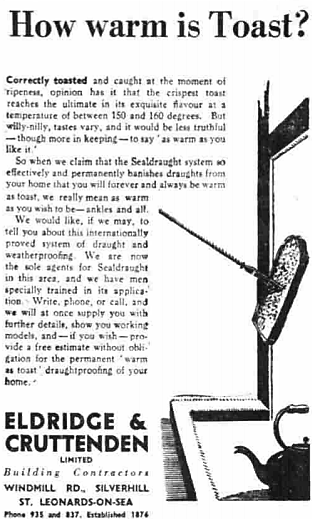
advertisement from the Hastings & St. Leonards Observer (East Sussex) 25th November 1950 How warm is Toast? Correctly toasted and caught at the moment of ripeness, opinion has it that the crispest toast reaches the ultimate in its exquisite flavour at a temperature of between 150 and 160 degrees. But willy-nilly, tastes vary, and it would less […]
Maconochie Brothers was a company set up in 1873 by Archibald (1854-1926) and James (1850-1895) Maconochie. (Maconochie is a surname derived from the Gaelic Macdonochie, the son of Duncan.) With food processing plants on the Isle of Dogs (London), in Lowestoft (Suffolk), in Fraserburgh (Aberdeenshire, Scotland) and other places, the company was a wholesale provision merchant and manufacturer of pickles, potted meat and […]
The noun cruse denotes a small earthenware vessel for liquids. It is of Germanic origin and related to words such as Dutch kroes and Swedish krus, of same meaning. The expression widow’s cruse signifies an apparently small supply that proves inexhaustible. It is an allusion to the First Book of Kings, 17. The prophet Elijah has been fed by ravens and has drunk from a […]
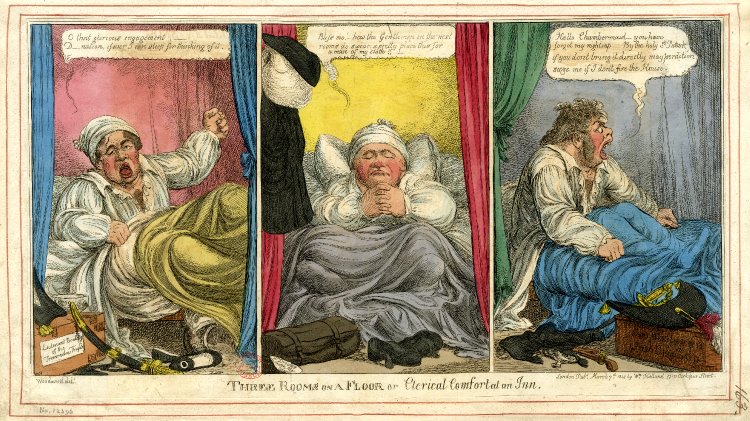
A nightcap is a cap worn in bed to keep one’s head warm. The word is first recorded in the description and valuation, made in 1378, of the articles that were in the shop of Thomas Trewe, haberdasher of London: one dozen of white caps, called “nightcappes”, was worth 2s. 3d.. The figurative […]
A blend of breakfast and lunch, the noun brunch denotes a late morning meal eaten instead of breakfast and lunch. It originated, apparently in the late 19th century, as Oxford University slang and is first recorded in Lunch at Oxford, by Margaret B. Wright, published in The Independent (New York City, New York, USA) of […]
The phrase the cold shoulder denotes a show of intentional and marked coldness or of studied indifference. Because the two earliest instances of this phrase recorded in the Oxford English Dictionary (2nd edition – 1989) are from the Scottish novelist and poet Walter Scott (1771-1832) and do not refer to food, Robert Allen writes in Dictionary of English Phrases (2008) that […]
The Italian noun gianduia (improperly gianduja) appeared in the 19th century to denote a soft confection made with chocolate and ground hazelnuts, first produced in Turin, the capital of Piedmont, a region in north-western Italy, in the foothills of the Alps. (The Italian name is Piemonte, from piede, foot, and monte, mount.) This confection was […]
The French masculine noun sanglier denotes a full-grown wild boar. It literally means a boar living on its own, separated from the herd, since, via Old and Middle French forms such as sengler and senglier, it is from the popular Latin singularis (porcus), solitary (pig) – cf. Middle-French terms such as porc sanglier, and in the Vulgate, the Latin version of the Bible, singularis ferus, the noun ferus meaning wild animal (cf. the […]



 word histories