How a telegram popularised ‘to bring home the bacon’.
USA, 1906—popularised by a telegram sent to boxer Joe Gans by his mother, requesting him before a fight to win and ‘bring home the bacon’
Read More
“ad fontes!”
USA, 1906—popularised by a telegram sent to boxer Joe Gans by his mother, requesting him before a fight to win and ‘bring home the bacon’
Read MoreUSA, 1920—‘(as) American as apple pie’: typically American in character—‘apple pie’ being here a symbol of American motherhood and traditional family values
Read More‘to be unable to run a whelk stall’ and variants: to be incapable of managing the simplest task or enterprise—coined by John Elliot Burns (1858-1943), English trade unionist and politician, in the 1894 New Year’s address to his constituents of Battersea
Read MoreUSA—‘apple polisher’ (1918): a person who curries favour with a superior; ‘apple polishing’ (1926): (an instance of) currying favour—with reference to the former practice of bringing a shiny apple as a gift to one’s teacher
Read MoreUSA—‘to go Dutch’ (1907): to have every participant pay their own expenses, or share expenses equally—via ‘to go Dutch treat’ (1887), from ‘Dutch treat’ (1873): a meal, etc., at which each participant pays their share of the expenses—from a German practice
Read MoreUSA, 1950s—The noun ‘doggy (or doggie) bag (or pack)’ denotes a bag, provided on request by the management of a restaurant, in which a diner may take home any leftovers; apparently, these leftovers were originally intended for the diner’s pet dog.
Read More
late 16th century—from early modern Dutch ‘maelstrom’ (now ‘maalstroom’)—originally a proper name designating a powerful whirlpool in the Arctic Ocean, off the west coast of Norway, which was formerly supposed to suck in and destroy all vessels within a wide radius
Read MoreUSA, 1946—‘to have, or to get, egg on one’s face’: to be, or to get, embarrassed or humiliated by the turn of events—refers either to having eggs thrown at one’s face or to yolk stains left on the face after the careless eating of a soft-boiled egg
Read MoreUSA, 1939—‘there is’, or ‘ain’t’, ‘no such thing as a free lunch’: everything inevitably involves a cost of some kind—literal meaning of ‘free lunch’ (first half of the 19th century): a lunch provided free of charge in a bar, saloon, etc., as a means of attracting customers
Read More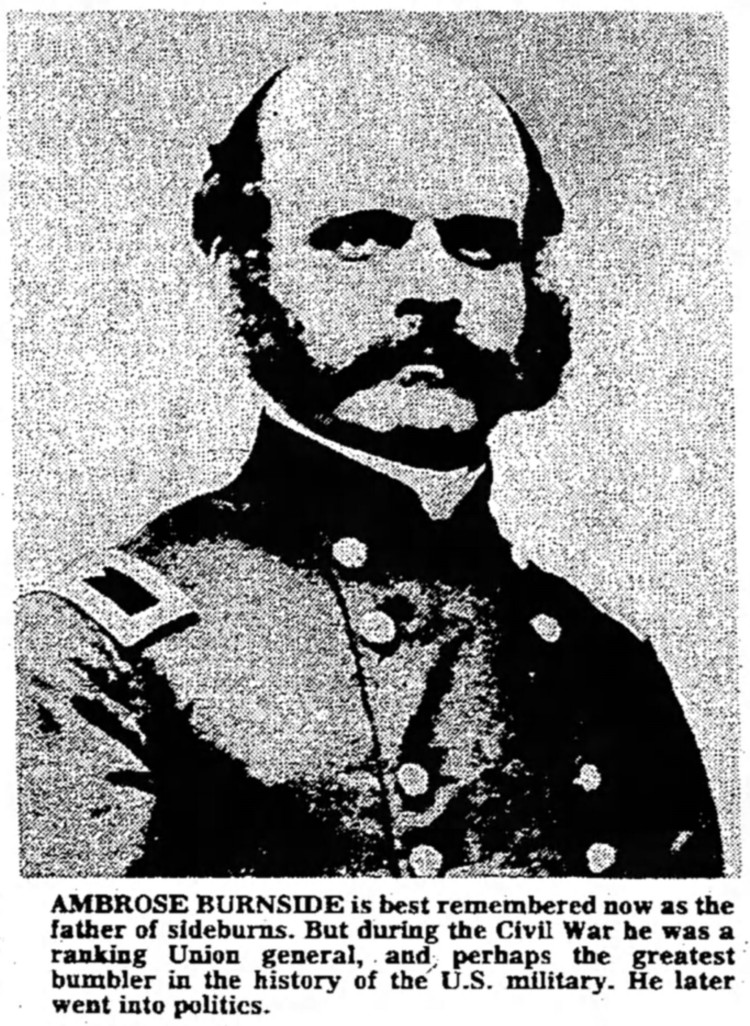
After Ambrose Burnside, Union general in the U.S. Civil War, ‘burnsides’ (1866) denotes thick side whiskers worn with a moustache and clean-shaven chin; on the pattern of ‘side whiskers’, it was altered to ‘sideburns’ (1875), itself altered to ‘sideboards’ (1882).
Read More
