The proper name Guy is derived, via French, from the Old German Wido, either from wit, meaning wide, or from witu, wood. Wido has become Guy in French because in words of Germanic origin, when initial, the labio-velar approximant /w/ has regularly become the velar /g/. For instance, in the French noun loup-garou, the element garou corresponds to English werewolf—in fact, loup was added when the […]
The phrase trick or treat is a traditional formula used at Hallowe’en by children who call on houses threatening to play a trick unless given a treat or present. In early use, the phrase was also tricks or treats, treat or trick, and variants. This phrase seems to have originated in Ontario (capital: Toronto), a province of […]
MEANINGS – attractive articles of little value or use – practices or beliefs that are superficially or visually appealing but have little real value or worth ORIGIN The noun trumpery, first recorded in the mid-15th century, is from the French noun tromperie, which means deception, trickery. This was one of the original meanings in […]
The phrase a skeleton at the feast, or at the banquet, denotes a person or event that brings gloom or sadness to an occasion of joy or celebration. This was originally an allusion to the practice of the ancient Egyptians, as recorded by the Greek biographer and philosopher Plutarch (circa 46-circa 120) in The Dinner of the Seven Wise […]
In A Dictionary of the English Language (1755), the English lexicographer Samuel Johnson (1709-84) thus defined bonfire: [from bon, good, French, and fire.] A fire made for some publick cause of triumph or exultation. In support of this etymology, bonfire in several languages is, literally, fire of joy. For example: – French feu de joie – Italian fuoco d’allegrezza – German Freudefeuer – Dutch vreugdevuur. But […]
The noun sport is a shortening of disport, which was borrowed in the early 14th century from Anglo-Norman and Old and Middle French forms such as desport, deport, disport (modern French déport). This French word was thus defined by Randle Cotgrave in A Dictionarie of the French and English Tongues (1611): Deport: masculine. Disport, sport, […]
The English poet John Taylor (1578-1653) wrote, in The great eater, of Kent, or Part of the admirable teeth and stomacks exploits of Nicholas Wood, of Harrisom in the county of Kent His excessiue manner of eating without manners, in strange and true manner described, by Iohn Taylor (1630): One Iohn Dale was too hard […]
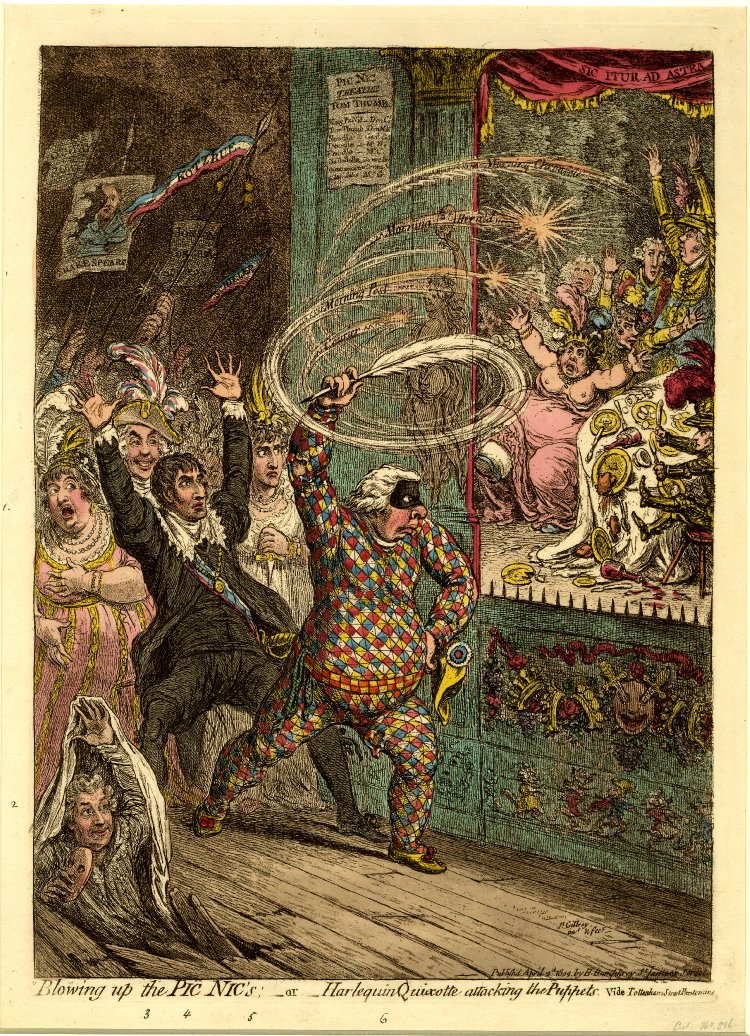
Blowing up the PIC NIC’s:—or—Harlequin Quixotte attacking the Puppets. Vide Tottenham Street Pantomime (1802), by James Gillray (1756-1815) — image: The British Museum MEANING a meal eaten outdoors ORIGIN This word is from French pique-nique, probably formed with reduplication from the verb piquer, to pick. (Similarly, pêle-mêle, the origin […]
the 1905 edition of Le Petit Larousse illustré, a French-language encyclopaedic dictionary published by the Éditions Larousse In 1890, Eugène Grasset (1845-1917) designed the image of la Semeuse (the Sower) blowing dandelion seeds, which accompanies the motto of the Éditions Larousse, Je sème à tout vent (I sow to the four winds). The word […]