a woman’s topless swimsuit, consisting of the lower half of a bikini—from the prefix ‘mono-’ and ‘-kini’ in ‘bikini’, reinterpreted as containing the prefix ‘bi-’—coined in 1946 by French clothing designer Louis Réard
a gesture (made by a French person to deny responsibility, knowledge or agreement) consisting typically in shrugging one’s shoulders while upturning one’s hands
in French contexts: a young person, especially a young man, belonging to a youth subculture of the 1950s and 1960s—UK, 1959—from the noun ‘blouson’ (a short jacket) and the adjective ‘noir’ (black)
smartly dressed—from the verb ‘fig out/up’, meaning ‘to smarten up’—this verb is probably an alteration of the verb ‘feague’, of uncertain origin, meaning ‘to make (a horse) lively’
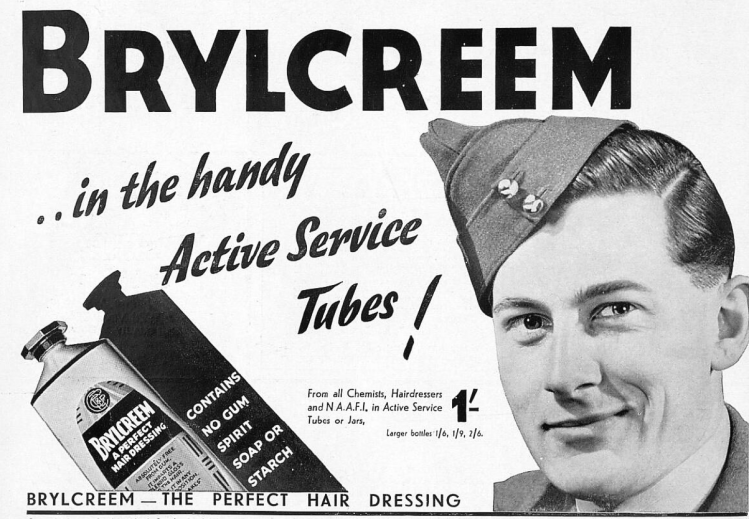
UK, 1941—a fighter pilot in the Royal Air Force; also used by the military land forces of any member of the R.A.F.—originally referred to WWII advertisements for Brylcreem hair cream, featuring a fighter pilot
UK—anything which discourages or inhibits sexual activity—originally (1943, British military slang): the sturdy, practical and unattractive underwear issued to female service personnel
a cheap suit of clothes; a (cut-price) tailoring business—UK, 1920, informal—refers to Harry Mallaby-Deeley (1863-1937), a Member of Parliament who opened a cut-price tailoring business in 1920
UK, 1930—used of a man who pretends to be well-off despite having little money—the image is of a man of limited means who spends what he has on smart clothes, and therefore cannot afford any breakfast


 word histories