origin of ‘Boxing Day’ (the first weekday after Christmas Day)
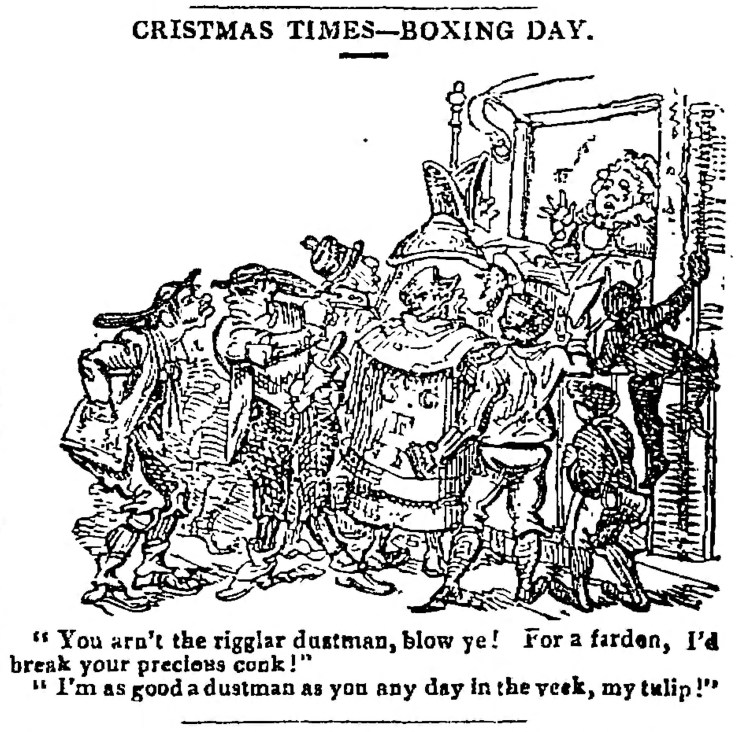
from the verb ‘box’, ‘to give a Christmas-box’, i.e. to give a gratuity or present to tradespeople and employees—originally a box in which money was collected
Read More
“ad fontes!”
from the verb ‘box’, ‘to give a Christmas-box’, i.e. to give a gratuity or present to tradespeople and employees—originally a box in which money was collected
Read MoreTo make (both) ends meet means to earn just enough money to live on. It is first recorded in The History of the Worthies of England (1662), by the Church of England clergyman Thomas Fuller (1607/8-61). The author wrote the following about the English Protestant leader Edmund Grindal (1519-83) – in the original text, to […]
Read MoreThe phrase money for old rope has various meanings: a profitable return for little or no trouble; a very easy job; a person or thing easy to profit from or to beat. The earliest occurrence of this phrase that I have found is from Driffield Coursing Club. “Peter Delmas” in the genial crowd, published in The Daily Mail (Hull, Yorkshire, England) […]
Read More
used to indicate that someone has finally realised something—UK, 1931—alluded originally to the mechanism of a penny-in-the-slot machine
Read MoreIn this expression, the noun poke denotes a bag, a small sack. It is from Anglo-Norman and Old Northern French forms such as poke and pouque, variants of the Old French forms poche and pouche — the last of which is the origin of English pouch. (Incidentally, English pocket is from Anglo-Norman poket, pokete, diminutive forms of poke.) The expression to buy a pig in a poke simply cautions against buying or accepting […]
Read More
The phrase to let the cat out of the bag means to disclose a secret. Although it is possible that to let the cat out of the bag originally referred to some specific allusion, such as a line in a play, that has now been lost, it is probable that this phrase is simply based on the […]
Read MoreMEANING to pay excessively, to be charged exorbitantly PROBABLE ORIGIN The expression to pay through the nose is first recorded in Piazza universale di proverbi Italiani, or, A common place of Italian proverbs and proverbial phrases digested in alphabetical order (1666), by Giovanni Torriano (floruit 1640): Oft-times Rich men engrossing commodities, will make one pay through the […]
Read More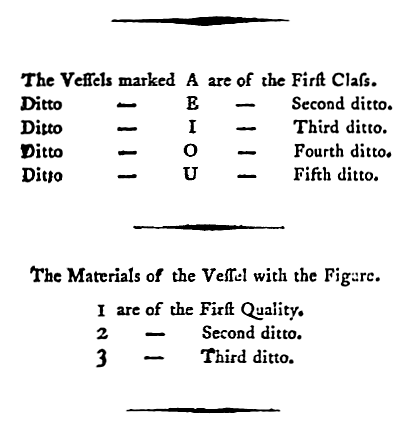
MEANING first class, outstanding ORIGIN Lloyd’s Register, historically Lloyd’s Register of Shipping, is an independent society formed in 1760 by a group of merchants operating at Lloyd’s coffee house in London, which surveys ships to ensure compliance with standards of strength and maintenance. The name also denotes an annual publication giving details […]
Read MoreMEANING The phrase to be barking up the wrong tree means to be pursuing a mistaken or misguided line of thought or course of action—cf. also origin of ‘gone coon’. ORIGIN In Americanisms, Old and New. A Dictionary of Words, Phrases and Colloquialisms peculiar to the United States, British America, the West Indies, […]
Read MoreThe proverb you can’t have your cake and eat it (too) means you can’t enjoy both of two desirable but mutually exclusive alternatives. It made more sense in its early formulations, when the positions of have and eat had not been reversed. It is first recorded in A dialogue conteinyng the nomber in effect of […]
Read More word histories