‘to go bald-headed’ (to rush without care or caution)
first recorded in The Biglow Papers (1848), by American author James Russell Lowell—based on the notion of leaving one’s hat behind in a rush of impetuosity
Read More
“ad fontes!”
first recorded in The Biglow Papers (1848), by American author James Russell Lowell—based on the notion of leaving one’s hat behind in a rush of impetuosity
Read MoreUSA, 1891—a passenger in the rear seat of a car who gives the driver unwanted advice; hence, figuratively, a person who is eager to advise without responsibility
Read Moreprimary meaning of ‘boggle’ was ‘to start with fright’, originally with reference to horses—probably related to the nouns ‘bogle’ and ‘bogey’, denoting an evil spirit such as horses are reputed to see
Read More1808, as ‘to talk a horse’s hind leg off’—‘[animal’s] hind leg off’ is probably a hyperbolic extension of ‘to talk’, emphasising the speaker’s persistence or eloquence
Read MoreBritish, 1925—‘to throw a spanner in(to) the works’: to cause disruption, to interfere with the smooth running of something—synonym (American English): ‘to throw a monkey wrench into’
Read More‘the lion’s share’ (UK, 1790)—calque of French ‘le partage du lion’ (now ‘la part du lion’)—from ‘The Heifer, the She-Goat, and the Ewe, in partnership with the Lion’, a fable by Jean de La Fontaine (1621-95)
Read MoreUSA—‘to look, or to feel, (like) a million dollars’, or ‘(like) a million bucks’: to look, or to feel, extremely good, or extremely attractive (early 20th century)—sometimes used in contrast to ‘like thirty, or 30, cents’: cheap, worthless (late 19th century)
Read Moreoriginally: a child wearing the house key tied around their neck and staying in the streets while their mother is at work—USA, 1935: a poor Afro-American woman’s child—USA & UK, WWII: a child whose mother was engaged in war industry
Read Morefrom the notion that even a dead cat will bounce if dropped from a sufficient height—UK, 1981: a rapid fall in the stock market with hardly any reaction—USA, 1985: a rapid but short-lived recovery in the stock market after a sharp fall—hence, 1992: any spurious success
Read More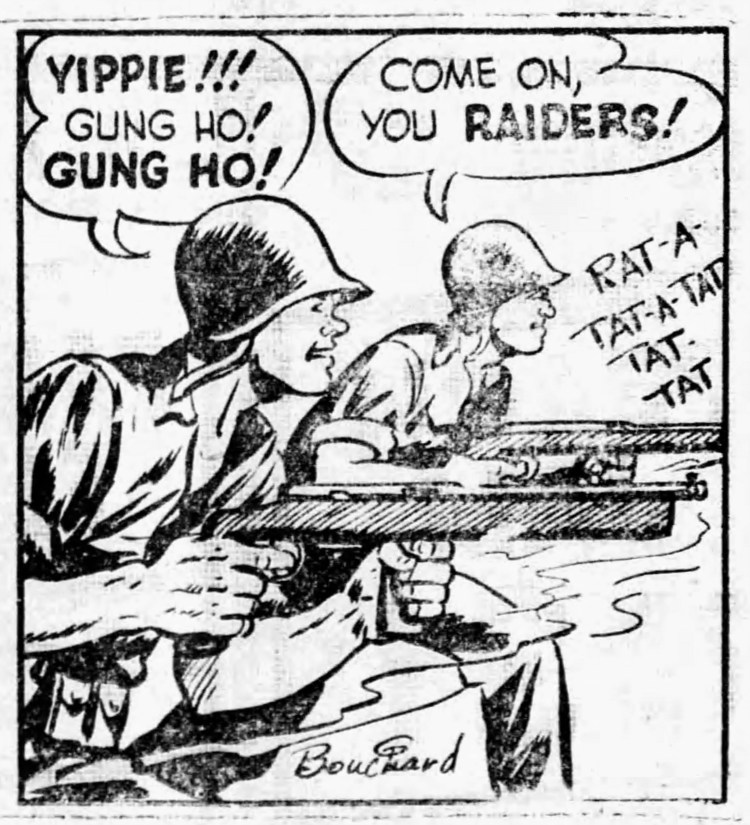
from Chinese ‘gōnghé’, short for ‘Zhōngguó Gōngyè Hézuò Shè’ (Chinese Industrial Cooperative Society)—interpreted as a slogan meaning ‘work together’ (USA, 1941)—adopted by Evans F. Carlson, commander of the 2nd Marine Raider Battalion (1942)
Read More
